
USDC on Arc: What Circle's Mainnet Launch Changes for Holders

 Prefer us on Google


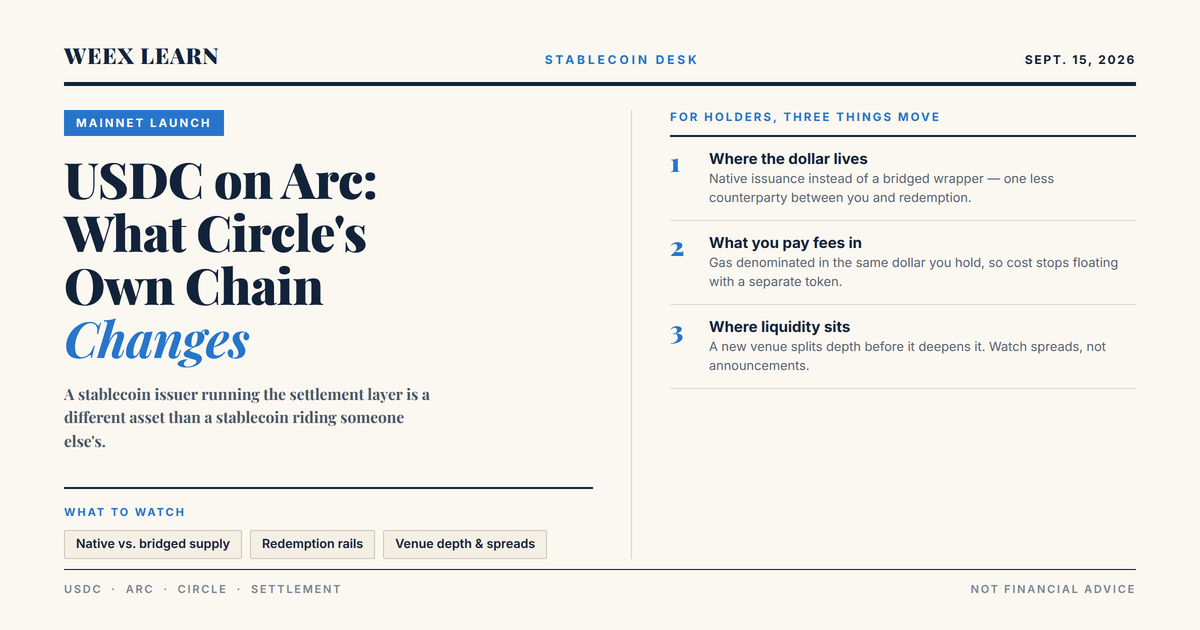
If you hold USDC, the public mainnet launch of Circle's Arc blockchain on September 16, 2026 changes nothing about the token in your wallet — and quite a lot about where that token can go to work. USDC on Arc is the network's native gas asset, meaning transaction fees are quoted and paid in dollars rather than in a volatile L1 coin. This article covers how that fee model actually works, what the launch does and does not do for existing USDC holders, why the separately issued ARC token is not the thing paying your gas, and how to get funded before liquidity starts routing through the chain.
USDC as native gas on Arc: How the fee model works
Most blockchains charge you in an asset whose price moves. Arc removes that variable. Circle's documentation states that Arc "denominates all transaction fees in USDC, the native gas token," accounted at 18-decimal precision at the protocol level. A transfer that costs a fraction of a cent today costs roughly the same fraction of a cent next month, because the unit of account is pegged to the dollar rather than to network demand for a speculative coin.
The fee curve itself is a modified EIP-1559. Instead of recalculating the base fee block by block, Arc derives it from an exponentially weighted moving average of block utilization, bounded by a floor and ceiling — 20 Gwei and 20,000 Gwei respectively in the testnet configuration Circle published. The stated design target is about $0.01 per transaction under normal load. Testnet performance ran well inside that: the average weekly transaction cost recorded on Arc testnet was $0.004, according to reporting on September 14, 2026.
Underneath, Arc separates consensus from execution. Malachite, a Tendermint-lineage BFT engine built by the Informal Systems team Circle acquired, handles consensus and delivers deterministic finality in roughly 350 milliseconds with no reorganization risk. Reth handles EVM execution, so existing Solidity contracts deploy without modification. Throughput is specified at around 3,000 transactions per second, with roughly half-second blocks.
The better way to read this: Arc is not competing for retail degen flow. Sub-second deterministic settlement and dollar-denominated fees are features a treasury desk asks for, not features a memecoin trader asks for.
What changes for USDC holders when Arc mainnet opens
Nothing about your existing balance. USDC on Ethereum, Solana, Base, Arbitrum, or an exchange account is unaffected by a new deployment chain. Circle has issued USDC across many networks for years, and Arc is one more issuance venue — not a migration, a swap, or a token upgrade. Any message telling you to move, re-register, or "upgrade" your USDC for Arc is a scam.
What does change is the demand picture. As of Q2 2026, Circle reported $73.3 billion of USDC in circulation, roughly 27% of the stablecoin market, with $14.8 trillion in onchain transaction volume over the quarter — up 151% year over year. Arc gives that float a venue where holding USDC is a functional requirement rather than a preference: every transaction on the chain consumes USDC. That is a structurally different demand source from DeFi collateral or exchange quote-currency demand, because it is consumed continuously and cannot be substituted.
Market data as of September 15, 2026, 03:00 UTC, from WEEX's USDC token page: USDC traded at $0.9998 with a market capitalization of $74.36 billion and 24-hour volume of $16.27 billion. The peg is doing what it should. Watch whether that market cap figure inflects in the weeks after September 16 — sustained net issuance would be the cleanest evidence that Arc is pulling in real balances rather than recycling existing ones.
Day-one integrations are already named: Aave, Morpho, Uniswap, and Aerodrome on the DeFi side; Rain, Thunes, and Wirex in payments; MetaMask, Ledger, and Fireblocks for custody and access. The larger prize, DTCC's tokenized asset settlement, is scheduled for the second half of 2027 — well past this launch.
ARC token vs USDC: Why they are not the same asset
This is where most of the search traffic is confused, and the confusion is expensive.
USDC pays gas on Arc. The ARC token does not. Circle's own gas reference is explicit that USDC is the sole fee denomination, with no ARC involvement at the protocol fee layer. ARC is positioned as a coordination asset for a future proof-of-stake validator model and for governance, not as the thing you spend to send a transaction.
ARC's history is also a private-markets story, not a retail one. Circle closed a $222 million presale on May 11, 2026, selling 740 million ARC at $0.30 for a $3 billion fully diluted valuation, with a16z crypto contributing $75 million alongside BlackRock, Apollo, ICE, SBI Group, Standard Chartered Ventures, ARK Invest, and others. The published supply is fixed at 10 billion, allocated roughly 60% to ecosystem and development, 25% to Circle, and 15% to reserve.
As of September 15, 2026, no public token generation event and no airdrop have been announced for ARC. Treat every "check your ARC eligibility" site accordingly — and be aware that tickers reading "ARC" already trade on some venues and are unrelated to Circle's chain. The practical rule for the next few weeks: if a page asks you to connect a wallet to claim ARC, it is not Circle.
-- Price
How to buy USDC and get funded before the Arc launch
Getting exposure to the Arc theme does not require a new token. It requires dollars on-chain, in the right place, with a clear path onward.
- Fund the position in USDC directly. On WEEX, USDC/USDT spot is the straightforward route for converting an existing stablecoin balance at close to parity, and the USDC price page shows the live quote and depth before you size the order.
- Check the spread, not just the price. Stablecoin pairs look free and are not. On a near-parity pair, a few basis points of slippage on a large clip is the entire trade's cost.
- Decide whether you need spot or margin. If you are hedging or expressing a view on peg stress rather than simply holding dollars, WEEX also lists a USDC/USDT perpetual — a market that is thin and mean-reverting by design, and unforgiving with leverage.
- Plan the withdrawal route before you need it. Native USDC reaches Arc through Circle's CCTP burn-and-mint path rather than a third-party bridge. Confirm the exact supported route at withdrawal time rather than assuming it on day one.
- If USDC itself is new to you, WEEX's explainer on how USDC works and how its reserves are structured covers minting, redemption, and depeg mechanics.
What traders usually miss on a launch like this: the first week of a new chain is when bridge routes are least mature and support queues are longest. Moving a meaningful balance on day one buys you very little and exposes you to exactly the operational friction that has stranded funds on every previous L1 debut.
What could go wrong: Permissioned validators and other risks
Arc launches with 12 founding validators — Circle, BlackRock, DTCC, Visa, Mastercard, Galaxy, Global Payments, ICE, MoneyGram, SBI Group, Standard Chartered, and Sumitomo Corporation. Validation is restricted to known institutions even though developer access is open. Critics have called this a consortium chain rather than a blockchain, and the objection is fair on its own terms: a set of identified, Circle-selected validators with a two-thirds threshold is a governance structure that prioritizes institutional trust over censorship resistance. If you object to that trade-off, Arc is not built for you, and that is the honest read.
Second, Arc has not received approval from financial regulators as a network; regulatory clarity for this category is still being legislated. Third, the testnet numbers — 671.5 million transactions across nearly 3 million wallets as of Q2 2026 — are incentivized activity with no real-asset value behind them. They demonstrate the plumbing works, not that demand exists.
The metric that will actually settle this is transfer volume between unaffiliated addresses after the incentives fade. Token-subsidized deposits have historically proved far less durable than genuine payment flow, and Arc's institutional pitch stands or falls on the second, not the first.
The bottom line on USDC and Arc
Arc makes USDC something it has not been before: the fuel, not just the cargo. For a stablecoin whose entire competitive story is regulatory standing and institutional distribution, having a purpose-built settlement layer where dollars pay for their own movement is a meaningful structural upgrade — and one that accrues to USDC's utility regardless of what ARC the token ever does. But the launch is the beginning of the test, not the result. Watch net USDC issuance, unaffiliated transfer volume, and whether the named day-one apps see real balances by year-end.
If you want USDC exposure ahead of that, the practical step is simply to hold dollars on-chain in an asset you can move — buy or convert USDC on WEEX spot and keep the position liquid rather than chasing an ARC token that has no public market.
FAQ
1. Does the Arc mainnet launch affect the USDC I already hold?
No. USDC on Ethereum, Solana, Base, or an exchange account is unchanged. Arc is an additional network where USDC is issued and used, not a migration or a token upgrade. Any instruction to move or "upgrade" your USDC for Arc is fraudulent.
2. Why does Arc use USDC for gas instead of its own token?
Because enterprise users need predictable, dollar-denominated costs. Pricing fees in USDC removes the volatile-token variable from transaction cost entirely. Circle's design target is roughly $0.01 per transaction; the testnet average was $0.004 per transaction on a weekly basis.
3. Can I buy the ARC token?
Not through any public Circle sale. The $222 million ARC round that closed on May 11, 2026 at $0.30 per token was private, and as of September 15, 2026 no public token generation event or airdrop has been announced. Unrelated assets trading under an "ARC" ticker are not Circle's chain token.
4. Is there an Arc airdrop for USDC holders?
Circle has announced no airdrop and no eligibility criteria. Sites offering to check ARC airdrop eligibility are fabricating both the program and the qualification rules, and connecting a wallet to them is the usual attack vector.
5. How do I get USDC onto Arc?
Native USDC moves to Arc through Circle's CCTP burn-and-mint path rather than a wrapped third-party bridge. Confirm the exact supported route and any exchange withdrawal support at the time you transfer — routes on a newly launched chain change quickly in the first weeks.
6. How fast and how cheap is Arc compared with Ethereum?
Arc targets deterministic finality in roughly 350 milliseconds with around 3,000 transactions per second, versus Ethereum's probabilistic finality measured in minutes. The trade-off is the validator set: Arc's is permissioned and institution-only, while Ethereum's is open.
Risk Warning
Crypto assets are volatile and trading them can result in partial or total loss of capital. Stablecoins are not risk-free: USDC's peg depends on the composition, custody, and liquidity of Circle's reserves, and past stablecoin depeg events have shown that a 1:1 design is not a 1:1 guarantee under stress. Trading USDC pairs carries liquidity and slippage risk despite near-parity pricing, and using leverage on a mean-reverting stablecoin perpetual can produce liquidation on moves of a fraction of a percent. Moving USDC to a newly launched network adds bridge, smart-contract, and operational risk, and funds sent on an unsupported route may be unrecoverable. Arc's validator set is permissioned and Circle-selected, which introduces counterparty and governance risk that does not exist on permissionless chains, and the network has not received approval from financial regulators. Regulatory treatment of stablecoins and of tokens such as ARC may change. Do your own research and never commit funds you cannot afford to lose.
This content is provided for general informational purposes only and doesn't constitute financial, investment, legal, or tax advice. Any events, rewards, online promotions, or related information mentioned herein should not be considered a recommendation, solicitation, or invitation to purchase, sell, trade, or otherwise deal in any crypto assets. Crypto assets are highly volatile and may result in loss. The availability of WEEX services, products, and related events may vary by region. You are responsible for ensuring that your participation is in accordance with applicable local laws and regulations.
You may also like
Robinhood Built a Chain for Tokenized Stocks: Did It Just Become a Meme Coin Casino?
What Is TermMax (TMX)? Inside the New Fixed-Rate DeFi Token Launching Today
Amid the boom in stablecoin investments, which stablecoins are worth keeping an eye on?
What Is Morpho (MORPHO) and How Does It Work?
Lost Your 2FA Device? Here's What to Do Next
Is 2FA Enough to Keep Your Crypto Safe?
SMS 2FA vs Authenticator App: Which Is Actually Safer?
What Is 2FA? A Beginner's Guide
How to Install Trust Wallet Safely: What Most Guides Leave Out
Senate CLARITY Act Cloture Vote Today: Can Trump's Ethics Compromise Get 60 Votes?
Trust Wallet vs MetaMask: Which One Is Better for Beginners?
What Is Aptos (APT)? Complete Layer-1 Blockchain Guide
Trust Wallet Seed Phrase: How to Store It Safely and What Never to Do
Puebla Mexico Crypto Farm Seized: Is Bitcoin Mining Legal in Mexico?

What Is Trust Wallet? A Complete Beginner's Guide
HYPE Futures Trading Strategy: Sizing Rules Around Unlocks
Bitcoin Funding Rate Before the Fed: What Longs Pay to Hold BTC
Dell Stock Futures PnL: How Profit and Loss Work on DELL Perps
How to Short Intel Stock with Futures: Where to Set TP and SL
Oracle Stock Futures After Earnings: How Leverage Got Liquidated
How to Trade Microsoft (MSFT) Stock Token with USDT on WEEX
How to Trade Apple (AAPL) Stock Token with USDT on WEEX
Crypto Futures Trading Explained: Leverage, Funding, Liquidation
Crypto Futures Trading: Leverage, Funding and Apple Perps
Donald Trump Oil Stock Investments: 9 Names, 6 Tradable Now
AVAV Stock Futures: How to Trade AeroVironment With Leverage
What Is 4STOCK? BNB Chain’s Stock Meme Trend Explained
Hunter Biden's Laptop Token Is Now Live on Base: Watch Out for Copycat Tokens
How to Trade Tesla (TSLA) Stock Token with USDT on WEEX: A Trading Guide for Beginers in 2026
SPCX Stock Gets a $220 Price Target: Why It All Comes Down to Starship's Reusability
Robinhood Built a Chain for Tokenized Stocks: Did It Just Become a Meme Coin Casino?
What Is TermMax (TMX)? Inside the New Fixed-Rate DeFi Token Launching Today
Amid the boom in stablecoin investments, which stablecoins are worth keeping an eye on?
What Is Morpho (MORPHO) and How Does It Work?
Lost Your 2FA Device? Here's What to Do Next
Is 2FA Enough to Keep Your Crypto Safe?


