
Senate CLARITY Act Cloture Vote Today: Can Trump's Ethics Compromise Get 60 Votes?

 Prefer us on Google


The Senate holds its cloture vote on the CLARITY Act today, September 15, 2026, at 2:15 p.m. ET, and it comes down to a simple but brutal math problem: Republicans hold 53 seats, at least two are expected to defect, and President Trump agreed to sweeping new ethics concessions just 48 hours ago to try to close the gap. Whether it's enough depends on seven named Democratic holdouts who, as of this morning, still hadn't confirmed their votes.
At A Glance:
- Today's vote is a cloture motion on the motion to proceed — a procedural threshold requiring 60 votes just to begin floor debate, not a vote on final passage of H.R. 3633 itself.
- Republican Senators Rand Paul and Josh Hawley are considered firm "no" votes, with Thom Tillis conditional, meaning GOP leadership realistically needs 9 to 10 Democratic crossover votes, not the seven a clean party-line tally would suggest.
- In the 48 hours before the vote, the White House agreed to remove the ethics sunset clause that would have expired in January 2029, making the ethics provisions permanent, while also dropping a criminal-liability shield under 18 U.S.C. § 1960 that developers had wanted.
- A coalition of state attorneys general led by New York's Letitia James sent senators a letter on September 14 warning the bill could weaken state-level enforcement against crypto scams — a late objection that's gotten far less coverage than the Trump ethics fight.
Written by: Crypto Market Analyst Nora | Reviewed by: Senior Financial Editor | Last Updated: September 15, 2026
What's Actually Being Voted On Today
It's worth being precise about what today's vote does and doesn't decide, because a lot of coverage blurs this. The 2:15 p.m. ET cloture vote is a motion to proceed — it determines only whether the Senate can begin formal floor debate on the CLARITY Act (H.R. 3633). It is not a vote on the bill's final text, and it is not a vote on the substitute language released this week. Debate and amendments only happen after cloture succeeds.
That said, the stakes are real. If the motion fails to reach 60 votes, Senator Cynthia Lummis (R-WY) has warned the legislation would effectively be dead for the remainder of 2026, with the next realistic window potentially not arriving until 2030 given the midterm election calendar.
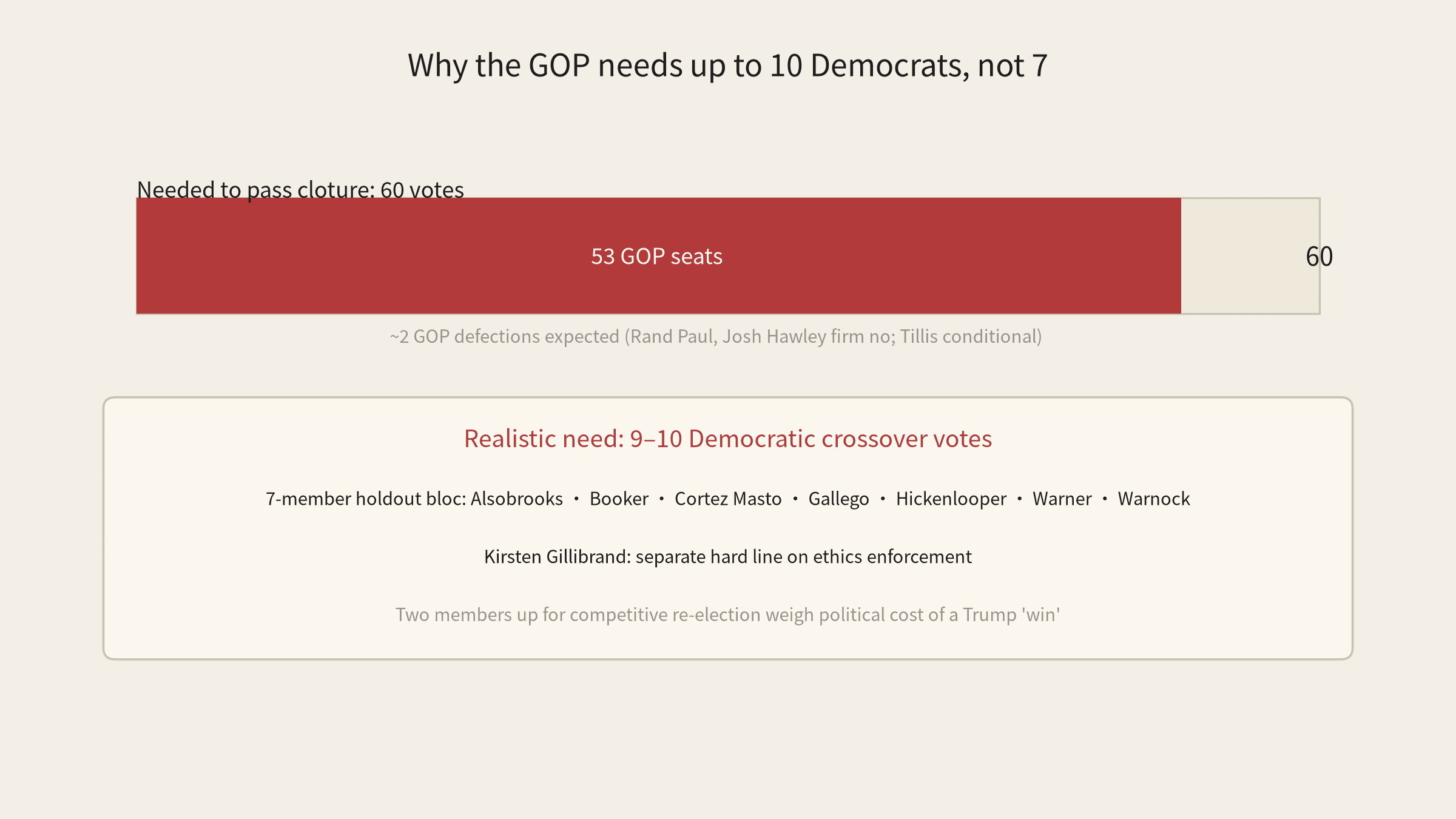
The Math: Why Republicans Need Up to 10 Democrats, Not Seven
Republicans control 53 Senate seats, which on paper means only seven Democratic or independent votes would be needed to clear the 60-vote threshold. But that clean math doesn't hold up. Senators Rand Paul and Josh Hawley are considered firm "no" votes on the Republican side, and Thom Tillis is listed as conditional — meaning GOP leadership may effectively be starting from around 50 or 51 confirmed yes votes, not 53. That pushes the real number of Democratic crossovers needed closer to 9 or 10.
On the Democratic side, seven senators have been the center of negotiations for months: Angela Alsobrooks, Cory Booker, Catherine Cortez Masto, Ruben Gallego, John Hickenlooper, Mark Warner, and Raphael Warnock. All seven issued a joint statement saying the earlier draft fell short on ethics, consumer protection, illicit finance safeguards, and market integrity requirements. Senator Kirsten Gillibrand has separately drawn her own hard line specifically on ethics enforcement, putting her in a similar but distinct camp.
<div align="center">
| Senator | Party | Position Going Into Sept 15 |
|---|---|---|
| Rand Paul | R | Firm no |
| Josh Hawley | R | Firm no |
| Thom Tillis | R | Conditional yes |
| Ruben Gallego | D | Led ethics compromise talks; undecided |
| Mark Warner | D | Part of 7-member holdout bloc |
| Catherine Cortez Masto | D | Part of 7-member holdout bloc |
| Raphael Warnock | D | Part of 7-member holdout bloc |
| Cory Booker | D | Part of 7-member holdout bloc |
| John Hickenlooper | D | Part of 7-member holdout bloc |
| Angela Alsobrooks | D | Part of 7-member holdout bloc |
| Kirsten Gillibrand | D | Separate hard line on ethics enforcement |
As of Tuesday morning, Senate Majority Leader John Thune's office had declined to say whether it would pull the vote entirely if a Monday whip count came back short of 60 — a sign that leadership itself wasn't confident heading into the vote.
What Changed: Trump's Ethics Concessions in the Final 48 Hours
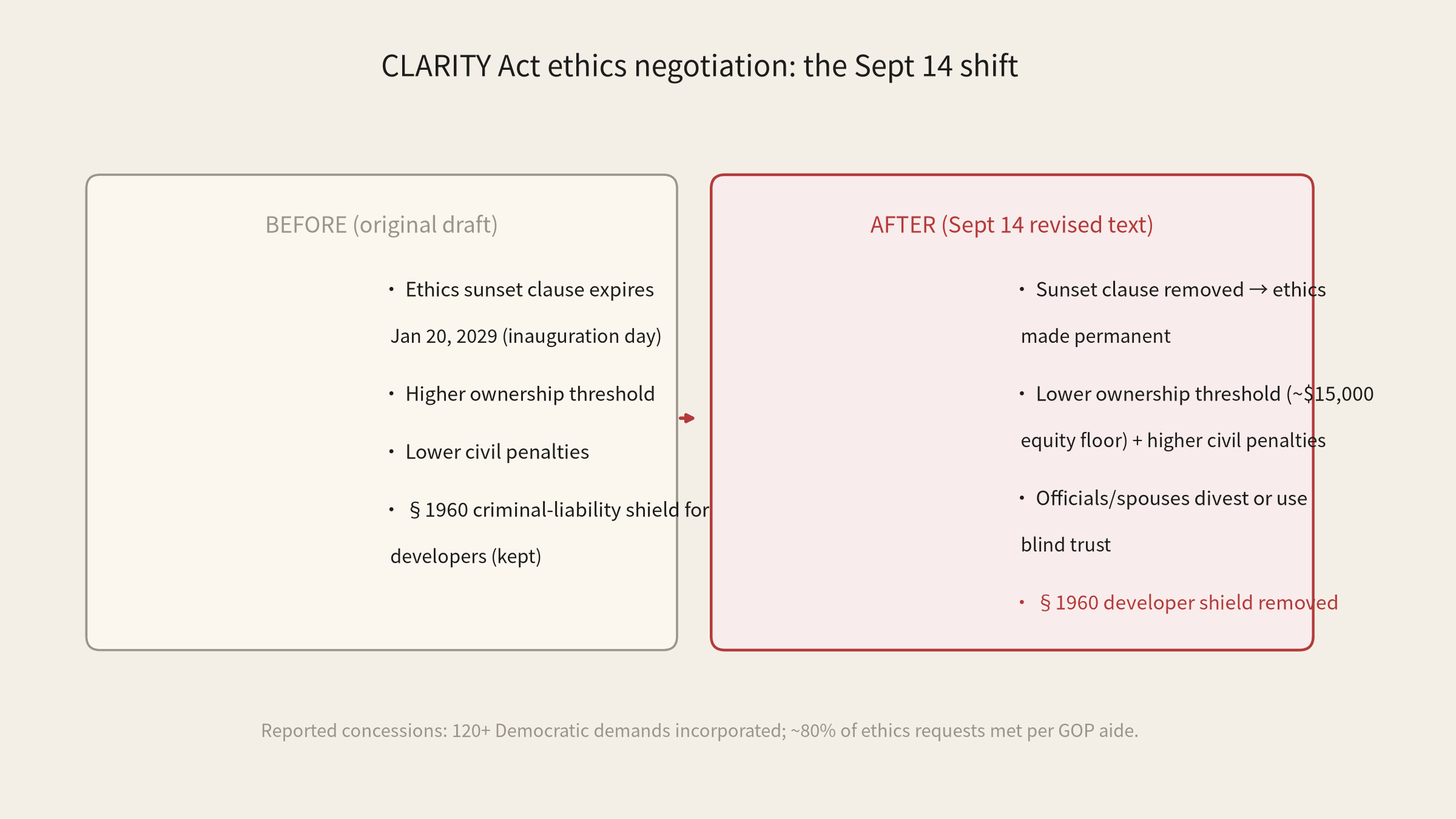
The most consequential development came on September 14, when President Trump agreed to stricter ethics rules than his administration had previously accepted, according to reporting confirmed the same day. Senator Lummis said the revised text incorporates more than 120 separate Democratic demands, framing it bluntly: "Democrats got what they wanted; now they need to take yes for an answer." A Senate GOP aide separately estimated the administration agreed to roughly 80% of what Democrats had originally requested in the ethics negotiation — though the aide acknowledged it remained unclear whether that would actually be enough to secure their votes.
The specific changes are more detailed than most headlines have captured:
- The ethics provisions' sunset clause, which had been set to expire at noon on January 20, 2029 — conveniently timed to the next presidential inauguration — was removed entirely, making the restrictions permanent rather than temporary.
- The revised text pairs a lower ownership threshold for covered officials with higher civil penalties, with reporting citing a specific $15,000 equity floor in token-issuing businesses that would trigger disclosure or divestment requirements.
- Covered officials and their spouses would need to divest "significant" crypto-related financial interests or place them in a qualified blind trust.
- In a separate but related concession, the updated draft removes a criminal-liability shield under 18 U.S.C. § 1960 that had been intended to protect software developers from prosecution over how others use their code — a provision the crypto industry had specifically pushed for, and its removal is being read as a concession Republicans made to secure ethics language Democrats could accept.
The enforcement structure remains a flashpoint even after these changes. Earlier drafts gave enforcement authority to the Department of Justice alone, with no independent role for state prosecutors — a structure the White House reportedly favored specifically because it keeps enforcement decisions with prosecutors Trump appoints, rather than state attorneys general he doesn't control.
-- Price
The State AGs' Pushback Nobody's Talking About
While nearly all coverage of this week's developments has centered on the Trump ethics fight, a separate objection has drawn far less attention despite arriving at almost the same moment. On September 14, a coalition of state attorneys general led by New York Attorney General Letitia James sent a letter to Senate Banking Committee leaders warning that the CLARITY Act, as currently structured, could weaken state-level enforcement tools against crypto scams. That objection is distinct from the Trump-specific ethics dispute — it's a broader structural concern about whether federalizing enforcement authority under the DOJ-only model leaves gaps that state prosecutors have historically filled, particularly in fraud cases that move faster than federal agencies can act. This letter has circulated with a fraction of the coverage the presidential ethics angle received, even though it touches directly on the same DOJ-versus-state-enforcement question driving the broader stalemate.
Democrats' Last-Minute Counterproposal
In the hours immediately before today's vote, Senate Democrats sent a counterproposal to the negotiating text, according to reporting published roughly 40 minutes before this article was written. Republicans reportedly called their own draft "final," rejecting the idea of further changes at this stage. Galaxy Digital's head of research, Alex Thorn, published analysis noting that beyond the sunset-clause removal, the newest language is broader in scope than earlier drafts and pairs the lower ownership threshold with meaningfully higher civil penalties than the version debated over the summer.
This last-minute back-and-forth is itself informative: it suggests that even after the widely reported September 14 "compromise," the text was still moving within 24 hours of the vote, and neither side was entirely settled on the final language going into the roll call.
Prediction Markets Are Split on the Outcome
The clearest sign of how much uncertainty remains is that prediction markets don't agree with each other. Kalshi's odds of passage jumped to 44% after the revised text was released on September 14, up sharply from roughly 18% beforehand. Polymarket, by contrast, had priced 2026 passage odds in the 16% to 26% range as of the days immediately before the compromise was announced, and hadn't yet fully repriced to reflect the new ethics language at the time of the most recent data available. That gap between the two markets — roughly 20 percentage points — reflects genuine disagreement among traders about whether Trump's concessions actually move the needed Democratic votes, or whether the seven-member holdout bloc will judge the changes insufficient regardless of the specific language.
An Analyst's Take: Why I Think the Compromise Solves the Wrong Problem
From where I sit, the September 14 concessions are genuinely substantive — a permanent ethics provision with real civil penalties and a lower disclosure threshold is a meaningfully different ask than what Republicans were offering even a month ago. But I don't think the size of the concession is actually the variable that determines today's outcome. The seven-member Democratic bloc isn't just negotiating over specific dollar thresholds; several of them are up for competitive re-election and are weighing whether being seen to hand Trump any kind of "win" on crypto ethics is politically survivable in their states, regardless of how strong the underlying text actually is. That's a fundamentally different calculation than a policy negotiation, and it's one that 120 incorporated Democratic demands doesn't necessarily resolve.
I'd also flag the Letitia James letter as underrated in terms of its potential impact today. If even a handful of senators view the DOJ-only enforcement model as a genuine gap in scam enforcement — not just a partisan Trump-specific concern — that's a harder objection to negotiate away with civil penalty thresholds, because it's not really about Trump at all. My read is that today's vote is closer than the headline "Trump agreed to ethics reforms" framing suggests, and the real tell will be whether Thune actually holds the vote as scheduled or quietly delays it if Tuesday morning's whip count still looks short.
What Happens Next, Either Way
If cloture succeeds, the Senate moves into formal floor debate, where further amendments to the ethics language, the stablecoin yield provision, and Section 604's DeFi developer liability protections all remain open questions before any final passage vote. If it fails, the bill doesn't disappear immediately, but Lummis's warning about a multi-year delay reflects the reality of the 2026 midterm calendar eating into the Senate's remaining working days this year.
For anyone trading crypto assets around this event, it's worth remembering that a successful cloture vote today is a procedural win, not regulatory clarity itself — actual market-structure certainty is still amendments and a final vote away. Traders managing crypto exposure around event-driven volatility like this sometimes use platforms like WEEX TradFi to keep speculative, news-sensitive positions contained within a broader portfolio strategy rather than concentrated around a single legislative outcome. Nothing in this article constitutes financial, legal, or investment advice.
FAQ
1. What Time Is the CLARITY Act Senate Vote Today?
The Senate cloture vote on the CLARITY Act is scheduled for 2:15 p.m. ET on September 15, 2026, and requires 60 votes to proceed to formal floor debate.
2. How Many Democratic Votes Does the CLARITY Act Need to Pass Cloture?
While Republicans hold 53 seats, expected defections from Senators Rand Paul and Josh Hawley, plus a conditional vote from Thom Tillis, mean GOP leadership likely needs 9 to 10 Democratic crossover votes rather than the seven a simple seat count would suggest.
3. What Ethics Changes Did Trump Agree to in the CLARITY Act?
President Trump agreed to remove the ethics provisions' sunset clause (previously set to expire in January 2029), making the restrictions permanent, along with a lower ownership disclosure threshold, higher civil penalties, and a requirement to divest significant crypto holdings or place them in a qualified blind trust.
4. Is Bitcoin Mining or Crypto Trading Legal Regardless of the CLARITY Act Outcome?
Yes. The CLARITY Act determines regulatory market-structure clarity around which agency oversees which digital assets; it does not make crypto trading or ownership illegal if it fails, since crypto remains broadly legal in the U.S. either way.
5. What Happens if the CLARITY Act Cloture Vote Fails Today?
If the motion fails to reach 60 votes, Senator Cynthia Lummis has warned the legislation would effectively be dead for the remainder of 2026, with the next realistic opportunity for comprehensive crypto market-structure legislation potentially not arriving until 2030.
This content is provided for general informational purposes only and doesn't constitute financial, investment, legal, or tax advice. Any events, rewards, online promotions, or related information mentioned herein should not be considered a recommendation, solicitation, or invitation to purchase, sell, trade, or otherwise deal in any crypto assets. Crypto assets are highly volatile and may result in loss. The availability of WEEX services, products, and related events may vary by region. You are responsible for ensuring that your participation is in accordance with applicable local laws and regulations.
You may also like
USDC on Arc: What Circle's Mainnet Launch Changes for Holders
Oracle Stock Futures After Earnings: How Leverage Got Liquidated

MU Stock Reclaims $1,000 Again: What's Actually Different This Time
XST Coin Price Fell Over 40% for Two Straight Days: What That Pattern Actually Means
Is The US Becoming The Crypto Capital? Brad Garlinghouse's Bold Predictions Explained
GPT-6 Astra and Crypto: The AI Token Bid and the Cyber Risk

Nike Is Being Removed From the S&P 100: What a 12 Year Low Actually Means for the Stock
Lululemon Stock Crashes to an 8 Year Low Right Before Its New CEO Even Starts

PONS Robinhood Chain Token: What the Buyback Rally Rests On

Dell Stock Surges 9.4% After Smashing Earnings Estimates: What Drove the AI Server Beat

SQQQ Explained: Why the 3x Inverse Nasdaq ETF Bleeds Value

How Safe Are the Crypto Exchanges Pakistani Traders Actually Use? A Security Comparison
XST Coin Price Crosses Into Deep Capitulation Territory: What a 90%+ Decline Actually Signals
Crypto Futures Liquidation in Pakistan: How It Works and How to Manage Risk
XPL/USDT After the August 25 Unlock: Will Ecosystem Incentives Create Demand or Selling Pressure?

SPCX Stock Keeps Swinging Around Its $135 IPO Price : What the Lockup Schedule Still Ahead Actually Means
Best Futures Exchange in Pakistan for 2026? What Leverage, Liquidity, and Liquidation Risk Actually Require
Crypto P2P Trading in Pakistan: Which Exchange Has the Best PKR Marketplace in 2026
Best Crypto Exchange in Pakistan for 2026: What You Need to Know Before Choosing
How to Earn WXT Rewards with WEEX Trade to Earn S6 Event

Adobe Stock Jumps After BlackRock Raises Stake to Over 10%: What an $8.4 Billion Bet Actually Signals
Before Swapping XSolut (XST): How to Check Liquidity, Price Impact, and Failed-Trade Risk 2026
MU Stock and the Apple CXMT Test: What Replacing Micron With Chinese Memory Actually Means
SPCX Stock Price Rebounds 16% From Its All Time Low: Is the Worst Finally Over for SpaceX
Is the Nikkei stock a Buy After Falling 10% From Its 2026 High? What Japanese Stocks Need to Recover
Gold Forum: Where the Polish Discussion Actually Happens — and the Question It Argues About Most
Samsung Stock Price Prediction 2026-2027: Can Samsung Reach $250 After the July Selloff?
SPCX Stock Price and the $116 Billion Lockup Expiry Tomorrow: What Actually Happens on August 6
MSTF Stock and the $100 Billion Azure Milestone: What Crossing This Threshold Actually Changes
AMD Stock vs Nvidia Stock: Who Is Winning the AI Chip Race Heading Into Q2 Earnings?
USDC on Arc: What Circle's Mainnet Launch Changes for Holders
Oracle Stock Futures After Earnings: How Leverage Got Liquidated
MU Stock Reclaims $1,000 Again: What's Actually Different This Time
XST Coin Price Fell Over 40% for Two Straight Days: What That Pattern Actually Means
Is The US Becoming The Crypto Capital? Brad Garlinghouse's Bold Predictions Explained
GPT-6 Astra and Crypto: The AI Token Bid and the Cyber Risk


