
SQQQ Explained: Why the 3x Inverse Nasdaq ETF Bleeds Value

 Prefer us on Google


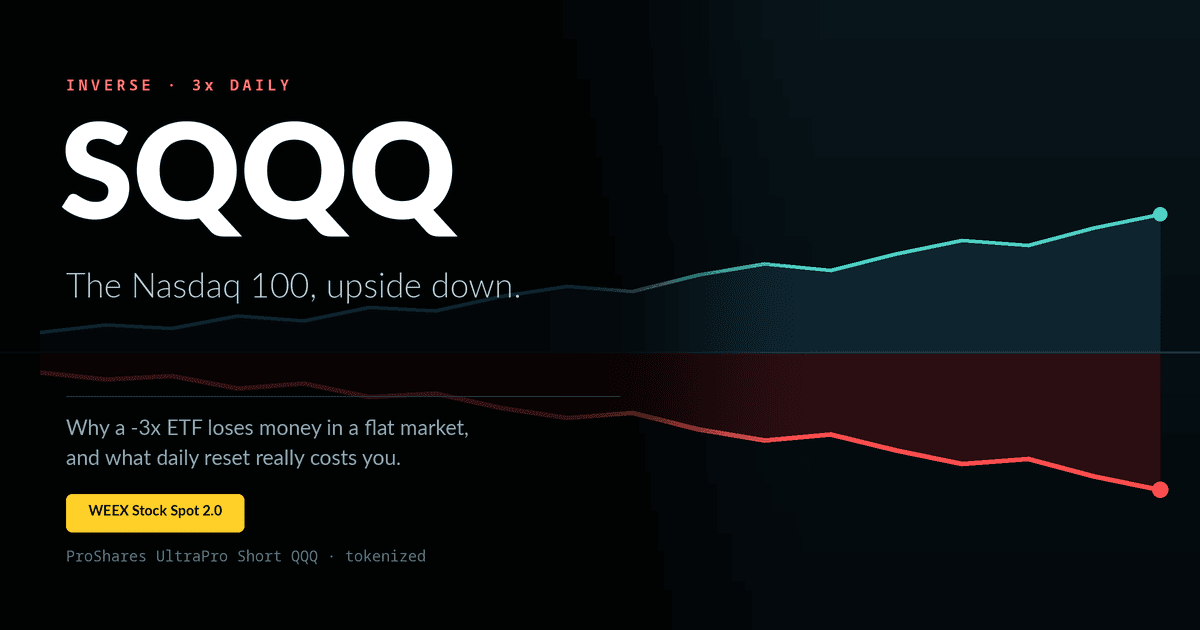
SQQQ, the ProShares UltraPro Short QQQ, seeks three times the inverse of the Nasdaq-100's daily return, and it has lost 99.97% of its value since launch. That number is not a scandal or a tracking failure. It is what a -3x daily-reset product mathematically does when it sits through a long bull market, and it is the single most important thing to understand before opening the position. This article covers how the daily reset produces that outcome, what SQQQ has done through 2026 specifically, the holding period the instrument is actually built for, and how to trade the tokenized SQQQ/USDT pair without inheriting a slow bleed.
The number that defines SQQQ
Set out plainly, using ProShares and market data through 2026:
- Over the trailing year, SQQQ lost roughly 62.69% while the Nasdaq-100 gained about 36.56%.
- Over five years, SQQQ is down approximately 96.15%.
- Since inception, it is down roughly 99.97%.
- The expense ratio is 0.95% annually — meaningful, but a small fraction of the total loss.
The fund did its job in every one of those periods. It delivered close to -3x the Nasdaq-100's daily move, every day. The catastrophic cumulative figure comes from compounding those daily results across an index that rose over time and moved around a lot on the way.
How daily reset compounding works against you
The mechanism is arithmetic, not fee drag. SQQQ rebalances its exposure at the end of each trading day so that the next day starts at -3x again. That reset means each day's return is applied to a base that already reflects the prior day's move, and the sequence of those multiplications does not equal three times the point-to-point move.
Two effects run simultaneously.
Trend drag. If the Nasdaq-100 rises persistently, SQQQ's asset base shrinks every day, so each subsequent 1% index gain destroys a smaller absolute amount — but the position also has progressively less capital to recover with. Recovery from a deep percentage loss requires an outsized percentage gain, and the shrinking base makes that arithmetically harder.
Volatility decay. Even in a flat market, oscillation costs money. Suppose the Nasdaq-100 falls 5%, then rises 5.26%, ending unchanged. SQQQ rises 15% to 115, then falls 15.8% to 96.8 — down 3.2% on a round trip that left the index exactly where it started. The bigger the daily swings, the worse this gets, and it gets worse quadratically.
QQQ's realised daily volatility running near 6.86% against 5.58% for SPY means the Nasdaq-100 is exactly the kind of high-variance underlying where this drag is largest.
What SQQQ has done in 2026
2026 has offered the setup SQQQ is designed for and still punished holders who overstayed.
The Nasdaq-100 was near record highs in April 2026, led by NVDA, MSFT, GOOG and META on AI capex and cloud acceleration. QQQ then fell about 7.3% from an all-time high of $746.16 to $693.69 in early June on mega-cap selling — a move that would have delivered roughly 20%+ to a well-timed SQQQ position held across it. By 27 August 2026 QQQ was trading near $718.66, and SQQQ around $36.96.
The macro backdrop through the second half of the year gave bears real arguments: 10-year Treasury yields above 4.5% compressing long-duration tech valuations, and oil above $100 on Strait of Hormuz disruption feeding inflation expectations. Analysts flagged the $645 level as a 10% drawdown threshold and the rising 200-day moving average around $640–$650 as the technical line to watch.
The point is that even a correct bearish call had a narrow useful window. A trader who was right about the June pullback and held from April to August captured the drawdown and then gave it all back plus decay.
-- Price
The only holding period that makes sense
Treat SQQQ as a hedging and short-term tactical instrument with three non-negotiable conditions.
- Define the exit before entry. Both a profit target and a stop. Without one, decay eventually eats the position regardless of whether the thesis was right.
- Keep the horizon to days, not months. The intended holding period for a -3x daily product is intraday to roughly a week. Anything longer requires the index to fall almost monotonically.
- Size for -3x, not for the ticket. A 5% portfolio allocation to SQQQ is a 15% notional short on the Nasdaq-100. Most sizing errors come from ignoring this.
There is a fourth, less obvious point. SQQQ is a reasonable hedge for a concentrated long tech book because it is capital-efficient — a small allocation offsets a large exposure. It is a poor standalone directional bet for the same reason: the leverage that makes it efficient as a hedge makes it fragile as a position.
Trading SQQQ/USDT on WEEX
WEEX lists SQQQ/USDT as part of Stock Spot 2.0, its tokenized-equities line, which puts US ETFs, single stocks, pre-IPO names and commodity trackers on USDT-quoted order books alongside crypto pairs. For a trader whose collateral already sits in stablecoins, this removes the need for a US brokerage account to express a Nasdaq-bearish view.
Steps:
- Open the WEEX app or website and go to spot trading.
- Select the Stocks tab.
- Search SQQQ and open the pair.
- Place a limit buy or sell order.
One structural wrinkle deserves attention. SQQQ's daily reset is defined against the US equity session close, but the tokenized pair trades continuously. Holding across a weekend means holding a product whose reset reference market is shut — pricing is market-maker driven, spreads widen, and Monday's open can gap. If your thesis is about a specific catalyst, prefer to be flat into closed hours rather than carrying the position through them.
The pair supports up to 20x on WEEX. Applying that to an instrument already running -3x daily leverage produces effective exposure most accounts cannot survive a normal Nasdaq bounce. Spot, small, and short-dated is the disciplined use. Fee tiers are in the WEEX fee schedule, and the current Stock Spot 2.0 campaign offers first-trade protection and a shared $100,000 pool — QQQ/USDT appears on its eligible-pair list for the volume task, so check the event terms if you are trading the long side of the same index.
FAQ
1. Why is SQQQ down 99.97% since launch?
Because it resets to -3x every day and the Nasdaq-100 has risen substantially over that span, with high daily volatility. Trend drag and volatility decay compound together. The fund tracked its daily objective correctly throughout.
2. Can SQQQ recover if the Nasdaq crashes?
It will rise sharply during a decline — a 7.3% QQQ drawdown like June 2026 translates to a roughly 20%+ SQQQ move. But it will not recover its since-inception losses, because the base it compounds from has shrunk to a fraction of its original value.
3. How long should SQQQ be held?
Intraday to about a week, with a predefined exit. It is built for tactical positioning and hedging, not for expressing a multi-month bearish view.
4. Is SQQQ better as a hedge or a directional bet?
As a hedge. Its capital efficiency lets a small allocation offset a large long tech position. The same leverage makes it fragile as a standalone position, where a single strong up day can wipe out weeks of gains.
5. Does the 0.95% expense ratio explain the losses?
No. It is a real cost but a minor one relative to the decay. The dominant driver is daily-reset compounding against a rising, volatile index.
Risk Warning
SQQQ is a -3x daily-reset product and is not suitable for holding beyond short tactical periods. It has lost approximately 62.69% over one year, 96.15% over five years, and 99.97% since inception — outcomes consistent with its design, not evidence of malfunction. A single strong Nasdaq-100 up day produces roughly three times that loss in the position, and a sustained rally can erase most of the capital committed. Because the tokenized pair trades 24/7 while the US equity market that defines the daily reset is closed, weekend and overnight pricing is estimated, spreads widen, and gap risk concentrates at the US open. Applying exchange leverage on top of an already -3x product creates effective exposure that can be liquidated by an ordinary market bounce. Digital assets and tokenized products are volatile and may result in partial or total loss of capital.
This content is provided for general informational purposes only and doesn't constitute financial, investment, legal, or tax advice. Any events, rewards, online promotions, or related information mentioned herein should not be considered a recommendation, solicitation, or invitation to purchase, sell, trade, or otherwise deal in any crypto assets. Crypto assets are highly volatile and may result in loss. The availability of WEEX services, products, and related events may vary by region. You are responsible for ensuring that your participation is in accordance with applicable local laws and regulations.
You may also like

How Safe Are the Crypto Exchanges Pakistani Traders Actually Use? A Security Comparison
XST Coin Price Crosses Into Deep Capitulation Territory: What a 90%+ Decline Actually Signals

XPL/USDT After the August 25 Unlock: Will Ecosystem Incentives Create Demand or Selling Pressure?

SPCX Stock Keeps Swinging Around Its $135 IPO Price : What the Lockup Schedule Still Ahead Actually Means

Best Futures Exchange in Pakistan for 2026? What Leverage, Liquidity, and Liquidation Risk Actually Require

Crypto P2P Trading in Pakistan: Which Exchange Has the Best PKR Marketplace in 2026
Best Crypto Exchange in Pakistan for 2026: What You Need to Know Before Choosing
How to Earn WXT Rewards with WEEX Trade to Earn S6 Event

Adobe Stock Jumps After BlackRock Raises Stake to Over 10%: What an $8.4 Billion Bet Actually Signals
Before Swapping XSolut (XST): How to Check Liquidity, Price Impact, and Failed-Trade Risk 2026

MU Stock and the Apple CXMT Test: What Replacing Micron With Chinese Memory Actually Means
SPCX Stock Price Rebounds 16% From Its All Time Low: Is the Worst Finally Over for SpaceX
Is the Nikkei stock a Buy After Falling 10% From Its 2026 High? What Japanese Stocks Need to Recover
Gold Forum: Where the Polish Discussion Actually Happens — and the Question It Argues About Most
Samsung Stock Price Prediction 2026-2027: Can Samsung Reach $250 After the July Selloff?

SPCX Stock Price and the $116 Billion Lockup Expiry Tomorrow: What Actually Happens on August 6
MSTF Stock and the $100 Billion Azure Milestone: What Crossing This Threshold Actually Changes
AMD Stock vs Nvidia Stock: Who Is Winning the AI Chip Race Heading Into Q2 Earnings?
AMD Stock Before August 4 Earnings: What the Helios Ramp and Data Center Crossing $6.5 Billion Actually Mean
Microsoft Stock Jumps After Azure Grows 43%: What the Biggest Cloud Beat in Years Actually Means
AAPL Stock at $5 Trillion Market Cap Falls 6%: Is Now the Time to Buy or Wait?
AMD Stock Falls 6% as Wedbush Raises Target to $600: What the Disconnect Means for Investors
Samsung Stock Is 30% Below Its Peak: What Getting Back to Record Highs Actually Requires
Tesla Stock Is Betting Everything on Robotaxi and Optimus: What Investors Are Actually Paying For
Microsoft Stock Before July 29 Earnings: What Azure Growth Rate Actually Needs to Show
Tesla Stock Is Down 17% in 2026: What Q2 Earnings Need to Deliver to Turn the Story Around
KOSPI Stock Market Enters Bear Market: What a 25% Drop From the Peak Means for Investors
[Country Name] Crypto Tax 2025: A Complete Guide
Italy Crypto Tax 2025: A Complete Guide
Poland Crypto Tax 2025: A Complete Guide
How Safe Are the Crypto Exchanges Pakistani Traders Actually Use? A Security Comparison
XST Coin Price Crosses Into Deep Capitulation Territory: What a 90%+ Decline Actually Signals
XPL/USDT After the August 25 Unlock: Will Ecosystem Incentives Create Demand or Selling Pressure?
SPCX Stock Keeps Swinging Around Its $135 IPO Price : What the Lockup Schedule Still Ahead Actually Means
Best Futures Exchange in Pakistan for 2026? What Leverage, Liquidity, and Liquidation Risk Actually Require
Crypto P2P Trading in Pakistan: Which Exchange Has the Best PKR Marketplace in 2026


