
Monero Futures Trading: The Liquidity Risk Guides Ignore

 Prefer us on Google


Monero futures trading works the way every other perpetual contract works: you post margin, take a long or short position on XMR, pay or receive funding, and get liquidated if the market moves far enough against you. That part is genuinely simple, and a dozen guides explain it identically. What they leave out is the fact that changes how the contract actually behaves. More than seventy exchanges have delisted Monero since 2024, starting with Binance in February of that year, and the EU's anti-money-laundering package is expected to restrict anonymity-enhancing coins at regulated venues by 2027. The spot market feeding the index price of any XMR perpetual is thinner and more fragmented than the spot market behind BTC or ETH — and thin index books produce wider wicks, faster cascades and worse fills. This article covers where XMR still trades, what the delistings do to the contract, how to read current positioning, and how to size and place a trade accordingly.
XMR traded at $515.05 on September 15, 2026, down 3.08% on the day, with $130.99 million of 24h spot volume and a $9.68 billion market capitalisation at rank 12 (CoinMarketCap). Its 24h range was $503.61 to $534.82. The all-time high of $798.91 was set on January 14, 2026 — the current price is about 35% below it, despite a roughly 85% recovery from the February 6 low near $278.
What Monero futures are, and where XMR still trades
An XMR perpetual is a contract that tracks Monero's price with no expiry, margined in USDT, with a funding rate paid between longs and shorts to keep the contract anchored to a reference index. You never take delivery of XMR, which is precisely why the product survived where spot listings did not — a derivative referencing a price is a different regulatory object from custody of a privacy asset.
That distinction explains the current map. Spot XMR access at large regulated venues has narrowed sharply since 2024, with activity migrating to non-custodial swap services and exchanges routing through licensed liquidity providers. Derivatives access held up better. WEEX lists XMR-USDT perpetual futures with leverage up to 100x as of September 15, 2026.
The useful mental model: XMR's derivatives market is now larger relative to its spot market than it was three years ago, and the gap is not a sign of speculative froth. It is a regulatory artefact.
Why delistings change how XMR futures behave
A perpetual's mark price is derived from an index built out of spot prices across reference venues. When the number and depth of those venues falls, three things follow, and none of them appear in the standard XMR futures guide.
The index gets noisier. Fewer, thinner constituent books mean a single large spot print moves the index more than it would for a deeply-listed asset. Mark price is what liquidates you, so index noise is liquidation noise.
Wicks run further before they are arbitraged back. Arbitrage between perp and spot requires someone able to trade both sides cheaply and quickly. Every delisting removes some of that capacity. The practical result is that XMR can print a low several percent below where the candle closes, and stops sitting in that band get taken out on a move that never really happened.
Venue availability is itself a position risk. This is the one traders consistently underprice. With an EU restriction on anonymity-enhancing coins expected at regulated venues by 2027, the set of exchanges offering XMR markets is a moving target. A perpetual position is a claim against a specific venue's market continuing to exist. Delisting announcements typically come with a forced-closure window, and forced closure in a thin book is not a fill you would choose.
None of this is an argument against trading XMR. It is an argument that the generic advice — tight stop, high leverage, add on dips — is worse advice for XMR than it is for BTC, and the guides that give it do not distinguish.
Reading XMR open interest and funding before you size
Positioning data does more work here than chart patterns, because in a thin market the positioning is the risk.
As of mid-September 2026, XMR open interest sat around $255 million after peaking near $318 million earlier in the week to September 12, with funding staying positive for several weeks — longs paying shorts to hold. Set that against $130.99 million of 24h spot volume: roughly two dollars of open leveraged exposure per dollar of daily spot turnover. That is far healthier than the 24:1 ratio seen on some altcoin perps, but it is still a market where a coordinated unwind has more positions to close than the spot book can absorb in a day.
The reading that matters: open interest fell about 20% from its weekly peak while price pulled back from $565 toward $515. Falling open interest into falling price is longs closing, not shorts opening — a flush rather than a new downtrend. Persistently positive funding through that flush says the long side remains crowded even after the pullback, which is the condition that produces a second leg down.
Technically, the backdrop is constructive. A golden cross formed on August 14, 2026 when the 50-day and 200-day EMAs crossed, and a double bottom confirmed at $291 broke its neckline at $447 — which is now the level that matters on the downside. Resistance sits at the recent $565 high, then $600. The wider privacy sector reached roughly $30.3 billion in market capitalisation, so XMR is not moving alone.
-- Price
How to short Monero without getting wicked out
Shorting a crowded-long asset into positive funding is structurally attractive — you get paid to hold the position — and it is also where thin-book risk bites hardest, because short squeezes in illiquid markets are violent.
- Short into strength, not into the flush. With funding already positive and open interest already down 20% from its peak, the easy part of the move is behind. Shorts placed near $565 resistance have a defined invalidation; shorts placed at $515 after the drop do not.
- Set the invalidation above the wick, not above the candle. XMR's own 24h range on September 15, 2026 was $503.61 to $534.82 — a 6.2% span on an ordinary day. A stop 3% above entry is inside normal daily noise.
- Trigger on mark price. In a thin book, last price can be printed by one trade. Mark price is the smoothed reference the contract liquidates against, and it is the more honest trigger.
- Attach the exit at entry. WEEX's user guide to take-profit and stop-loss orders covers market versus limit TP/SL, trigger-price selection, and the slippage and fill failures that happen when volatility spikes.
- Take partial profit at the level, not past it. $447 is a structural level, not a round number. Scaling out into it beats holding for $400 and giving back the move on a squeeze.
Position sizing for a thin-book asset like XMR
Generic advice says risk 1–2% of capital per trade. That is the right principle and the wrong input, because the number that should drive sizing is the asset's own range, not a rule of thumb.
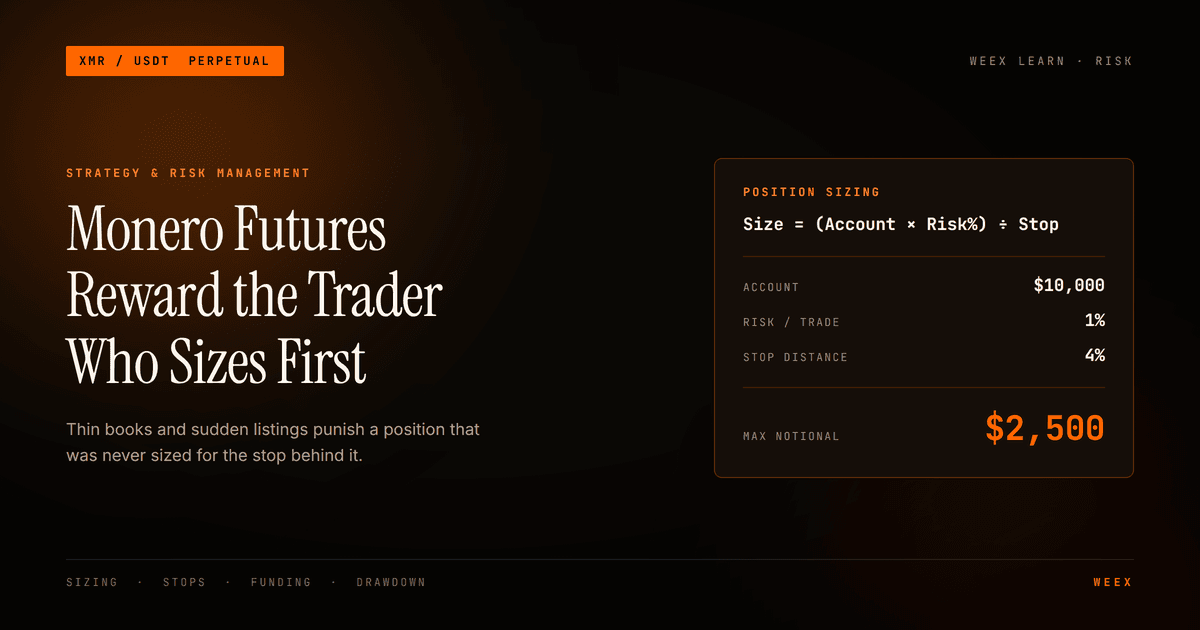
Work it backwards. XMR's ordinary daily range is currently around 6%, and the gap between the current $515 and the $447 neckline is about 13%. A stop that respects structure therefore needs to sit roughly 7–13% away from entry, depending on whether you are trading the range or the level. If you are risking 1.5% of a $10,000 account — $150 — and your stop is 10% away, the position is $1,500 of notional, which at 5x leverage means $300 of margin. Not $2,000 at 20x with a 3% stop, which is the configuration that produces the liquidation.
Two further constraints specific to XMR:
- Cap the leverage below what the venue offers. A 100x maximum is a capability, not a recommendation. At 100x, liquidation sits roughly 1% from entry — inside a single fifteen-minute candle on this asset.
- Keep the holding period short enough to outrun venue risk. A multi-month leveraged XMR position is also a multi-month bet that the market stays listed where you opened it. WEEX's risk management guide covers the mechanics of position sizing, margin mode and trigger orders that make a short holding period practical to run.
What most XMR guides get wrong
They treat Monero as Bitcoin with better privacy and apply Bitcoin's playbook. The technology comparison is fine; the market-structure comparison is not. BTC perps sit on top of the deepest spot market in crypto. XMR perps sit on top of a spot market that regulation has been steadily narrowing for two years, with more narrowing scheduled. Same instrument, materially different fill quality, wick behaviour and tail risk. Size for the market you are actually in.
FAQ
1. Where can you still trade Monero futures?
Derivatives access held up better than spot access through the delisting wave. WEEX lists XMR-USDT perpetual futures with leverage up to 100x as of September 15, 2026. Because a perpetual references a price rather than custodying the asset, it is treated differently from a spot listing — but venue availability can still change, so confirm before you open a position.
2. Why have so many exchanges delisted Monero?
More than seventy exchanges have removed XMR since 2024, Binance first in February 2024, driven by anti-money-laundering rules covering anonymity-enhancing assets. The EU's AML package is expected to restrict them at regulated venues by 2027.
3. How do I short Monero with leverage?
Open a short position on an XMR perpetual contract, post margin, and set a stop above your invalidation level. The specific caution for XMR is stop placement: its ordinary daily range was 6.2% on September 15, 2026, so a stop inside 3% sits within normal noise.
4. What does positive funding on XMR mean?
Longs are paying shorts to hold, which indicates the long side is crowded. Funding has stayed positive through September 2026 even as open interest fell about 20% from its weekly peak near $318 million — a combination that usually means the long side has not fully capitulated.
5. Is XMR's thin spot market a reason to avoid futures on it?
Not by itself, but it should change your settings rather than your conviction. Thin index books widen wicks and worsen fills, so the same view should be expressed with lower leverage, wider stops and smaller notional than you would use on a deeply-listed asset.
Risk Warning
Monero is volatile and leveraged XMR positions can result in partial or total loss of margin. The risks here go beyond ordinary market risk. XMR's spot liquidity has been progressively fragmented — more than seventy exchanges have delisted it since 2024 — which makes the index behind the perpetual noisier and allows price to wick several percent past the level at which it closes, taking out stops and liquidating positions on moves that do not hold. Venue risk is real and asymmetric: regulatory action on anonymity-enhancing assets, including the EU restriction expected by 2027, can remove a market with a forced-closure window that leaves you exiting into a thin book at a price you did not choose. Funding has been persistently positive, so long positions pay to hold and that cost compounds over multi-day positions. Leverage of up to 100x places liquidation roughly 1% from entry, well inside XMR's normal intraday range of around 6%. Nothing in this article is a recommendation to buy, sell or short XMR. Trade only with capital you can afford to lose.
This content is provided for general informational purposes only and doesn't constitute financial, investment, legal, or tax advice. Any events, rewards, online promotions, or related information mentioned herein should not be considered a recommendation, solicitation, or invitation to purchase, sell, trade, or otherwise deal in any crypto assets. Crypto assets are highly volatile and may result in loss. The availability of WEEX services, products, and related events may vary by region. You are responsible for ensuring that your participation is in accordance with applicable local laws and regulations.
You may also like
Senate CLARITY Act Cloture Vote Today: Can Trump's Ethics Compromise Get 60 Votes?
Trust Wallet vs MetaMask: Which One Is Better for Beginners?
Bitcoin Funding Rate Before the Fed: What Longs Pay to Hold BTC
Crypto Futures Trading Explained: Leverage, Funding, Liquidation
How to Trade U.S. Stocks Without a Brokerage Account Using USDT

MetaMask Transaction Stuck or Failed? Here's How to Fix It
How to Install and Set Up MetaMask (2026 Updated Guide)
Is Arbitrum (ARB) Worth Buying After Its 30% Rally? An Analysis About Utility, Supply and Risks
Can You Trade U.S. Stocks With 5 USDT? Here's the Real Math
SpaceX Stock Price Holds Near $141: Why Isn't a $100 Billion Spaceport Plan Moving It?

Marvell Stock (MRVL) Beat Earnings and Raised Guidance: Why Did It Fall Anyway?

Where Is XST Actually Trading Now? A Look at Volume Distribution After the Crash
NVDA Stock Jumps 7% After Earnings: Is $250 Next?
Why Is Raini Studios Token (RST) Up Today Despite Low Trading Volume?
Before You Buy CyberLeek: You Should Know CYBERLEEK Token Risks First
Is CyberLeek (CYBERLEEK) Safe? Price Crash and Key Token Risks Explained
CyberLeek Price Prediction 2026: Can CYBERLEEK Recover After the Crash?

Why Is CyberLeek Price Falling Today? CYBERLEEK Crash Explained
SEC Sends Crypto Custody Rule to White House: What the Review Means for Investment Advisers
NVDA Earnings Call Recap: Revenue Guidance, AI Demand and Key Takeaways
Hamster Kombat Is Down 97% From Its Peak: What Happened to Crypto's Biggest Web3 Onboarding Experiment?

Nvidia Earnings Report Today: Did NVDA Beat Revenue and EPS Estimates?
Did Nvidia Beat Earnings? NVDA Q2 Results and Stock Reaction Explained

How to Buy USDT with Easypaisa Using PKR in 2026
Easypaisa Crypto Guide: How to Use the Mobile Wallet for P2P Trading in Pakistan
How to Log In to MetaMask: Unlock, Troubleshooting and Recovery (2026)
WEEX Mini App Launch Rewards: Trial Funds, BTC Airdrops, and an iPhone 17 Pro Giveaway Explained
How to Buy USDT with JazzCash in Pakistan Safely in 2026
JazzCash Crypto Guide: How PKR-to-USDT P2P Payments Work in Pakistan
H/USDT After the Unlock: What Humanity Protocol’s New Supply Means for Traders
Senate CLARITY Act Cloture Vote Today: Can Trump's Ethics Compromise Get 60 Votes?
Trust Wallet vs MetaMask: Which One Is Better for Beginners?
Bitcoin Funding Rate Before the Fed: What Longs Pay to Hold BTC
Crypto Futures Trading Explained: Leverage, Funding, Liquidation
How to Trade U.S. Stocks Without a Brokerage Account Using USDT
MetaMask Transaction Stuck or Failed? Here's How to Fix It


