
Bitcoin at $75,000: Anatomy of a $3 Billion Short Squeeze

 Prefer us on Google


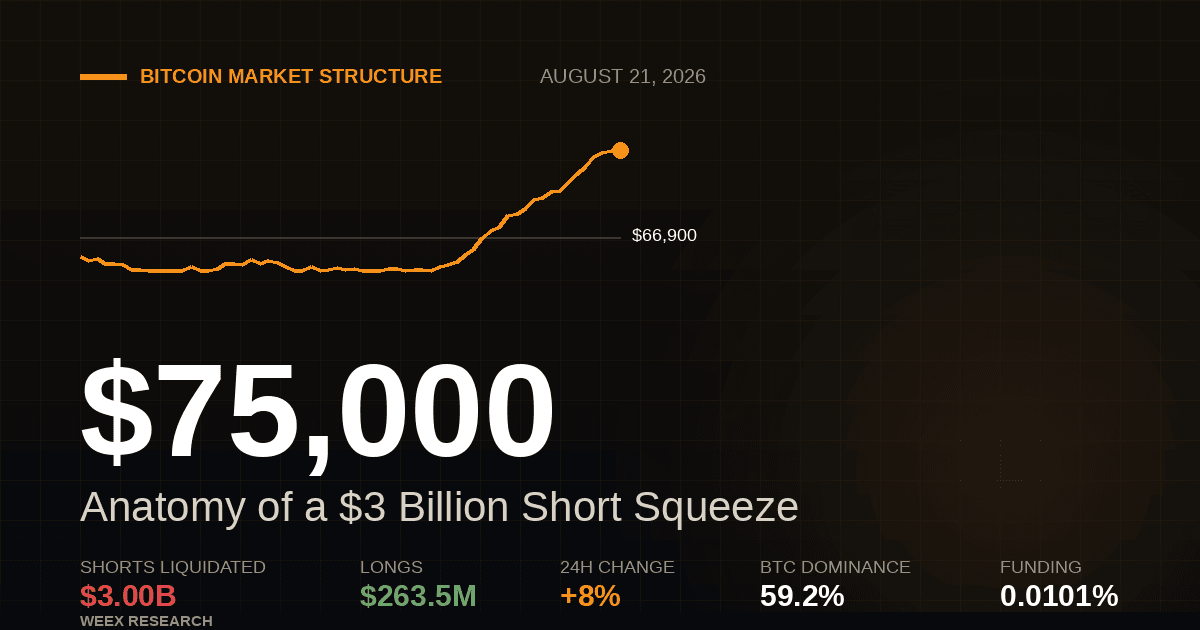
Bitcoin crossed $75,000 late on Thursday, August 20, 2026 — its first print above that level since late May — after a 24-hour advance of roughly 8%. Ether reached $2,376, up 4.8%. XRP added 16%. On a weekly basis bitcoin was up 19%, ether 25%, XRP 28%.
"Bears in pain, right now," wrote analyst James Check as the level broke.
They were. Over the preceding 24 hours, $3 billion of short positions were liquidated against $263.5 million of longs — the largest one-sided short flush since at least 2021. That asymmetry is the story, and it is a different story than the one most coverage is telling.
Why is Bitcoin going up? The short answer
Three things stacked in sequence, and the order matters:
- The US Treasury said it would at least double long-dated bond buybacks to $4 billion, pulling the 30-year yield back from 5.337% — its highest reading since 2007. Risk assets bid.
- That bid cleared bitcoin's range ceiling, which had capped price between roughly $62,000 and $66,900 since July 8, triggering a dense band of short liquidations sitting between $65,000 and $67,000.
- Trump's White House call to pass the CLARITY Act landed hours later, into a market that had already made most of its move, and supplied a second leg above $70,000.
The popular framing — "Trump pumped bitcoin" — has the causality backwards. The regulatory headline extended a move that a Treasury refunding operation started.
Anatomy of a $3 billion short squeeze
Six weeks of compression did the setup work. Volatility ground to multi-year lows inside the range, which taught traders that every approach to the range high was worth fading. By Wednesday, the aggregated long-short accounts ratio for BTC had fallen to 0.835, down from around 1.05 on Tuesday — meaning more accounts were positioned short into the break than long.
When $66,900 gave way, those shorts became forced buyers into thin resting supply. More than $1 billion cleared in a single hour.
Metric (24h to Aug 20, 2026) | Reading |
|---|---|
Short liquidations | $3.00B |
Long liquidations | $263.5M |
BTC share of liquidations | $1.67B |
ETH share of liquidations | $1.14B |
Largest single hour | >$1B |
BTC long/short account ratio | 0.835 (from ~1.05 Tuesday) |
BTC daily spot volume | $59B, up 250% |
Coinbase Fear & Greed | 59 "greed" (from 41 "fear") |
Source: CoinDesk market data and Coinalyze, August 20, 2026.
A squeeze of this shape is self-terminating. Shorts can only be liquidated once. The buying that produced the last $8,000 of upside came from traders who had no choice, and that bid does not repeat.
Was it Trump, or was it the Treasury?
This is the question worth sitting with, because the answer determines whether the move is durable.
Treasury buyback operations are a liquidity mechanism with a measurable, repeatable transmission channel into risk assets. A presidential request that Congress pass a bill is a sentiment input whose effect decays within days unless the bill actually moves. The CLARITY Act still needs 60 Senate votes it does not have, with a first procedural vote not expected until September 15.
There was also a second, quieter policy signal in the same session: Trump floated the idea of sizable US government bitcoin purchases and revealed that regulators are working on a compliant route for Hyperliquid. HYPE open interest jumped 29%, the largest increase of any major token — and that increase came after the comments, not during the initial break. Which is a neat natural experiment: where Trump's words were the actual catalyst, the positioning response is visible and isolated. On BTC, it is not.
The better reading: this was a rates-driven breakout that a policy headline amplified. If Treasury buybacks continue and yields stay contained, the move has legs. If the September vote fails, the second leg is the part that gives back.
-- Price
What the derivatives data says about the next leg
Here is the counterintuitive part. After the largest short liquidation event in five years, leverage did not blow out.
Derivatives metric | Reading, Aug 20, 2026 | Read |
|---|---|---|
BTC funding rate | 0.0101% | Restrained given the move's size |
ETH funding rate | 0.0103% | Same |
Total open interest | $131.25B, +9.11% | Exposure rebuilt fast |
BTC open interest | $23.4B, +7.18% | Moderate |
Aug 28 basis (OKX) | 7.68% annualized | Compressed |
Sep 25 basis (Deribit) | 4.71% annualized | Compressed |
BTC dominance | 59.2% | Capital concentrating in majors |
Altcoin Season index | 36/100 (from 44) | Not an alt rotation |
Compressed basis alongside a rising spot price means spot buying is leading futures. That is a cleaner signal than a leverage-driven extension — it suggests real allocation rather than borrowed conviction. Spot bitcoin and ether ETFs drew roughly $700 million combined on August 20, the largest single-day inflow in months, which supports the same reading.
The caution: absent funding pressure after a squeeze this size usually means the leverage build-up has not arrived yet, not that it will not. Open interest climbing 9% in 24 hours while funding stays flat is the setup, not the resolution.
How to trade BTC after a squeeze without getting run over
The most expensive mistake available right now is treating a completed short squeeze as an entry signal. One trader who had made $49 million shorting crypto lost $24 million on ether inside 12 seconds during this move. The mechanics that punished them punish late longs the same way, just in the other direction.
Practical structure:
- Define invalidation before entry, not after. The breakout level — roughly $66,900, the old range high — is the obvious structural line. Below it, the breakout thesis is simply wrong.
- Size to the gap, not the stop. In a squeeze-driven tape, price can move through a stop rather than filling at it. Assume slippage.
- Treat the second leg as conditional. Roughly the portion of this move above $70,000 rests on a policy headline that has not converted into votes.
- Prefer spot for conviction, futures for defined risk. If the reason you want exposure is the rates picture rather than the squeeze, spot BTC/USDT removes funding and liquidation from the equation entirely.
For traders who do want leverage, WEEX's BTC/USDT perpetual futures market was quoting around $75,330 on August 21 and offers up to 400× — a number that should be read as a ceiling to avoid, not a target. At 400×, a 0.25% adverse move is a full liquidation. In a tape where bitcoin just travelled 8% in a day and more than $1 billion of positions cleared in a single hour, high leverage is not aggressive positioning; it is a coin flip with a fee attached.
Where BTC sits after the move
As of August 21, 2026, WEEX data put bitcoin at $75,279.76 with a market cap of $1.51 trillion and 24-hour volume of $60.28 billion. The 50-day EMA sat at $64,533.57 and the 200-week EMA at $64,257.62 — meaning price is roughly 17% above both, which is stretched but not historically extreme. WEEX's Fear & Greed reading was 68, and 64% of surveyed users on the platform were positioned bullish.
BTC snapshot (Aug 21, 2026, WEEX) | Value |
|---|---|
Price | $75,279.76 |
Market cap | $1.51T |
24h volume | $60.28B |
50-day EMA | $64,533.57 |
200-week EMA | $64,257.62 |
Fear & Greed | 68 |
Platform sentiment | 64% bullish |
Max futures leverage | 400× |
That 17% gap above the 50-day EMA is the single number worth watching. Squeeze-driven rallies typically mean-revert toward that line before deciding anything. A retest is not a failure of the thesis — chasing the print above $75,000 and calling a retest a failure is how the move takes money from both sides in one week. WEEX's BTC technical dashboard tracks those EMAs live if you want to watch the gap close.
Bitcoin at $75,000 is a real breakout with a mechanical origin and a policy overlay that has not yet been ratified by a vote. Trade the mechanics. Treat the policy as optionality.
FAQ
1. Why is Bitcoin going up right now?
The immediate trigger on August 20, 2026 was a US Treasury announcement doubling long-dated bond buybacks to $4 billion, which pulled the 30-year yield off a 2007 high and bid risk assets. That cleared bitcoin's six-week range ceiling and forced $3 billion of shorts to buy back. Trump's CLARITY Act comments extended the move hours later.
2. How big was the Bitcoin short squeeze?
$3 billion in short liquidations against $263.5 million in longs over 24 hours — the largest one-sided short flush since at least 2021. BTC accounted for $1.67 billion and ETH $1.14 billion, with more than $1 billion clearing in a single hour.
3. Is it too late to buy Bitcoin after the breakout?
Nobody can answer that for your position. What the data says: price sits roughly 17% above both its 50-day and 200-week EMAs, funding is still flat, and the forced-buying component of this rally cannot repeat. Those conditions historically favour waiting for a retest over chasing the print.
4. What does the low funding rate mean after a squeeze?
BTC funding at 0.0101% after an 8% day means traders have not yet piled into leveraged longs. It is a constructive signal in the short run, but it also means the leverage build-up that usually follows a squeeze this size is still ahead, not behind.
5. Was the Bitcoin rally caused by Trump?
Partly, and later than most coverage suggests. The breakout began with the Treasury buyback announcement; Trump's remarks landed hours afterward and drove a second leg. The clearest evidence his comments moved a market is HYPE, whose open interest rose 29% specifically after he mentioned a US pathway for Hyperliquid.
6. What leverage should I use trading BTC futures?
That is a personal risk decision, but the arithmetic is fixed: at 400× a 0.25% adverse move liquidates the position, and this tape has produced 8% daily ranges. Traders who survive squeeze conditions generally use low single-digit multiples and size so a full stop-out is survivable.
Risk Warning
Crypto assets are highly volatile and you may lose part or all of the capital you commit. This article describes a market that just moved 8% in 24 hours and liquidated over $3 billion in positions — conditions in which stop orders may fill far from their trigger price, and in which leveraged positions can be closed automatically before you can react. Perpetual futures carry funding costs that accrue against you while positions are held, and liquidation risk that scales directly with leverage; at high multiples, routine intraday volatility is sufficient to close a position entirely. Price levels, funding rates, open interest and liquidation figures cited here are timestamped to August 20–21, 2026 and change continuously. Regulatory outcomes referenced, including the CLARITY Act, are unresolved and may not occur. Nothing here is investment advice.
This content is provided for general informational purposes only and doesn't constitute financial, investment, legal, or tax advice. Any events, rewards, online promotions, or related information mentioned herein should not be considered a recommendation, solicitation, or invitation to purchase, sell, trade, or otherwise deal in any crypto assets. Crypto assets are highly volatile and may result in loss. The availability of WEEX services, products, and related events may vary by region. You are responsible for ensuring that your participation is in accordance with applicable local laws and regulations.
You may also like

How to Trade Unitree Stock When You Can't Buy 688836

What Is ANSEM (The Black Bull)? The Pump Story, the 60 Percent Wallet and the Risks

What Is Based (BASED)? The Hyperliquid Super App Token Explained

Why Did SIREN Crash? The Whale Dump Explained, and What SIREN Is

Why POPCAT Crashes? A Complete Explanation

Memecoin Season 2025 is Coming?
What is niggaliquid (NL) Coin: A Comprehensive Guide to the Solana Meme Token
WEEX API Integration Guide: Auth, Limits, and the 403 Trap

WEEX API Guide: From API Key to Your First Signed Order

Apple Stock Fell 6.6% on a Record Quarter: What Traders Missed
SNDK Stock Price: Why SanDisk Trades at 43x Trailing and 7x Forward Earnings

WEEX Copy Trading API: Endpoints, Limits and 5 Error Codes
Crypto News API for AI Agents: What the WEEX Endpoints Return

WEEX API Trading Cost: The Full Fee Stack, Not Just Maker-Taker
WEEX API Error Codes Decoded: Fix 40001 to 43011 Fast
WEEX API Rate Limits: Where Bots Actually Hit 429
Ansem Makes Memes Great Again?

Crunch Time for the CLARITY Act: What’s in Store for Crypto?
Tokenized Stocks 101: When the World's 7+3 Most Valuable Companies Become Crypto's Underlying Assets
Amid the boom in stablecoin investments, which stablecoins are worth keeping an eye on?
How the Three Most Valuable IPOs of 2026 Will Ignite a New RWA Narrative?
With the World Cup hype building, which tokens are worth keeping an eye on?
With OpenClaw taking the world by storm, what can the Agentic economy bring to Web3?
Conflict Escalates, Oil Prices Moon: How Will Crypto React?
US-Iran Tensions Boil Over: How War Rewires the Crypto Market
BTC Approaches $60K: Crypto Isn't Dead, It's Just Filtering the Noise
What Just Happened Referring to Decoding Crypto's Latest Plunge

WEEX Labs: Is the Much-Hyped “Supercycle” Finally Upon Us?
WEEX Labs: Gold & Silver Hit New Highs, Is Bitcoin's Safe-Haven Narrative Losing Its Luster?

WEEX Labs: Is the Chinese Meme Coin Craze Really Now?
How to Trade Unitree Stock When You Can't Buy 688836
What Is ANSEM (The Black Bull)? The Pump Story, the 60 Percent Wallet and the Risks
What Is Based (BASED)? The Hyperliquid Super App Token Explained
Why Did SIREN Crash? The Whale Dump Explained, and What SIREN Is
Why POPCAT Crashes? A Complete Explanation
Memecoin Season 2025 is Coming?


