WEEX Labs: Gold & Silver Hit New Highs, Is Bitcoin's Safe-Haven Narrative Losing Its Luster?

By: WEEX|2026-01-21 12:30:00
0
Share
copy

From early 2025 through today, gold and silver prices have soared relentlessly, shattering one historical high after another, while Bitcoin has slipped into a volatile downtrend. Its much-touted "digital gold" label now seems to be gathering dust on this flight to safety.

But this story is far from over—2026 may yet deliver a dramatic twist.

Note: You can trade gold (XAUT/USDT), silver (XAG/USDT), and Bitcoin (BTC/USDT) on WEEX.

Gold & Silver Surge: Sovereign Assets Enter a "Gilded Age"

Per the latest data, gold surged 65% in 2025, effortlessly breaching the $4,000 threshold. In 2026 alone, it has climbed further to $4,800—its strongest performance in nearly four decades. Silver’s catch-up rally has been even more staggering: a 141.4% annual gain, marking its biggest leap since 1979.

Traditional inflation-hedge narratives fall short here. The real catalyst? A paradigm shift. As we saw in February 2022 when $300 billion of Russia’s FX reserves were frozen during the Ukraine invasion, central banks worldwide received a brutal wake-up call: Assets that are someone else’s liabilities—like U.S. Treasuries or bank deposits—can be zeroed out overnight in extremis.

While such "black swan" events were once outliers, today’s toxic cocktail of U.S. fiscal instability, whiplash tariff wars, fiat devaluation fears, and eroding Fed independence has turned tail risks into mainstream concerns. Sovereigns and institutions are now front-running this reality, hoarding gold as their armor of choice.

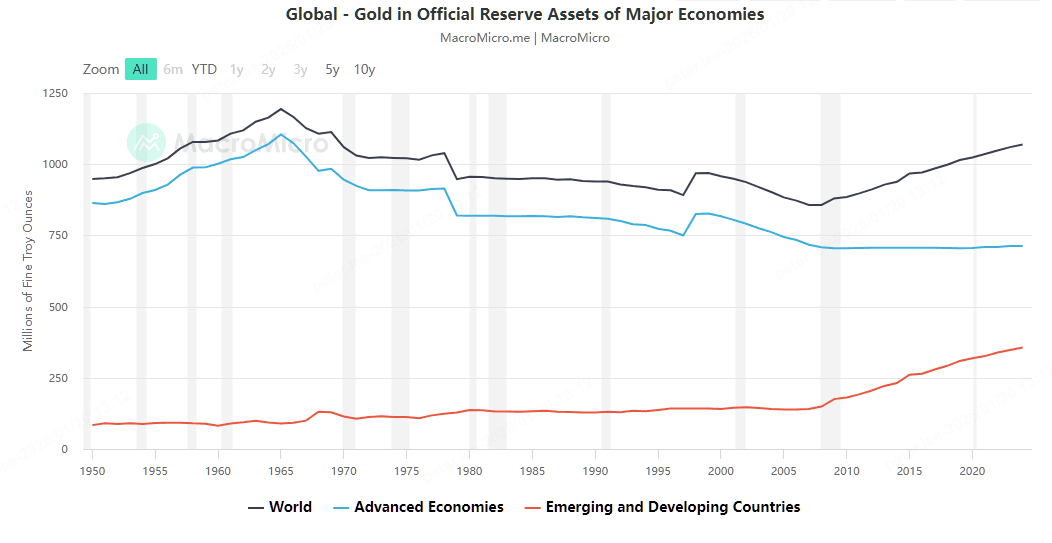
The numbers speak volumes: Global central banks bought over 600 metric tons of gold in 2025 (per World Gold Council), lifting gold’s share of official reserves to 25–27%. With 2026 purchases projected at 840 tons, the PBOC has led the charge—adding gold nonstop since 2022 to amass 74.15 million ounces (~2,300 metric tons) by December 2025.

WEEX Labs: Gold & Silver Hit New Highs, Is Bitcoin's Safe-Haven Narrative Losing Its Luster?

Emerging economies surge in gold purchases 

Silver follows a similar—but more industrial—logic. As macro analyst Luke Gromen explained when shifting to silver late last year: Its supply is rock-stiff. Even if prices double, new mines take 5–7 years to come online—while solar and EV demand soars.

Is Bitcoin’s "Digital Gold" Narrative on Ice?

Meanwhile, Bitcoin peaked at $126,000 last October before rolling into a technical bear market. As of this writing, it remains trapped in a grinding downtrend—a stark contrast to precious metals’ fireworks.

As shown above, the Bitcoin/Gold ratio has plummeted from its 2024 peak of 40 to below 20 today—with no bottom in sight.
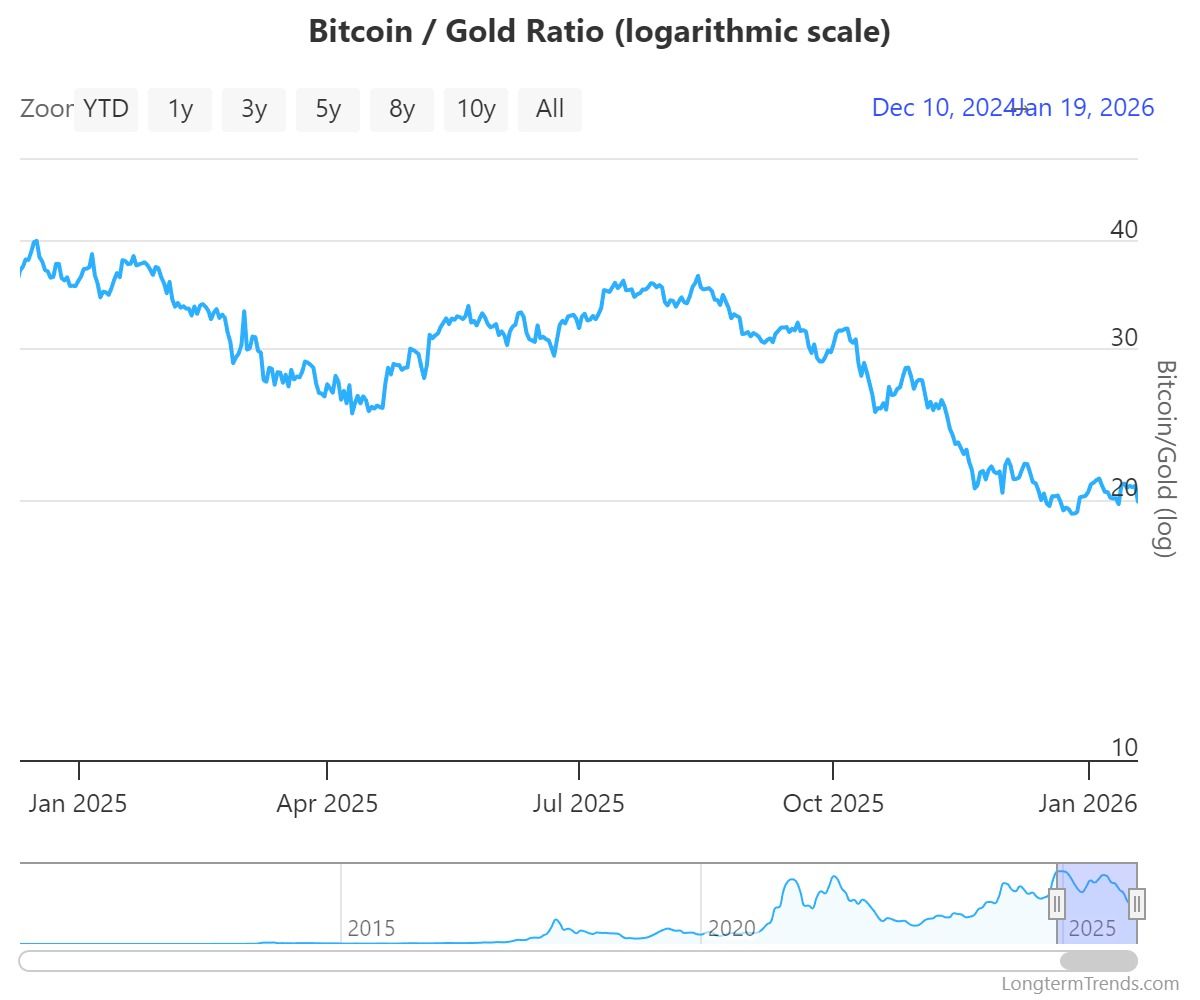
<a href=BTC GOLD Rate hits new lows">

BTC/GOLD hits new lows https://www.longtermtrends.com/bitcoin-vs-gold/

This divergence has given gold bull Peter Schiff ample ammunition. Tweeting recently, he quipped: "Bitcoin’s failure to match gold’s gains undermines its narrative as digital gold, resulting in a spectacular crash."

Why didn’t Bitcoin ride the same macro wave?

In my view, the core distinction is structural vs. cyclical. Gold and silver are riding an enduring geopolitical realignment; Bitcoin’s swings remain tied to its halving cycle (now widely debated) and liquidity tides.

Deeper context matters: As deglobalization and great-power rivalry intensify, trust in dollar assets is fraying. Central banks aren’t just fighting inflation—they’re re-engineering reserves for a sanctions-prone world. Naturally, sovereigns flock to gold—a $14 trillion market with millennia of trust. Bitcoin, by contrast, lives and dies by leveraged crypto-native capital: retail speculators, hedge funds, and prop shops. Crucially, per IMF data, central banks hold less than 0.1% of global Bitcoin reserves. Until sovereigns step in, "digital gold" remains a promise—not a reality.

Can Bitcoin stage a gold-like breakout?

Bitcoin's safe-haven narrative hasn't budged—limited supply, inflation hedge, decentralization, easy portability, and hack-resistant. While broader sovereign adoption remains elusive for now, its edge in portability, divisibility, and transparency is unmatched. At the same time, the relentless rally in gold and silver prices has cracked open the ceiling for Bitcoin's long-term potential.

Zooming in on Bitcoin itself, from late 2022 through October last year, it rode a three-year bull run, underscoring how its value is steadily being unlocked. Slipping into a consolidation phase now isn't out of left field—after a three-year surge, Bitcoin often cools off for 12-18 months (think 2018 or 2021), and this pattern aligns perfectly with its historical ups and downs.

Heading into 2026, gold and silver's momentum might hold strong, but Bitcoin isn't backed into a corner. With the Fed's measured rate cuts and progress on U.S. crypto market structure laws, Bitcoin—and the broader crypto ecosystem—will toughen up even more. Its real shot at glory isn't about aping gold, but forging deep ties with traditional finance via RWA (Real World Assets), PayFi, stablecoins, and the like, reshaping its story as a premier store of value.

On a brighter technical note, history shows that gold often pulls ahead of Bitcoin at liquidity inflection points—digital asset research firm Delphi Digital pegs it at about 3 months, while BitWise's research lead André Dragosch puts it at 4-7 months. Either way, once gold wraps up repricing safe-haven demand, currency debasement and fiscal strains will linger on, setting the stage for Bitcoin's big breakout. When gold and silver's "safe-haven premium" starts spilling over, Bitcoin's higher volatility typically amps up the reaction—history doesn't lie.

As illustrated in the chart below, taking a straight-line view of Bitcoin's correlation with gold suggests its rally might be better late than never. That said, this is just one lens on the market.
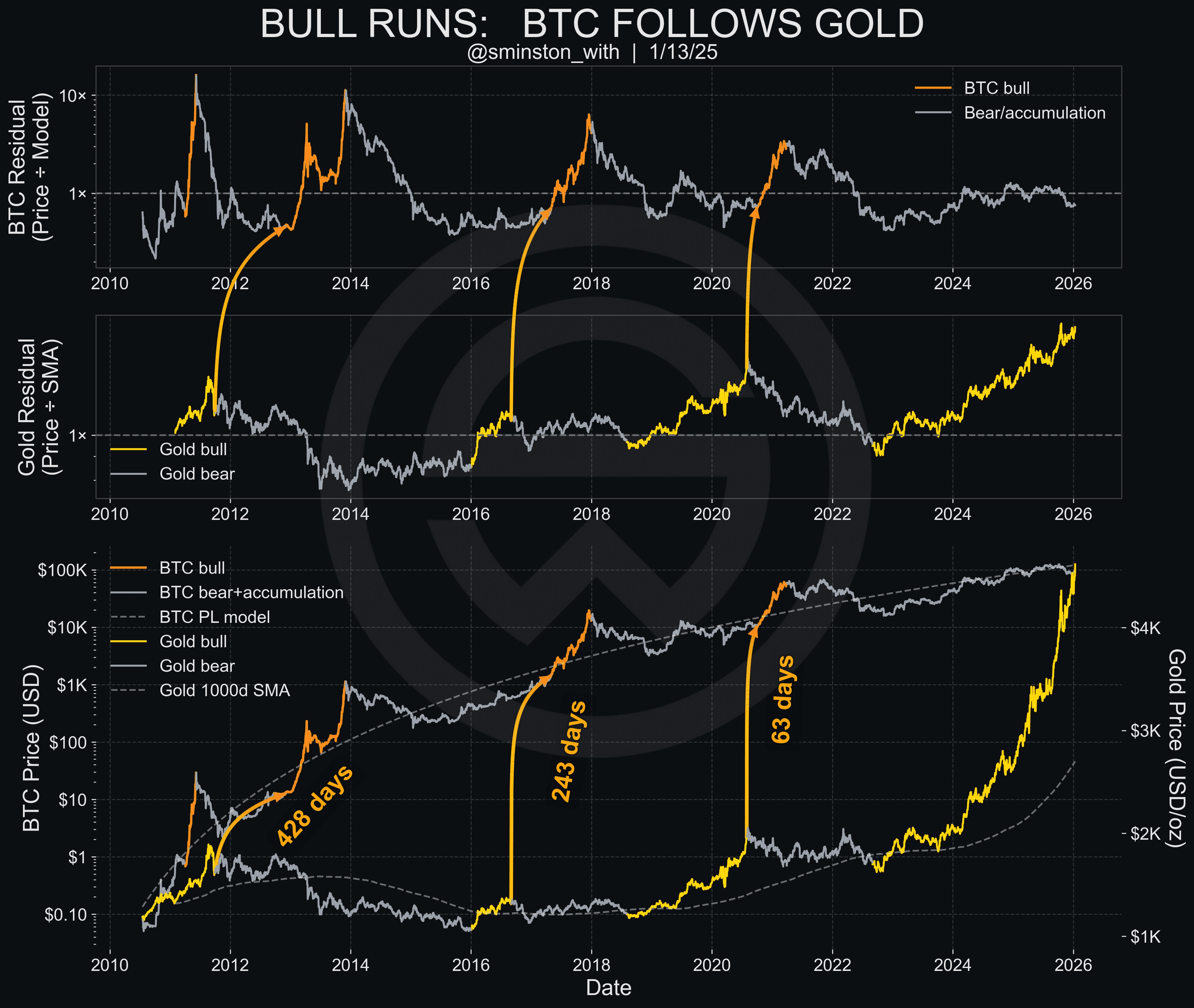
Bitcoin's rallies always follow gold's

Bitcoin's rallies always follow gold's https://x.com/sminston_with/status/2011148322934063137

All in all, while gold and silver's record highs lay bare the cracks in Bitcoin's safe-haven pitch, they also tee up a chance for a fresh narrative. In 2026's backdrop of rebounding liquidity expectations, Bitcoin's current "gathering steam" could forge a powder-keg bottom, redefining its "digital gold" crown under a new era of seamless system integration.

-- Price

--

You may also like

Crunch Time for the CLARITY Act: What’s in Store for Crypto?

The CLARITY Act, the most closely watched piece of crypto legislation in the U.S. history, has entered its final sprint.

Over the past few months, questions such as who should receive stablecoin yields, how to allocate liability in DeFi, and whether traditional banks would suffer a “bloodletting” have repeatedly stalled the bill. It wasn’t until recently that the deadlock was truly broken. Senator Thom Tillis confirmed on Monday that he and Senator Alsobrooks have been in talks with various parties for months and have finally produced a proposal that is broadly acceptable to all sides.

So, what exactly does the long-delayed CLARITY Act entail? And if it passes, what changes will it bring to the crypto market? This article provides an in-depth breakdown.

CLARITY Act Overview: Establishing Compliance and Classification

The Digital Asset Market Clarity Act (CLARITY Act) is the most ambitious attempt at crypto industry regulation by the U.S. Congress to date.

The bill passed the House of Representatives in July 2025 but has been stalled for an extended period due to disputes in the Senate.

Simply put, the bill primarily covers three key areas:

First, it clarifies the regulatory boundaries between the SEC and the CFTC. This is one of the most challenging issues facing those U.S. crypto companies. Currently, there is an overlap in the SEC and CFTC’s functions regarding the classification of digital assets, leaving companies facing long-standing uncertainty regarding their “regulatory status” from a compliance perspective.Second, establishing a regulatory framework for stablecoins. The bill imposes restrictions on stablecoin yields, but more crucially, it expands the scope of coverage—unlike the GENIUS Act signed in 2025, which targeted only issuers, the CLARITY Act extends to a broader range of entities, including trading platforms and wallet service providers, thereby filling a legislative gap.Third, strengthening investor protection and disclosure requirements. The bill strengthens the legal basis for holding parties accountable for fraudulent transactions, clarifies the criteria for determining market manipulation, and restricts insiders from abusing non-public information for illegal gains.

Additionally, federal regulators will issue a stablecoin disclosure framework and a list of compliance activities within one year of the bill’s passage, establishing a more predictable compliance roadmap for the industry’s development.

The Key Compromise: How Does the Stablecoin Yield Provision Balance the Interests of Both Sides?

It is clear that the biggest stumbling block preventing this bill from moving forward has been the issue of stablecoin yields—specifically, where the money comes from and whether it will siphon deposits away from banks—which has long been a major point of contention between the traditional banking sector and the crypto industry.

The key to breaking this deadlock lies in the compromise text on stablecoin yields reached by Senators Thom Tillis and Angela Alsobrooks. The provision explicitly prohibits crypto companies from paying “any form of interest or yield” (i.e., similar to bank deposits or interest-bearing products without cause) solely because customers hold stablecoins. However, it preserves room for rewards based on “real activity,” such as trading rebates, membership benefits, and on-chain interaction incentives.

Traditional banks have long feared that high-yield stablecoins would erode their deposit base, leading to massive capital outflows. This ban directly positions stablecoins as “payment tools” rather than “savings products,” effectively putting their minds at ease.

On the other hand, while crypto project teams cannot directly pay interest, they can still gain market share through product innovation, boosting user engagement, and expanding use cases.

In my view, this compromise may appear to be a mere semantic game on the surface, but it effectively amounts to a “redefinition of function”—stablecoins have shifted from their previous role as “savings-like assets” seeking risk-free returns back to that of “base money” for payments, settlements, and ecosystem incentives. However, the exact criteria for determining “real activity” remain vague, and this is likely to become a new battleground for all parties vying for regulatory interpretation in the future.

Following the key compromise, the probability of the bill being signed into law in 2026 surged to 70% on the prediction market Polymarket, setting a monthly high. https://polymarket.com/event/clarity-act-signed-into-law-in-2026

With the implementation of this compromise, the probability of the bill being signed into law in 2026 on the prediction market Polymarket briefly surged to 70%, setting a monthly record.

However, on the very day this article was written, U.S. banking trade groups still stated that the Senate’s stablecoin incentive compromise was “not sufficient”—they fear that the wording of the ban is not firm enough and that disguised economic incentives might emerge.

Clearly, this battle is far from over.

What Changes Will the Crypto Market See?

In fact, on every level, the CLARITY Act is more than just a simple update to regulatory terminology; it marks a landmark shift for the U.S. crypto market as it moves from a “pilot phase” to “institutionalization,” and the crypto market will benefit from this.

Leading compliance players see a revaluation: As a leader in compliant stablecoins, Circle (CRCL) is one of the bill’s biggest beneficiaries, with its stock surging 20% on Monday alone. As interest income from reserve assets grows and USDC continues to expand its market share across multiple use cases, Circle’s profit outlook is expected to become increasingly clear, enabling its transformation from a “crypto cyclical stock” to a “Web3+AI infrastructure stock.”Stablecoin ecosystem stands to benefit directly: Stablecoins are explicitly defined as “payment tools” rather than “deposit-like products.” This represents a major boon for cross-border payments, the tokenization of RWA (real-world assets), and AI-driven business models, helping to revitalize sectors such as DeFi, PayFi, and RWA.Overall market sentiment is improving: As a “macro-level” development, the CLARITY Act will further boost risk appetite as btc-42">Bitcoin recently rebounded to the $80,000 mark.

The next two weeks will be a critical window for the CLARITY Act’s passage. The crypto industry has made clear concessions regarding the flexibility of financial products to alleviate the concerns of the traditional financial system. This concession is not a retreat, but a strategic trade-off.

Of course, this does not mean everything is settled—the banking sector continues to question the boundaries of “real-world activities,” and regulatory responsibilities for DeFi have not yet been fully clarified. But at the very least, for the entire crypto industry, a “clear bill” that can be implemented is more important than a “perfect bill.” And the active progress being made at this stage is itself a sign that crypto assets are moving toward a mature capital market.


Tokenized Stocks 101: When the World's 7+3 Most Valuable Companies Become Crypto's Underlying Assets

The trend of tokenizing U.S. stocks is unstoppable: U.S. stocks and related ETFs are being extensively tokenized, allowing users to freely buy and sell these “tokenized stocks” on-chain, enabling 24/7 trading, low barriers to entry, and highly combinable on-chain asset allocation.

Among all tokenized U.S. stock assets, the most liquid and most representative of the “U.S. stock market ethos” are the seven tech giants known as the “Magnificent Seven”—Apple (AAPL), Microsoft (MSFT), NVIDIA (NVDA), Amazon (AMZN), Google’s parent company Alphabet (GOOGL), Meta (META), and Tesla (TSLA).

They account for over 80% of the volatility in the U.S. stock market.

In today’s guide, we’ll explore the overall structure of the U.S. stock market, the business evolution of the Magnificent Seven, and finally discuss how three upcoming “rising stars” set to go public will reshape the market.

I. The U.S. Stock Market: A Bull Market Dominated by the “Magnificent Seven”

The U.S. stock market, benchmarked by the S&P 500 Index, has a total market capitalization exceeding $50 trillion, but it is highly concentrated among tech giants. As of April 2026, the “Seven Sisters” collectively accounted for approximately 33.7% of the S&P 500’s weighting (up from just 12.5% in 2016), with a combined market capitalization of about $20 trillion. The top 10 stocks sometimes account for nearly 40% of the index.

Simply put: buying an S&P 500 ETF ≈ buying the “Seven Sisters.”

For ordinary investors, a straightforward question arises: what does this actually mean? The most intuitive answer is that whether you make money or not depends largely on these seven companies.

This structure gives rise to the typical “long bull, short bear” characteristic of the U.S. stock market:

Dual-engine growth driven by earnings and buybacks: These giants consistently maintain free cash flow profit margins of 15%+, combined with annual stock buybacks in the hundreds of billions of dollars, creating a structural bull market characterized by “a floor on the downside and leverage on the upside.”Highly simplified macro-level pricing: The Fed’s interest rate path determines the denominator of valuations, the pace of AI commercialization determines the numerator of earnings, and global dollar liquidity determines market elasticity.Bear markets feature “sharp declines and gradual recoveries”: When macroeconomic headwinds or liquidity tightening occur, indices typically experience a rapid 10%–15% pullback within 1–3 months. However, passive fund allocations and institutional bottom-fishing quickly restore the upward trend, with bear market cycles generally lasting no longer than six months.

For on-chain investors, understanding this structure implies that trading U.S. RWA essentially involves trading the discounted cash flows of a few core assets and macro liquidity premiums. If systemic volatility occurs in the broader market, on-chain prices typically revert to their anchored levels within 1–3 minutes through arbitrage mechanisms.

II. A Detailed Breakdown: The Deep Integration of the “Seven Sisters” and AI

1. NVIDIA—The Computing Power Provider of the AI Era

NVIDIA is the world’s highest-valued publicly traded company and the investment with the fastest profit growth, the most direct benefits, and the greatest certainty in the current AI wave. It is also closely tied to the AI sector of the cryptocurrency market.

- Main Business: GPU chips, with the data center business accounting for approximately 91% of the company’s total revenue.

- Market Capitalization: Approximately $5.09 trillion as of the end of April 2026, with a weighting of about 7.85% in the S&P 500.

- Performance: GPUs based on the Blackwell architecture hold a near-monopoly in the global AI training sector. CEO Jensen Huang has publicly stated that the company’s market capitalization could reach $10 trillion in the future.

Click to Trade NVDAON/USDT

2 Apple — Consumer Hardware × Service Ecosystem Empire

Apple is the world’s second-largest company by market capitalization. Its core business consists of the iPhone, a “super product,” coupled with a service ecosystem spanning over 2.5 billion active devices.

- Main Business: iPhone sales + monetization of the service ecosystem (App Store, Apple Music, iCloud, etc.).

- Market Cap: Approximately $3.97 trillion as of the end of April 2026, with a weighting of about 6.12%.

- Performance: Q1 FY2026 revenue of $143.8 billion, up 16% year-over-year; EPS of $2.84, up 19% year-over-year, exceeding expectations across the board. Services revenue surpassed $30 billion for the first time.

Click to Trade AAPLON/USDT

3. Microsoft — The “Shovel Seller” of Cloud Computing × AI

Microsoft has transformed from a traditional software company selling Windows and Office into a cloud computing and AI integration giant centered on Azure cloud services.

- Core Businesses: Azure cloud services + Copilot AI office assistant + enterprise software.

- Market Cap: Approximately $3.15 trillion as of the end of April 2026, with a weighting of about 4.86%.

- Financial Results: Q3 FY2026 revenue of $82.9 billion (up 18% YoY), EPS of $4.27 (exceeded expectations); Microsoft Cloud revenue: $54.5 billion (up 29% YoY); annualized AI revenue run rate exceeded $37 billion (up 123%). Demand for AI Copilot and Azure remains strong, but AI investments have put slight pressure on gross margins.

Click to Trade MSFTON/USDT

4 Amazon — E-commerce Empire × Cloud Computing King

Amazon is the most diversified of the “Big Seven,” but its true profit engines are AWS (cloud computing) and advertising.

- Core Businesses: E-commerce (traffic base) + AWS Cloud (profit core) + Advertising (fastest-growing major business).

- Market Cap: Approximately $2.83 trillion as of the end of April 2026, with a weighting of about 4.37%.

- Financial Results: Q1 2026 revenue of $181.5 billion (up 17% YoY), EPS of $2.78 (beat expectations); AWS cloud business revenue of $37.6 billion (up 28% YoY, the fastest growth in 15 quarters). AWS accounts for only about 17–18% of total revenue but contributes over 60% of operating profit; Annualized revenue from the advertising business has exceeded $70 billion, with growth exceeding 20%.

Click to Trade AMZNON/USDT

Alphabet, Google’s Parent Company—The “Trio” of Search × AI × Cloud

Alphabet holds nearly 90% of the global search engine market share, while also owning Google Cloud, the world’s third-largest cloud platform, and DeepMind, the leading AI research organization.

Core Businesses: Search Advertising (Cash Cow) + Google Cloud (Rapid Growth) + AI Business.Market Cap: Approximately $4.20 trillion combined, with a combined weighting of about 6.51%.Performance: Q1 2026 revenue of $109.9 billion (up 22% YoY), EPS of $5.11 (significantly beating expectations); Google Cloud revenue of $20.0 billion (up 63%).

Click to trade GOOGLON/USDT

6 Meta — The AI Advertising Machine of Social Media

After navigating the “metaverse slump” of 2022, Meta staged a strong rebound in 2025 driven by AI advertising.

Core Business: Social media advertising across the Facebook, Instagram, and WhatsApp ecosystem.Market Cap: Approximately $1.70 trillion as of the end of April 2026, with a weighting of about 2.62%.Performance: Daily active users (across the entire suite) reached 3.58 billion, continuing to grow even at this massive scale. Annualized revenue from the AI advertising automation tool Advantage+ has reached $60 billion, with AI-driven ad impressions growing by 18% and average ad prices rising by 6%.

Trade METAON/USDT

Tesla — The Narrative King: From Selling Cars to Selling the “Future”

Tesla is the most unique of the “Seven Sisters”—there is a significant tension between its actual financial performance (car sales) and its capital market narrative (autonomous driving + robotics).

Core Businesses: Electric vehicle manufacturing + energy storage + Full Self-Driving (FSD) system + Optimus robot.Market Cap: Approximately $1.40 trillion as of the end of April 2026, with a weighting of about 2.1% .Performance: 2025 marked the first full-year revenue decline, down approximately 3%; the market is watching for signs of recovery following persistently weak delivery numbers.

Click to Trade TSLAON/USDT

It is worth noting that the Q1 2026 earnings season has reached its peak—on April 29–30, Amazon, Alphabet, Microsoft, and Meta reported strong results, with Apple following suit the next day. The short-term impact of these earnings reports on stock prices is evident. However, overall, the “Big Seven” are expected to see total Q1 earnings grow by approximately 14.5% to 20.3% year-over-year, remaining the primary drivers of overall earnings growth for the S&P 500.

Further Reading: RWA Eco Week: Share $60,000!

III. A New Variable Deserves Close Attention: The Three Mega IPOs of 2026

The landscape of the “Seven Sisters” is not set in stone. In 2026, three of the largest private tech companies in history are lining up for IPOs—once they go public, they may not only redefine the “Seven Sisters” but also bring about a systemic disruption to the liquidity structure of global capital markets.

We previously discussed this in our article, “How the Three Most Valuable IPOs of 2026 Will Ignite a New RWA Narrative?”:

SpaceX — The Space Economy

Launch missions and Starlink (satellite internet) account for the vast majority of revenue, with combined revenue for these two businesses projected to exceed $20 billion in 2026. SpaceX has quietly filed for an IPO, planning to go public around June 2026, with its target valuation raised from an earlier $1.75 trillion to over $2 trillion.

OpenAI — The King of AI Applications, Parent Company of ChatGPT

As the pioneer of generative AI, OpenAI’s annualized revenue has surged to $25 billion. OpenAI plans to go public as early as the fourth quarter of 2026, with a target valuation of approximately $1 trillion.

Anthropic — AI Safety Company, Developer of the Claude Model

As OpenAI’s main rival, Anthropic positions itself as a provider of “safe and reliable AI.” It has attracted significant investment from Amazon and Google, with a valuation pegged at $350 billion, making it a darling of the enterprise AI market. Anthropic is considering an IPO as early as October of this year, targeting a valuation of approximately $900 billion.

However, all three of these soon-to-be-listed companies are currently operating at a loss. Under the S&P 500’s inclusion criteria (which require four consecutive quarters of profitability), they cannot be passively included in major indices in the short term, meaning they lack the automatic buying support from trillions of dollars in passive investment funds.

SpaceX’s strategy is to list on the Nasdaq and seek inclusion in the Nasdaq-100 index as soon as possible. Nasdaq, for its part, is proposing new rules to help large-cap new companies like SpaceX gain rapid index inclusion. Once included in the NASDAQ-100 Index, SpaceX’s stock would directly enter the investment universe of passive funds and ETFs, attracting substantial holdings from both institutional passive investors and retail investors.

IV. Conclusion: Investment Considerations Following the On-Chain Integration of U.S. Stocks

With the entry of top-tier institutions like Nasdaq and the NYSE, RWA is transitioning from a niche narrative to a core topic in mainstream finance. The RWA tokenization products from the “Seven Sisters” serve as the best “ambassadors” for this trend, providing the crypto industry with compelling arguments to persuade mainstream investors.

It is foreseeable that the combination of tokenization and DeFi composability will give rise to entirely new financial scenarios, such as pre-IPO subscription trading, hedging, yield aggregation, collateralized lending, and arbitrage strategies. On-chain stocks will evolve from mere trading instruments into a full layer of financial infrastructure.

Although the integration of cryptocurrencies and RWA is deepening, leading to occasional convergence in price performance, fundamental and technical analysis of the stock market may still differ from that of cryptocurrencies. When purchasing tokenized stocks on-chain, users must still ask themselves the same questions they would in a traditional brokerage account:

What is this company actually worth? Is the current price undervalued?

As the Q1 2026 earnings season unfolds and the countdown begins for three of the largest IPOs in history, the market is rewriting these answers one by one—and we will continue to follow the story.

Amid the boom in stablecoin investments, which stablecoins are worth keeping an eye on?

As we enter the second quarter of 2026, the overall sentiment in the cryptocurrency market remains relatively subdued. At the start of this week, Bitcoin finally rebounded, recouping the losses incurred following the breakdown of US-Iran negotiations, whilst a handful of meme coins began to surge against the market trend; however, the sustainability of the market’s overall momentum and the strength of its narratives remain to be seen.

In this market environment, an increasing number of investors are turning to stablecoin investments. According to our observations, whilst USDT and USDC still firmly dominate the stablecoin market share, a wave of regulatory compliance is driving the rapid rise of a new generation of USD-pegged stablecoins. The total market capitalisation of stablecoins has now reached $318.9 billion, representing a 3.47% increase year-to-date.

It is fair to say that we are currently in a stablecoin bull market—the number and market capitalisation of USD-pegged stablecoins are on the rise, whilst highly competitive yields are attracting sustained participation from both institutional and retail investors.

Click here to participate in WEEX’s stablecoin investment campaign: 12% APR on USDC, 10% APR on USD1/USDT

Below are several of the most popular stablecoins currently on the market that are well worth keeping an eye on.

World Liberty Financial USD (USD1)

USD1 is a US dollar-pegged stablecoin launched by World Liberty Financial in April 2025; the project was co-founded by the family of former US President Trump. USD1 operates on a 100% fully-reserved model, with reserve assets comprising US dollar cash, US government money market funds and other cash equivalents, all of which are custodied and issued by BitGo Trust Company.

Key features:

Zero-fee minting and redemption: Unlike most stablecoins, USD1 offers completely free minting and redemption services.Multi-chain deployment: Supports major blockchains such as Ethereum, BNB Chain, Solana and Tron.Guaranteed transparency: Utilises Chainlink’s Proof of Reserves (PoR) mechanism to provide real-time on-chain reserve verification.Institutional-grade custody: Managed by the regulated BitGo Trust Company, compliant with US regulatory standards.

It is worth noting that the USD1 project has recently been embroiled in controversy. According to public data, World Liberty Financial recently borrowed nearly 190 million USD1 by staking WLFI on the Dolomite protocol, triggering severe liquidity strain for USD1. However, following the repayment of 25 million USD1 last Saturday, market tensions have finally begun to ease.

As of the date of writing, WLFI has fallen by 20% over the week, whilst USD1 currently has a market capitalisation of approximately $4.14 billion. The token price remains pegged at around 1:1 and has not been affected by the aforementioned circular lending incident.

Click to trade USD1/USDT

USDS (USDS)

USDS is an upgraded stablecoin within the Sky ecosystem, evolved from MakerDAO’s (now renamed Sky) DAI in September 2024. As a long-standing stablecoin in the DeFi space, USDS inherits DAI’s decentralised characteristics whilst introducing additional innovative features.

Key Features:

Optional Upgrade: Users can upgrade DAI to USDS at a 1:1 ratio, or revert back to DAI at any time.SKY Token Rewards: USDS holders are eligible for token rewards built into the Sky protocol.DeFi Compatibility: USDS boasts excellent liquidity and high base yields across major DeFi lending protocols, such as Aave and Morpho.Decentralised Governance: Managed through the Sky DAO community.

The standout feature of USDS is its ‘stablecoin + native yield’ model, with a current market capitalisation of approximately $11.5 billion.

Click to trade USDS/USDT

USDD (USDD)

Launched by TRON DAO Reserve in May 2022, USDD is the core stablecoin of the TRON ecosystem. This stablecoin operates on an over-collateralised model and is backed by a variety of cryptocurrencies, including Bitcoin, Ethereum and TRX.

Key Features:

Decentralised community governance: Oversighted by the decentralised stakeholder community of TRON DAO Reserve.Over-collateralisation: The value of reserve assets exceeds the total amount of USDD in circulation; the current collateralisation ratio is approximately 170%.Multi-chain support: Deployed on TRON, Ethereum and BNB Chain.Smart contract issuance: Issued and redeemed via smart contracts on TRON.

USDD currently has a market capitalisation of approximately $1.52 billion. Thanks to its decentralised nature and TRON’s high-performance network, USDD is widely used in scenarios such as payments, trading and staking, offering holders highly competitive returns.

Click to trade USDD/USDT

Ripple USD (RLUSD)

RLUSD is issued by Standard Custody & Trust Company, LLC, a wholly-owned subsidiary of Ripple, and is specifically designed for enterprise-grade payments and cross-border settlements. It is deployed on the XRP Ledger and is also compatible with the Ethereum ecosystem.

Key features:

Designed for cross-border payments: leveraging the efficiency advantages of blockchain technology.Fully backed by US dollars: each RLUSD is supported by at least an equivalent value in US dollars and cash equivalents.Compliance advantages: Ripple possesses a global portfolio of licences and over a decade of experience in compliant operations.Wide accessibility: Services available to financial institutions, enterprises and developers.

Leveraging Ripple’s deep expertise in cross-border payments and extensive network of financial institution partnerships, RLUSD surpassed a market capitalisation of US$1.4 billion within less than six months of its launch, demonstrating strong growth potential.

United Stables (U)

U is a US dollar-pegged stablecoin issued by United Stables Limited (British Virgin Islands). The reserve assets for $U are held in a dedicated trust arrangement operated by the registered trustee, Wallets Trust Limited, ensuring that the reserve assets are completely legally segregated from the issuer’s corporate assets and are bankruptcy-isolated.

Key features:

1:1 Collateralisation: Every U is backed 1:1 by fiat US dollars and high-quality stablecoins, held in segregated, auditable custody.Acceptable Reserves: U accepts fiat currencies and trusted stablecoins as reserves.Partner and User Empowerment: Empowers exchanges, market makers, over-the-counter platforms, wealth management institutions and payment networks through unified liquidity, whilst sharing ecosystem rewards with partners and users.AI-enabled and programmable: Enables autonomous, intelligent trading.Enhanced corporate privacy: Supports confidential balance functionality — safeguarding financial privacy whilst ensuring on-chain transactions remain auditable.

U currently has a market capitalisation of US$1 billion.


Conclusion: The Stablecoin Bull Market is Underway

As a crucial anchor of value in the crypto market and a key bridge to the real world, stablecoins are seeing their safe-haven and wealth management attributes further amplified amidst a lack of narrative momentum and market volatility.

Coupled with the orderly progress of the GENIUS Act and the Clarify Act, numerous signs indicate that the stablecoin boom has only just begun.

It is foreseeable that, driven by the parallel advancement of compliance and innovation, the stablecoin sector will continue to grow, and stablecoin wealth management is becoming an increasingly important investment method within the crypto market.

We will continue to rigorously select and list new stablecoins that meet compliance requirements and possess sufficient liquidity, promptly adding them to our wealth management section. We also advise investors to diversify their holdings across different types of stablecoins according to their own risk preferences, whilst keeping a close eye on reserve transparency and potential returns.

Further reading:

WEEX — Subscribe now to earn steady returns: https://www.weex.com/staking

WEEX — Auto Earn: https://www.weex.com/events/promo/spot-earn-3

How the Three Most Valuable IPOs of 2026 Will Ignite a New RWA Narrative?

The US stock market is set to welcome the three most valuable IPOs in history this year—OpenAI, SpaceX and Anthropic. These three unicorns are also poised to bring fresh innovation and narrative depth to the RWA narrative within the crypto world.

In 2026, the US stock market is set to stage a trillion-dollar IPO frenzy.

OpenAI, SpaceX and Anthropic, three era-defining unicorns, have a combined valuation approaching $3.3 trillion, far exceeding the market capitalisation of the crypto sector. As for today, the total circulating market capitalisation of cryptocurrencies, including stablecoins, has just rebounded to $2.45 trillion.

It is anticipated that the listings of these three companies will not only drive an overall upward shift in the valuation benchmark for the technology sector but will also inject fresh scope for imagination and value anchors into the crypto world’s RWA narrative.

SpaceX, OpenAI and Anthropic: IPOs in Progress

Following recent geopolitical turbulence, the US stock market is currently in a recovery phase, whilst the AI and space technology sectors continue to attract massive institutional capital, with a market appetite for high-growth, high-barrier assets reaching a peak. The imminent IPOs of these three major projects are a concentrated manifestation of this trend.

SpaceX: The Largest IPO in History, Musk’s Final Puzzle Piece

SpaceX is the space-based Starlink project under Elon Musk’s. The uniqueness of its IPO lies in its three-dimensional business model of hardware with services and data: the ongoing sales of Starlink terminals, revenue from network service subscriptions, and the potential for tokenisation of space data assets.

According to public data, SpaceX is achieving global broadband coverage through its low-Earth orbit satellite network. It has deployed over 9,500 satellites, with revenue projected at approximately $12.3 billion in 2025, accounting for around 70% to 80% of SpaceX’s total revenue. The service has over 10 million users and is rapidly expanding into the aviation, maritime and defence sectors.

Regarding the IPO timeline, Musk has confirmed plans to proceed with the listing in 2026, with the process set to begin as early as June, ahead of OpenAI and Anthropic.

It is worth noting that SpaceX has recently raised its target valuation for the IPO to over $2 trillion. Viewed from a broader perspective, when this largest IPO in human history is placed within the grand narrative of surpassing the seven giants of the US stock market, it transcends a mere fundraising exercise. Through a highly impactful vision and meticulous capital orchestration, it is continuously reinforcing market consensus and asset premiums ahead of the listing.

OpenAI: The AI Era’s Most Cash-Burning Growth Machine

As the developer of ChatGPT, OpenAI has established absolute leadership in the field of AGI (Artificial General Intelligence).

From a fundamental perspective, OpenAI is growing at a pace unprecedented in human history: ChatGPT’s weekly active users have surpassed 900 million, Codex serves over 2 million developers weekly, and annualised revenue in February 2026 has crossed the $25 billion threshold. The company forecasts annual revenue exceeding $280 billion by 2030 and has publicly declared its ambition to build an AI super-app platform.

Just at the end of March, OpenAI completed the largest funding round in Silicon Valley’s history, raising a total of $122 billion from investors including SoftBank, Amazon, NVIDIA and Andreessen Horowitz, at a valuation of $852 billion. Amazon alone invested $50 billion, alongside a commitment to spend $100 billion on AWS cloud services.

A clear sign accompanying this development is that OpenAI has, for the first time, opened up banking channels to raise funds from individual investors. This move is widely interpreted as a move to build momentum ahead of a potential IPO in the fourth quarter.

In contrast to SpaceX’s status as the sole player in the commercial space sector, OpenAI currently remains mired in fierce competition and massive losses: it burns through over $14 billion annually, a cost incurred to maintain the computational infrastructure required for training cutting-edge models and expanding data centres, and the company has pledged to invest over $600 billion in cloud servers over the next five years.

Faced with competition on multiple fronts from Anthropic, Google and the open-source community, this parallel state of massive losses and rapid business growth will continue to be scrutinised by the public market.

Anthropic: OpenAI’s Strongest Rival, Focusing on Safety and Enterprise AI

In contrast to OpenAI’s aggressive expansion, Anthropic, developer of the Claude series of models, has adopted a more prudent approach favoured by compliance bodies and large enterprises. Its brand positioning of "AI safety first" has secured it the number two spot in the AI sector.

The business growth driven by this differentiated approach is equally staggering: Anthropic’s annualised revenue this year has surged from $9 billion at the end of 2025 to $30 billion, setting a record for the fastest quarterly growth rate in enterprise software history for a company of this scale.

In fact, thanks to the advantages of its Claude series of models in long-text processing and the safety of Constitutional AI (a method of training AI systems to align with human values), Anthropic has become the preferred choice in the enterprise AI market: currently, eight of the global Fortune 10 companies are paying customers of Claude, with enterprise customers accounting for over 80% of revenue.

In its Series G funding round this February, Anthropic raised $300 million, with its valuation soaring to $380 billion.

It is reported that Anthropic is considering an IPO on the Nasdaq as early as October 2026, aiming to raise over $60 billion, with an estimated valuation range of between $400 billion and $500 billion at that time.

Summary: Pre-IPO is riding a wave of momentum

By 2026, RWA has become the most certain narrative in the crypto industry: the value of US Treasury bonds tokenised on-chain has exceeded $1.28 trillion, and the entire RWA market is projected to grow by over 200% year-on-year in 2025. The combined valuation of these three major IPOs approaches $3.3 trillion, far exceeding the current total market capitalisation of the crypto market, signalling that the crypto world is on the cusp of an unprecedented RWA boom: the most sought-after tech equity assets are waiting to be tokenised on-chain.

The current surge in a range of pre-IPO products represents the inevitable path for RWA to extend from bonds and ETFs to high-growth tech equities. Based on our observations, there are currently three main models for participating in pre-IPOs on-chain:

Pre-market contracts: These facilitate equity-like trading via perpetual contracts, offering high capital efficiency and low barriers to entry. However, pricing is highly dependent on oracles, making them susceptible to manipulation and subject to significant risk exposure.Tokenisation of real equity: This involves establishing legal title on-chain through an SPV (Special Purpose Vehicle) structure, with the underlying assets backed by real equity, ensuring a clear compliance pathway. This is the most legally robust of the three models, but it involves high compliance barriers and limited tradable shares, and currently remains in an early, institution-led phase.Shadow shares/IOUs: Pre-traded in the form of pre-market spot contracts, with physical settlement occurring once the underlying equity assets have been tokenised on-chain. The process is simple and rapid to implement, but the trust in the custody of the underlying assets is weak, and legal risks cannot be overlooked.

Each of these three approaches has its own trade-offs, and none are yet fully mature. However, the underlying logic is consistent: from US Treasuries and real estate to technology equities, the tokenisation of assets is an irreversible trend in financial innovation and a positive step towards financial democratisation, which will be enabling more ordinary investors to participate on an equal footing in scarce assets that were previously the preserve of top-tier institutions.

In summary, this year’s three major IPOs represent not only a historic moment for the US stock market but also provide the strongest catalyst for the deep integration of blockchain technology and Real-World Assets (RWAs). We will continue to monitor this trend, seeking a balance between product innovation and regulatory compliance, and will launch relevant RWA products at the appropriate time to provide investors with more efficient and transparent participation methods, whilst welcoming the arrival of the new era of equity tokenisation.
 

Further reading: Tokenized Stock Trading Week

51% Attacks Explained: How Blockchains Get Rewritten

51% Attacks are one of the clearest ways to understand how blockchain security really works. 51% Attacks do not break private keys, but they can break trust in transaction history. When 51% Attacks succeed, an attacker can reverse recent payments, trigger deep chain reorganizations, and exploit exchanges or merchants that assume a transaction is already final.

For anyone researching blockchain risk, this matters because the real danger behind 51% Attacks is not just technical. It is economic. A chain is only as secure as the cost of overpowering its consensus. In this guide, you will learn what 51% attacks are, how they work, what attackers can and cannot do, and why some blockchains are far more exposed than others.

What Are 51% Attacks?

A 51% attack happens when one miner, validator set, or coordinated group controls enough consensus power to influence which version of the blockchain becomes the accepted history. In Proof of Work networks, that usually means controlling a majority of hash power. In other consensus systems, the threshold for disruption may differ, but the principle stays the same: one actor gains enough influence to undermine honest participants.

In practice, 51% attacks are usually associated with chain reorganizations. The attacker secretly builds an alternative version of the chain while the public network continues operating normally. If the attacker’s private chain becomes heavier or longer under the protocol’s rules, the network may accept it as canonical. That is where recent transactions can be erased or replaced.

This is why 51% attacks are so dangerous for exchanges, payment processors, and merchants. A transaction may look confirmed, yet still be vulnerable if the network’s finality is weak and the attacker can outpace honest block production.

How 51% Attacks Work in Crypto

The classic attack path is a double-spend.


First, the attacker sends coins to an exchange or merchant. The transaction enters the public chain and receives the required confirmations. Once the platform credits the deposit, the attacker trades the funds for another asset or withdraws value elsewhere.

At the same time, the attacker privately mines or validates a competing chain that excludes the original payment. Because the attacker controls the majority of consensus power, this hidden chain can eventually overtake the public one. Once the attacker has already extracted value, they publish the private chain. Honest nodes then follow the protocol rules and accept the stronger chain, while the original deposit disappears from canonical history.

The result is simple but severe: the exchange or merchant loses value, and the attacker keeps the proceeds.

This also explains why 51% attacks are often described as consensus attacks rather than wallet hacks. The attacker is not stealing your private key. The attacker is rewriting the order of transactions the network agrees to recognize.

What 51% Attacks Can and Cannot Do

A successful attacker can:

Reverse their own recent transactionsDelay or censor new transactionsTrigger deep chain reorganizationsUndermine settlement confidence on weaker chains

A successful attacker usually cannot:

Steal coins from wallets they do not controlForge signatures for another userMint unlimited coins outside protocol rulesFreely rewrite finalized history in networks with strong finality defenses

That distinction is critical. Many newer users hear “51% attacks” and assume attackers can drain any wallet on the network. That is not how this threat works. The real damage comes from broken finality, not broken cryptography.

Why Smaller Chains Face Higher 51% Attack Risk

Not every blockchain faces the same exposure. Large networks with massive, globally distributed mining or staking power are much harder to attack. Smaller networks, especially minority Proof of Work chains, often carry far more risk.

One reason is the rise of hash-rental markets. Attackers do not always need to own mining hardware outright. If enough hash power can be rented for a short period, the cost of launching 51% attacks falls dramatically. That makes smaller chains with lower security budgets much easier to exploit.

Historical cases show this clearly. 

Targeted Network

Attack Period

Exploited Value (Estimated)

Attack Vector and Operational Notes

Bitcoin Gold (BTG)

May 2018

~$18 Million

Double-spend targeting exchanges via massive rented hash power, utilizing wallet GTNjvCGssb2rbLnDV1xxsHmunQdvXnY2Ft.

Ethereum Classic (ETC)

January 2019

~$1.1 Million

Successful double-spend through deep chain reorganization.

Expanse (EXP)

July 2019

Undisclosed

Detected via deep reorg tracking monitoring systems.

Litecoin Cash (LCC)

July 2019

Undisclosed

Chain reorganization detected exceeding 6 blocks deep.

Vertcoin (VTC)

December 2019

Undisclosed

51% attack resulting in deep chain reorganization and network disruption.

Bitcoin Gold (BTG)

Jan/Feb 2020

~$70,000+

Secondary attack exposing the continued vulnerability of the network.

Ethereum Classic (ETC)

August 2020

~$5.6 Million

Coordinated DaggerHashimoto rental via NiceHash; targeting OKEX.

Why 51% Attacks Are Not the Whole Story

The phrase “51% attacks” is useful, but it can oversimplify the real security model.

Research on selfish mining shows that attackers may not always need a full majority to distort network incentives. By withholding blocks and strategically releasing them, a coordinated mining group can waste honest miners’ work and gain an unfair advantage. Under some conditions, this creates centralization pressure long before a full majority is reached.

Modern blockchain security therefore depends on more than just one number. It depends on network propagation, miner or validator distribution, economic incentives, and how finality is enforced.

That is why newer systems increasingly rely on stronger finality mechanisms. In Proof of Stake and BFT-style designs, deep rollbacks can become far more costly because they require slashable behavior, supermajority failure, or direct economic loss. Some networks also use anti-reorg systems and checkpoint-based defenses to reduce the attacker’s payoff window.

The big takeaway is this: 51% attacks reveal whether a network has real security depth or only superficial decentralization.

How to Evaluate a Blockchain’s Defense Against 51% Attacks

If you are evaluating a chain, ask these questions:

How expensive is it to control enough consensus power to disrupt the network?Can that power be rented cheaply from outside markets?Does the chain rely only on probabilistic confirmations, or does it have stronger finality?How concentrated are miners or validators?How do exchanges and infrastructure providers handle reorg risk?

These questions matter more than marketing language. A blockchain may promise speed, low fees, or accessibility, but if its consensus can be cheaply overwhelmed, those benefits come with a real tradeoff.

Conclusion

51% Attacks remain one of the most important concepts in blockchain security because they expose the gap between apparent confirmation and true finality. 51% Attacks do not let someone break your wallet keys, but they can let attackers reverse payments, exploit exchanges, and rewrite recent chain history when consensus becomes too concentrated or too cheap to control.

If you want to assess crypto risk seriously, do not just ask whether a chain is popular. Ask how it handles reorganizations, how expensive majority control really is, and what defenses stand between honest users and successful 51% Attacks. That is where blockchain trust is either earned or exposed.

Learn more about consensus design, finality, and exchange risk before you rely on any blockchain for serious value transfer.

FAQ

Q1:What are 51% attacks in simple terms?

51% attacks happen when one actor controls enough consensus power to influence which blockchain history the network accepts as valid.

Q2:Can 51% attacks steal funds from my wallet?

Not directly. They usually cannot steal coins from a wallet without the private key, but they can reverse recent transactions and disrupt settlement.

Q3:Which blockchains are most vulnerable to 51% attacks?

Smaller Proof of Work chains are often more exposed, especially when hash power can be rented cheaply from external markets.

Q4:Are Proof of Stake networks immune to 51% attacks?

No. They change the attack model, but they are not automatically immune to censorship, disruption, or finality-related attacks.

Q5:Why do exchanges care so much about 51% attacks?

Because exchanges can lose money if a deposit appears confirmed, gets credited, and is later erased by a chain reorganization.

With the World Cup hype building, which tokens are worth keeping an eye on?

As an official partner of LaLiga, WEEX believes that the principles of rules, fairness and long-term value emphasised in sporting events align closely with WEEX’s ongoing commitment to trading security, risk management systems and user experience. We are also actively promoting brand communication and interactive activities that incorporate sports culture. This article will provide a detailed analysis of which tokens are worth keeping an eye on against the backdrop of this June’s World Cup.


The 2026 World Cup, co-hosted by the United States, Canada and Mexico, will kick off on 11 June and culminate in the final on 19 July, spanning 39 days. With an expanded field of 48 teams, 104 matches and 16 host cities, this tournament is the largest World Cup in history.

Currently, the latest data from prediction market Polymarket shows Spain leading the favourites with a 16% probability of winning, followed closely by France (14%), England (11%), Argentina (9%) and Brazil (9%).


On 28 March, as excitement builds ahead of the World Cup, the fan token sector has already seen a collective surge: CHZ rose by 13% in a single day, SANTOS gained 11%, ASR climbed 7%, and GALFT has continued to rise steadily in small increments; the market appears to have begun pricing in expectations for the tournament.

In fact, looking back at major events such as the 2022 Qatar World Cup and the 2024 European Championship, sports and fan tokens led by CHZ all saw remarkable gains. This demonstrates that anticipation of the events themselves serves as a powerful catalyst for speculation in this sector.

Let’s take a look at which tokens are worth keeping a close eye on.

Click here to trade:

CHZ/USDT

GALFT/USDT

BAR/USDT

ARG/USDT

PSG/USDT

SANTOS/USDT

AFC/USDT

OG/USDT


Chiliz (CHZ)

Founded in 2018, Chiliz is the undisputed leader in the sports crypto sector. Its fan engagement platform, Socios.com, has amassed over 5 million registered users and partners with top-tier clubs such as FC Barcelona and Paris Saint-Germain.

CHZ serves as the base currency for purchasing all Socios fan tokens, whilst also functioning as the gas fee token for the Chiliz Chain; on-chain transactions trigger the burning of a portion of CHZ, creating deflationary pressure.

2026 marks a pivotal milestone in Chiliz’s Vision 2030 strategy: the company plans to re-enter the US market with an investment of between $50 million and $100 million, and has already obtained EU MiCA regulatory certification, enabling it to reach 450 million EU users in compliance with regulations. The host nation effect in the North American market, combined with the new issuance of tokens for multiple national teams, means that CHZ’s catalytic impact during this World Cup could exceed that of 2022.

However, historically, CHZ has experienced significant pullbacks following every World Cup, so investors should pay particular attention to market rotation.

Galatasaray Fan Token (GALFT)

GALFT is the official fan token of Istanbul’s prestigious football club Galatasaray, issued via the Socios.com platform. It is one of the earliest European top-tier club tokens to be launched within the Socios ecosystem. Holders can participate in club decision-making votes, gain priority access to home match tickets and signed merchandise, whilst also enjoying exclusive opportunities to interact with the club’s legends; voting weight is linked to the number of tokens held.

The Turkish national team has recently performed impressively in the qualifiers and took a crucial step towards the World Cup finals with a 1-0 victory over Romania on 26 March. Several key Galatasaray players have been selected for their respective national teams squads for the 2026 World Cup, or the ongoing critical stages of the qualifiers, which may be a key reason for GALFT’s recent counter-trend rise and speculative fervour.

FC Barcelona Fan Token (BAR)

BAR is one of the first top-tier club tokens issued on the Socios platform, backed by one of the football clubs with the broadest global fan base, which is called FC Barcelona. Token holders can participate in club-related voting, gain access to exclusive content, and qualify for official merchandise. As Barcelona was an early core partner in the Chiliz ecosystem, BAR was once a benchmark asset in the fan token sector.

In this World Cup, Spain tops the prediction markets with a 16% chance of winning, and Barcelona-affiliated players, such as Yamal and Pedri, are expected to feature heavily in the Spanish national team. Should Spain continue to progress in the tournament, the knock-on effect of Spain fever is likely to provide additional support for BAR.

BAR has recently seen a weekly increase of 8%, a slightly slow start, but it has begun to catch up.

Argentine Football Association Fan Token (ARG)

ARG is the official national team token issued by the Argentine Football Association (AFA) on the Socios platform, and is one of the few tokens on this watchlist directly tied to a World Cup-qualifying national team.

Unlike club tokens, the price movements of national team tokens are more directly correlated with the World Cup schedule – every match Argentina progresses to could act as a catalyst for ARG’s price. Holders can participate in official interactions such as voting on kit designs and shirt number selections, and win match tickets and VIP stadium experiences via the Socios app.

It is worth noting that should Messi lead his team deep into the tournament, the level of attention and hype surrounding this national team token is set to rise significantly.

Paris Saint-Germain Fan Token (PSG)

PSG is the official fan token of French Ligue 1 giants Paris Saint-Germain, and alongside BAR, one of the first top-tier club tokens to be launched on the Socios platform.

PSG boasts a vast fan base across Asia, the Middle East and Europe, and its token holders are spread across a wide international audience, which contributes to the token’s relatively high trading activity.

In this World Cup, France ranks third with an 14% chance of winning the title, and several PSG players, including former teammates of Mbappé, which is now at Real Madrid, and current first-team regulars, will be representing the national side.

Historically, whenever the French team has performed impressively in major tournaments, the PSG token has shown a clear correlation with market sentiment.

It is worth noting that the PSG token has risen by 8% over the past week, demonstrating strong momentum and placing it in the upper-middle tier among mainstream fan tokens.

Santos FC Fan Token (SANTOS)

SANTOS is the official fan token of Santos Football Club, the renowned São Paulo-based team, issued by the club itself and distinct from the Socios system.

Holders enjoy exclusive voting rights, autographed memorabilia and specific experience benefits at the Vila Belmiro stadium.

As a representative club of Brazil, SANTOS holds strong emotional appeal amongst South American fans. Given that Brazil is a major favourite to win this World Cup, with a 9% probability of victory on Polymarket, the growing interest in South American themes may bring additional attention to SANTOS.

Arsenal Fan Token (AFC)

AFC is the official fan token issued by Premier League giants Arsenal on the Socios.com platform.

Token holders can participate in customising matchday experiences, exclusive club voting and fan engagement activities, whilst accumulating reward points via the Socios app.

One of the most notable features of the AFC token is its relative decoupling from the club’s on-pitch performance: data shows that during Arsenal’s 10-match winning streak in the league at the end of 2025, the AFC token rose by over 30%, whilst Bitcoin fell by 7.6% over the same period, demonstrating the fan token’s ability to trade independently in specific contexts.

Meanwhile, the England national team has a 11% probability of winning the World Cup on Polymarket, making them one of the favourites for the tournament, with several Arsenal players selected for the Three Lions squad. Should England’s campaign progress well, the AFC token is likely to receive an additional boost in sentiment during the World Cup cycle.

OG Fan Token (OG)

The background of the OG Fan Token is entirely different from other football-related tokens. It originates from the esports sector. Founded in 2015 and specialising in Dota 2, OG is the only team in history to have won The International (TI) twice in 2018 and 2019, with total prize winnings exceeding $26.6 million.

In March 2020, OG became the first esports club to launch on the Socios.com platform, pioneering the introduction of fan tokens to the esports sector.

Whilst its price drivers have relatively low correlation with football events, OG’s esports team is set to participate in major tournaments this year, including the IEM Cologne Major 2026, the 2026 Esports World Cup, the Honor of Kings World Cup 2026 and The International 2026 (TI 15), which may drive price volatility.


In summary, as the world’s largest sporting IP this year, the 2026 World Cup typically provides a significant catalyst for CHZ and fan tokens during its pre-event build-up phase. However, historical experience suggests that price speculation peaks tend to occur around the time of the event’s opening, rather than during or after the event itself; investors should therefore remain vigilant for signals indicating the end of the speculative rally.


More:

Champions League Fan Token 0% Fee Campaign https://www.weex.com/events/promo/ucl-rewards

Earn USDT daily with Auto Earn. Enjoy flexible USDT savings. Auto earn passive income while you trade. Simple, secure, no lock-up.
Start Earning Now

Popular coins

iconiconiconiconiconiconicon
Customer Support:@weikecs
Business Cooperation:@weikecs
Quant Trading & MM:bd@weex.com
VIP Program:support@weex.com