
- Buy Crypto
- Markets
- Futures
- Spot
- Copy Trade
 Earn
Earn- More
Coinbase vs. Wall Street: Who Is Deciding the Next Move for the US Financial System?

Original Title: The Crypto CEO Who's Become Enemy No. 1 on Wall Street
Original Authors: Amrith Ramkumar, Dylan Tokar, Gina Heeb, the Wall Street Journal
Translation: Peggy, BlockBeats
Editor's Note: When the crypto industry truly touches the financial core area of banking deposits and payments, the conflict is no longer a battle of ideas, but a battle of interests. This article takes Brian Armstrong's confrontation with Wall Street as a clue, revealing the essence of the game between banks and crypto platforms behind the "CLARITY Act." This is not only about the legality of stablecoin yields but also about who will dominate the rule-making power of the next-generation financial system.
The following is the original text:
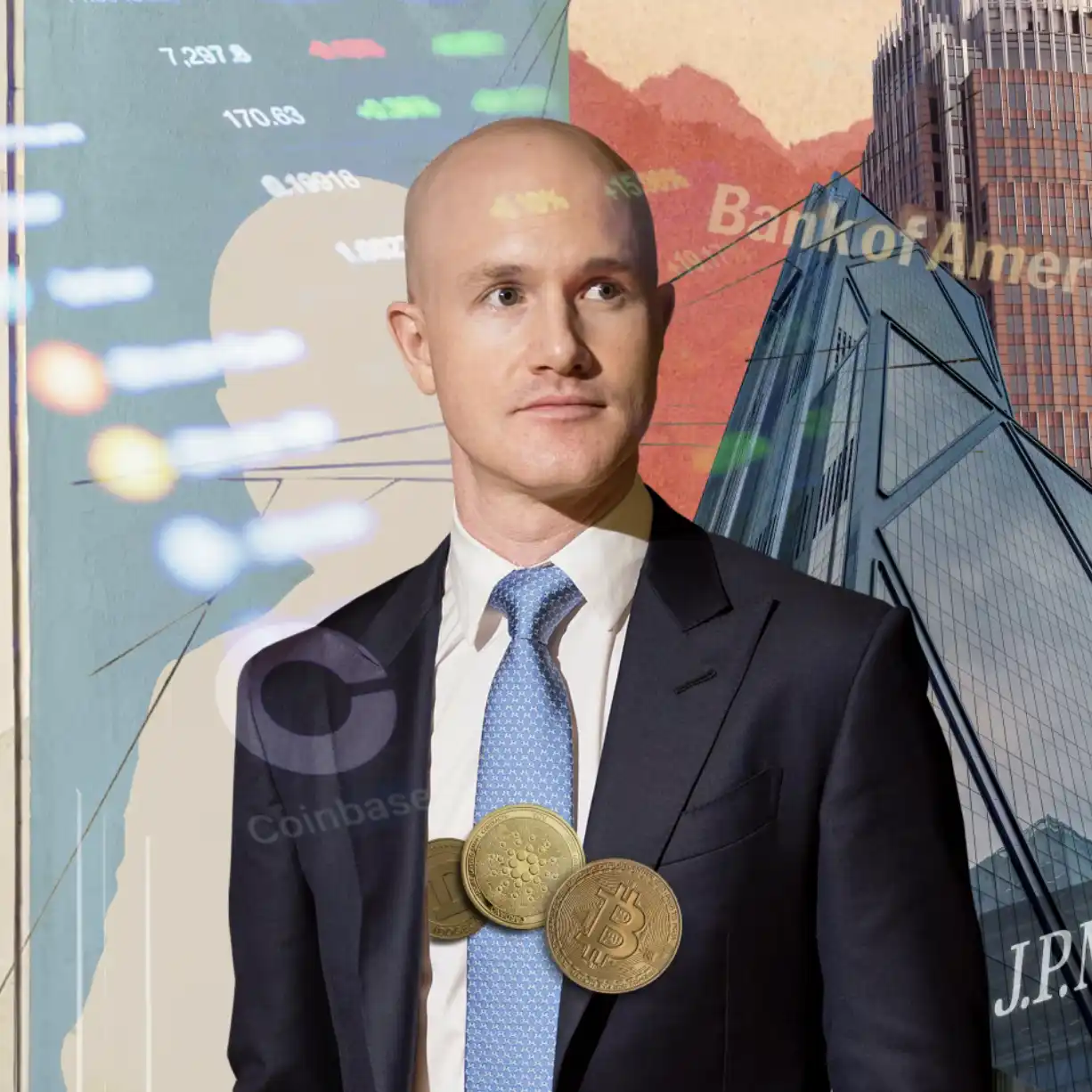
Last week, during the World Economic Forum in Davos, Switzerland, Brian Armstrong, CEO of the largest U.S. cryptocurrency company, was having coffee with former UK Prime Minister Tony Blair when Jamie Dimon suddenly interrupted.
"You're talking nonsense," said Jamie Dimon, who has long been skeptical of cryptocurrency and once called Bitcoin a "fraud," pointing his index finger directly at Armstrong's face.
According to sources, Dimon's core message was simple: for Armstrong to stop lying on TV. Just the week before, Armstrong accused banks of trying to undermine legislation on multiple business TV shows, legislation aimed at establishing a new regulatory framework for digital assets.
This open conflict was apparently not in line with the purpose of the Davos annual meeting to "promote global leadership cooperation."
As the crypto industry rapidly enters the mainstream U.S. financial system, some heavyweight figures on Wall Street have begun to realize that a threat is looming. Although banks have to some extent embraced crypto assets—such as assisting clients in investing in Bitcoin or using digital assets to enhance cross-border transfer efficiency—when crypto businesses touch their core territory, banks choose to draw a line: resident deposits.
Surrounding a key issue, banks and Coinbase are in direct conflict: whether crypto exchanges should be allowed to offer "yield on hold" to users. This so-called "reward" typically refers to regularly paying a certain percentage of return to stablecoin holders, such as a 3.5% annualized yield. Stablecoins are a type of digital asset pegged to real-world currencies like the U.S. dollar.
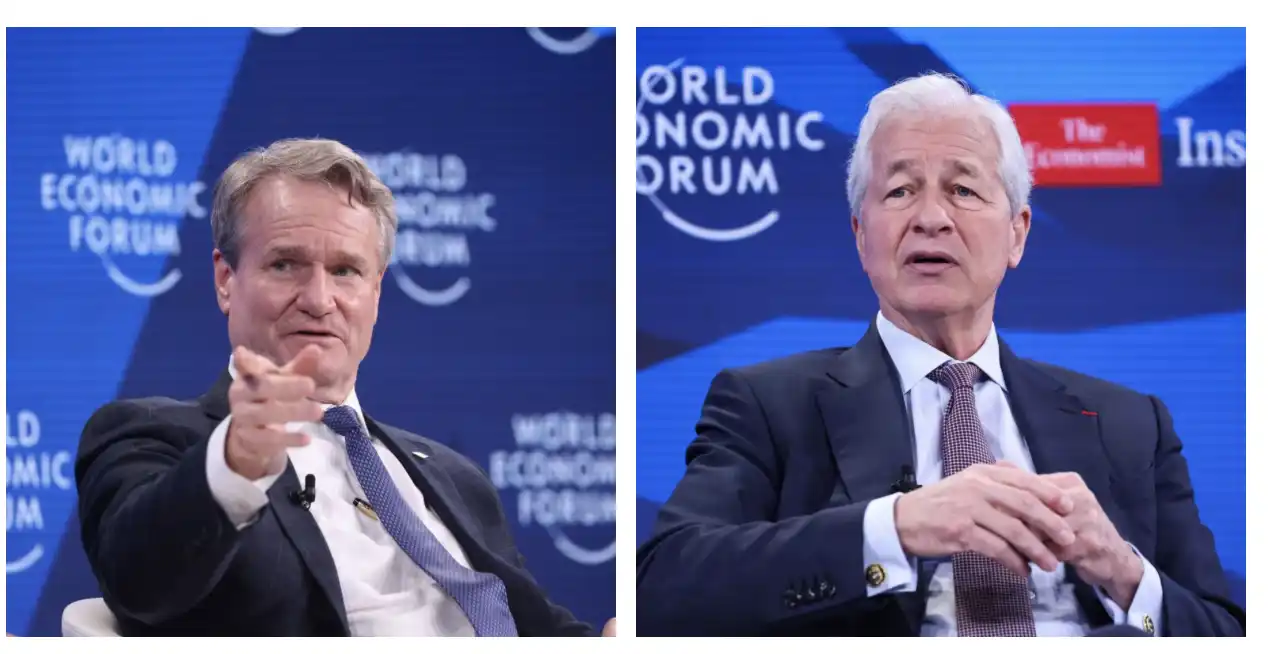
Bank of America CEO Brian Moynihan, and JPMorgan Chase CEO Jamie Dimon.
Banks argue that such user-facing rewards are fundamentally no different from interest on a bank account. Due to the much lower yield provided by banks — typically below 0.1% for savings accounts — they are concerned that the result will be a significant number of consumers moving funds into crypto assets. This outflow of funds, banks argue, will weaken the viability of community banks and impact lending to businesses.
On the other hand, Brian Armstrong and other crypto industry figures believe that the free market should prevail: banks could easily compete with stablecoins by offering higher deposit rates, or even enter the stablecoin business themselves.
This legislation, called the Clarity Act, could reshape the future of everyday financial services, including bank deposits and electronic payments.
According to sources, in the latest round of efforts to seek a compromise, the White House plans to convene a meeting on Monday between banking and crypto industry groups, with AI and Crypto Czar David Sacks from the Trump administration expected to attend. Coinbase's US policy chief Kara Calvert is also among the invitees.
43-year-old Armstrong co-founded Coinbase in 2012 and has played a key role in advancing the legitimacy and mainstream adoption of the crypto industry. As the head of a company valued at around $55 billion, Armstrong wields significant influence in industry debates, especially in this Washington showdown.
Just a day before a Senate committee was preparing to vote on a version of the bill that could substantially prohibit companies like Coinbase from offering yields to customers, potentially resulting in losses of billions of dollars, Armstrong posted on X platform: "We'd rather have no bill than a bad bill."
A few hours later, the vote was abruptly postponed, leaving the financial world surprised.
Ron Hammond, Head of Policy and Advocacy at digital asset trading firm Wintermute, stated: "Now it looks more like Coinbase against banks rather than the crypto industry against banks."
Armstrong's counterattack did not stop with the January 14th X post. He later reiterated his views on a TV show, stating in a Bloomberg interview that bank lobbyists were "trying to stifle competition" and accusing banks of "essentially taking their deposits and lending them out without customer permission."
According to sources familiar with the matter, these remarks directly led to a series of uncomfortable confrontations with several bank CEOs in Davos.
"If you want to be a bank, just go be a bank." Brian Moynihan said this last week during a 30-minute meeting with Armstrong at the main Davos venue. The meeting appeared friendly on the surface but somewhat tense.
Citigroup CEO Jane Fraser only gave Armstrong less than a minute. (Coinbase is a client of both Citigroup and JPMorgan and has business partnerships with multiple banks.)
And this "minute" was even more than what Wells Fargo CEO Charlie Scharf offered. When Armstrong approached him, Scharf bluntly stated that the two had "nothing to talk about." Dimon, Scharf's former boss, was nearby when this happened.
"Banking Disruptor"
Armstrong studied economics and computer science at Rice University in Houston and was an early advocate of digital currency and blockchain concepts. He read the Bitcoin whitepaper published by the pseudonymous Satoshi Nakamoto in 2008; during his time at Airbnb in 2011, he was frustrated by the difficulties of remitting money to South America.
These experiences paved the way for the creation of Coinbase. The company initially sought to address a core issue plaguing cryptocurrency investors: the lack of a secure place to store digital assets. Subsequently, as some users wished to do more than just "hodl" Bitcoin but to trade it, Coinbase naturally evolved into an exchange.
Coinbase quickly outgrew its humble beginnings in a small San Francisco apartment (the company's first office). By 2017, when another co-founder departed, Armstrong had become the company's undisputed leader.
Former colleagues previously told The Wall Street Journal that Armstrong is introverted, sometimes struggles to communicate with employees, and is not adept at giving direct criticism face-to-face to subordinates. Some former employees feel his management style is somewhat reminiscent of the calm and restrained Vulcans from "Star Trek."

2014 Brian Armstrong, CEO of Coinbase.
However, Armstrong's ambitions for Coinbase have never been hidden. He positioned Coinbase as the American company that would bring cryptocurrency into the mainstream. Today, Coinbase's business scope covers multiple areas from online payments and stock trading to commodities and prediction markets.
“Fundamentally, we want to be an alternative to a bank,” he said on a Fox Business show last year. “We want to build a super app to offer all kinds of financial services.”
With business expansion, Armstrong invested millions to build the largest lobbying machine in the industry. After experiencing several crypto market cycles of boom and bust, Coinbase went public in April 2021, reaching a market capitalization of up to $100 billion at one point, and Armstrong's personal stake briefly rising to around $13 billion.
After surviving the industry collapse of 2022 and regulatory pressure during the Biden administration in 2023, Armstrong began a strong counterattack and gradually found his own voice. The founder who once preferred to wear headphones, write code in the office, and was somewhat reluctant to speak publicly has now become the most active advocate for the cryptocurrency industry in Washington—and the U.S. political attitude towards cryptocurrency is undergoing a significant change.
Through a network of Super PACs, Coinbase invested around $75 million in the 2024 election cycle to counter skeptical candidates and build grassroots support for cryptocurrency-related bills. The Super PAC group announced on Wednesday that they currently have $193 million in funds.
Trump's victory in 2024 opened a policy window for Armstrong that he had been pursuing for a decade. He praised Trump for opening the “dawn of the crypto new era” and attended a “Crypto Ball” with performances by Snoop Dogg before and after Trump's inauguration. Now, this executive changes into a suit every two months at least, leaves his iconic t-shirt and black jacket behind, and goes to Capitol Hill to meet with politicians.
“In all matters related to cryptocurrency in the United States, Coinbase is at the forefront,” said Anthony Scaramucci, Founder of SkyBridge Capital and long-time crypto investor.
Last summer, Trump signed the Genius Act into law, paving the way for several companies to issue stablecoins. This law fueled rapid growth in stablecoin activity. The act prohibited issuers from directly paying interest to users but did not cover exchanges or third parties like Coinbase. This "omission" was seen by banking industry groups as a regulatory loophole and is precisely the flashpoint of the current conflict surrounding the Clarity Act.
The Long Road to Legislation
The House had already passed its version of the Clarity Act last year, but moving forward in the Senate was widely seen as more challenging, in part due to significant disagreements on which rules crypto companies should follow. The Senate Agriculture Committee, responsible for overseeing provisions related to the Commodity Futures Trading Commission, advanced its own version on Thursday. Lawmakers will still need to vote on a single text in the full Senate and reconcile it with the House version.
According to sources familiar with the matter, Brian Moynihan's core point to Armstrong is: If crypto companies like Coinbase wish to offer bank-like services, then in the eyes of many banks, they should bear an equivalent regulatory burden as banks. Regulatory bodies, including the Federal Reserve and the Office of the Comptroller of the Currency, review a bank's risk profile, conduct regular examinations of its operations, and set strict capital requirements for lending and investment.
"The controversy surrounding the 'reward mechanism' is actually an exception in our overall cooperation with banks," said Coinbase's Chief Policy Officer Faryar Shirzad. "We have a close partnership with banks and have announced multiple collaborations."
Coinbase has established a profitable partnership with stablecoin issuer Circle, allowing it to earn a significant revenue share from the mainstream stablecoin USDC. Through this unique arrangement, Coinbase is able to offer 3.5% yield to some USDC holders, which is unusual in the industry. The company stated that such incentives help attract users and provide consumers with more options in an environment of extremely low savings rates.
"There is no reason to prohibit paying interest to consumers," Armstrong said in an interview with The Wall Street Journal last year.
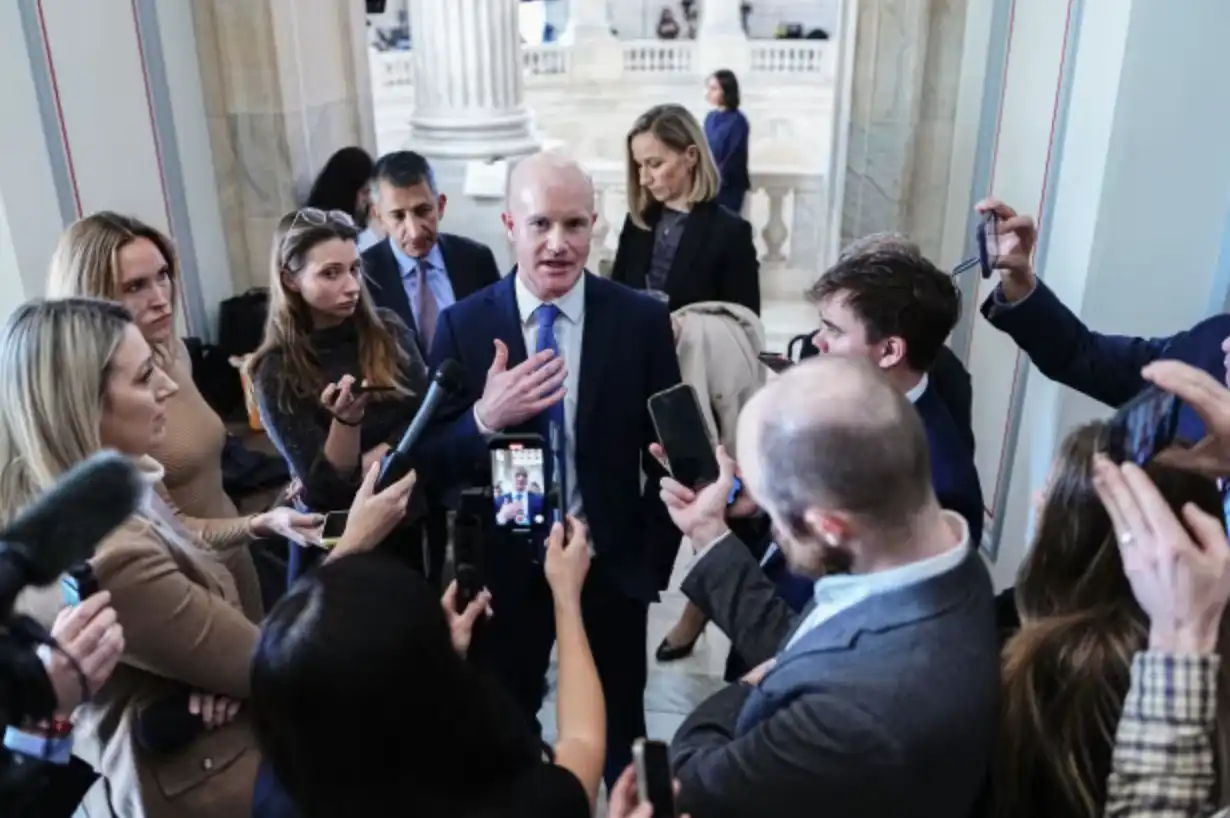
On January 15, 2026, Brian Armstrong appears on Capitol Hill.
As the Clarity Act gradually moves toward a Congressional vote, banks have begun behind-the-scenes intense lobbying. Citing a government estimate, banks claim that approximately $66 trillion in deposits could be "pulled out" from the traditional financial system if relevant restrictions are lifted. This lobbying quickly paid off: in this nearly 300-page draft bill, a series of provisions and potential amendments were added, which Armstrong sees as equivalent to a failure of the crypto industry. He promptly withdrew his support, and Senate Banking Committee Chairman Tim Scott (Republican, South Carolina) also postponed the scheduled vote a few hours later.
According to insiders, Armstrong has a plan on how to break the deadlock. He has suggested to Brian Moynihan that a new stablecoin issuer category be established: as long as they meet stricter regulatory standards, they would be allowed to pay interest to users. This way, banks could theoretically enter the competition under the same rules framework as Coinbase.
Other proposals advocate largely prohibiting interest payments but retaining a small set of exceptions for institutions like Coinbase.
Regardless of the final proposal, the legislation's advancement will almost certainly rely on Armstrong's endorsement.
"The current situation is that everyone believes whether this legislation will pass ultimately depends on whether Coinbase gives the nod," said Hilary Allen, a professor at the American University College of Law, a securities law expert, and also a crypto skeptic. "This is a truly shocking reality."
You may also like

Average Earnings per Person $90 Million, Earth's Biggest Private Buyer of Gold

Wall Street Giant 'Forces' SEC Showdown, Crypto Exemption Setback in January

Glassnode: Undercurrent Surges at $83k Resistance, BTC Enters Oscillating Accumulation "Deep Dive Zone"

Coinbase vs. Wall Street: Who Is Deciding the Next Move for the US Financial System?

Geopolitical Risk Escalation: US Stocks, Precious Metals Simultaneously 'Turn Tail,' Bitcoin Struggles to Hold $81,000

Key Market Information Discrepancy on January 30th - A Must-Read! | Alpha Morning Report
Risk Asset Rollercoaster, the World Is on Edge Over the US vs. Iran

Hong Kong-Based OSL Group Launches $200M Equity Raise for Stablecoin and Payments Expansion
Key Takeaways OSL Group, a prominent digital asset platform in Asia, has initiated a significant $200 million equity…

Gold Price Prediction: Current Trends and Future Outlook for January 28, 2026
Key Takeaways Gold and silver prices play a significant role in the global economy, reflecting both market trends…

Central Bank of the UAE Endorses First USD-Backed Stablecoin
Key Takeaways The UAE Central Bank has endorsed the first US dollar-backed stablecoin, USDU, to streamline compliant settlements…

Can the Gold Price Rise to $6,000?
Key Takeaways Gold prices in 2026 have experienced dramatic surges, reaching unprecedented levels in just the first month…
Bitcoin’s Historical Bottom Indicator Points to $62K – Could BTC Fall That Low?
Key Takeaways Bitcoin is nearing a critical support level of \$62,000, with key indicators suggesting potential further declines.…

Talos Raises $45M Series B Extension Backed by Robinhood, Bringing Total Funding to $150M
Key Takeaways: Talos, a leading provider of institutional digital asset trading technology, has raised $45 million in a…
What is the Next Milestone for Gold Prices and Will It Reach $6,000 by Year End?
Key Takeaways: Gold prices recently crossed the $5,000 per ounce mark, spurring predictions of further increases amidst global…

Bitcoin Price Prediction: Binance Inflows Just Hit a 4-Year Low – Violent Move Above $100K is Next
Key Takeaways: Bitcoin inflows into Binance have dropped to their lowest in four years, potentially signaling a tight…

Gold to $10,000 and Silver to $150: My Wild, Or Perhaps Not-So-Wild 2026 Price Predictions
Key Takeaways Geopolitical uncertainties are significantly driving up the demand for gold and silver, suggesting the prices may…

Hong Kong Enhances Gold Market Access Through Hang Seng Gold ETF and Tokenized Units
Key Takeaways: The Hang Seng Gold ETF offers Hong Kong investors direct access to gold by launching a…

Russia Caps Crypto Investments at $4,000 Annually for Non-Qualified Investors – Will Others Follow Suit?
Key Takeaways Russia’s proposal sets a $4,000 annual investment limit for non-qualified crypto investors, sparking discussions on regulatory…


 App
App