
ZetaChain Integrates Claude Opus 4.7 to Power Cross-Chain AI Agent

 Prefer us on Google


The pace of AI and Web3 integration is accelerating, and ZetaChain is moving quickly to stay ahead. Just 24 hours after Anthropic released Claude Opus 4.7 on April 16, 2026, ZetaChain rolled out a native integration.
This isn’t just another AI partnership announcement. It signals a shift toward blockchains that are designed to work with AI agents by default. With this update, developers can build applications where AI operates across multiple chains—without relying on bridges or fragmented infrastructure.
As interest in AI-driven crypto projects continues to grow, ZetaChain’s approach is starting to draw attention from both developers and traders. In this article, we’ll break down what this integration actually does, why it matters, and how you can trade ZETA on WEEX.
What Is ZetaChain?
ZetaChain positions itself as a “universal” Layer 1, built to connect different blockchains under one system. Instead of deploying separate versions of an app on Ethereum, Solana, or Bitcoin, developers can build once and interact across chains.
The key idea here is chain abstraction. Rather than moving assets through bridges, ZetaChain allows smart contracts to interact with multiple chains directly. That removes one of the biggest weak points in DeFi—bridge exploits.
Its 2.0 upgrade, launched in early 2026, introduced several building blocks that made this possible:
- A universal app layer for cross-chain deployment
- A private memory layer for storing state (important for AI agents)
- Developer tools that simplify cross-chain logic
The Claude integration builds on top of this, adding intelligence to the infrastructure.
What Claude Opus 4.7 Brings
Claude Opus 4.7 is one of the more advanced AI models currently available, especially for tasks that require reasoning over large datasets or multi-step execution.
A few capabilities stand out for Web3 use:
- A very large context window, allowing it to process complex multi-chain data
- Strong performance in coding and automation tasks
- More stable long-running reasoning compared to earlier versions
In practical terms, this means AI agents can handle more complex instructions without breaking them into smaller steps or relying heavily on human input.
How the Integration Works
Instead of connecting to AI through external APIs, ZetaChain embeds Claude Opus 4.7 directly into its AI layer.
This allows agents to:
- Read data from multiple blockchains at the same time
- Execute transactions across chains within a single workflow
- Keep track of past actions using persistent memory
For example, a developer could create an agent that manages assets across Ethereum and Solana. The agent could monitor prices, move funds, and rebalance positions without switching environments or tools.
That level of coordination is difficult to achieve with traditional cross-chain setups.
A Shift Toward Cross-Chain AI Agents
What’s emerging here is a new category of applications—AI agents that operate across multiple blockchains.
These aren’t just simple bots. They can:
- Manage portfolios across chains
- Look for arbitrage opportunities between ecosystems
- Optimize yield strategies
- Monitor risk exposure in real time
Until now, most of this required separate tools, manual coordination, or complex infrastructure. ZetaChain is trying to bring it into a single environment.
What It Means for Developers and the Market
For developers, this lowers the barrier to building cross-chain applications. Instead of dealing with multiple SDKs and bridge logic, they can focus on what the application actually does.
For the market, it adds another layer to the AI-crypto narrative that has been building throughout 2026. Projects that can combine real utility with AI capabilities tend to attract more attention—but that also means expectations are higher.
ZETA, the native token, has seen increased activity around these developments. Like many assets tied to emerging narratives, it tends to move with both news flow and overall market sentiment.
How to Trade ZETA on WEEX
If you’re looking to trade ZETA, WEEX offers access to the ZETA/USDT pair with a straightforward setup.
Here’s how to get started:
- Create a WEEX account
- Complete identity verification
- Deposit USDT or another supported asset
- Go to the spot market and search for ZETA/USDT
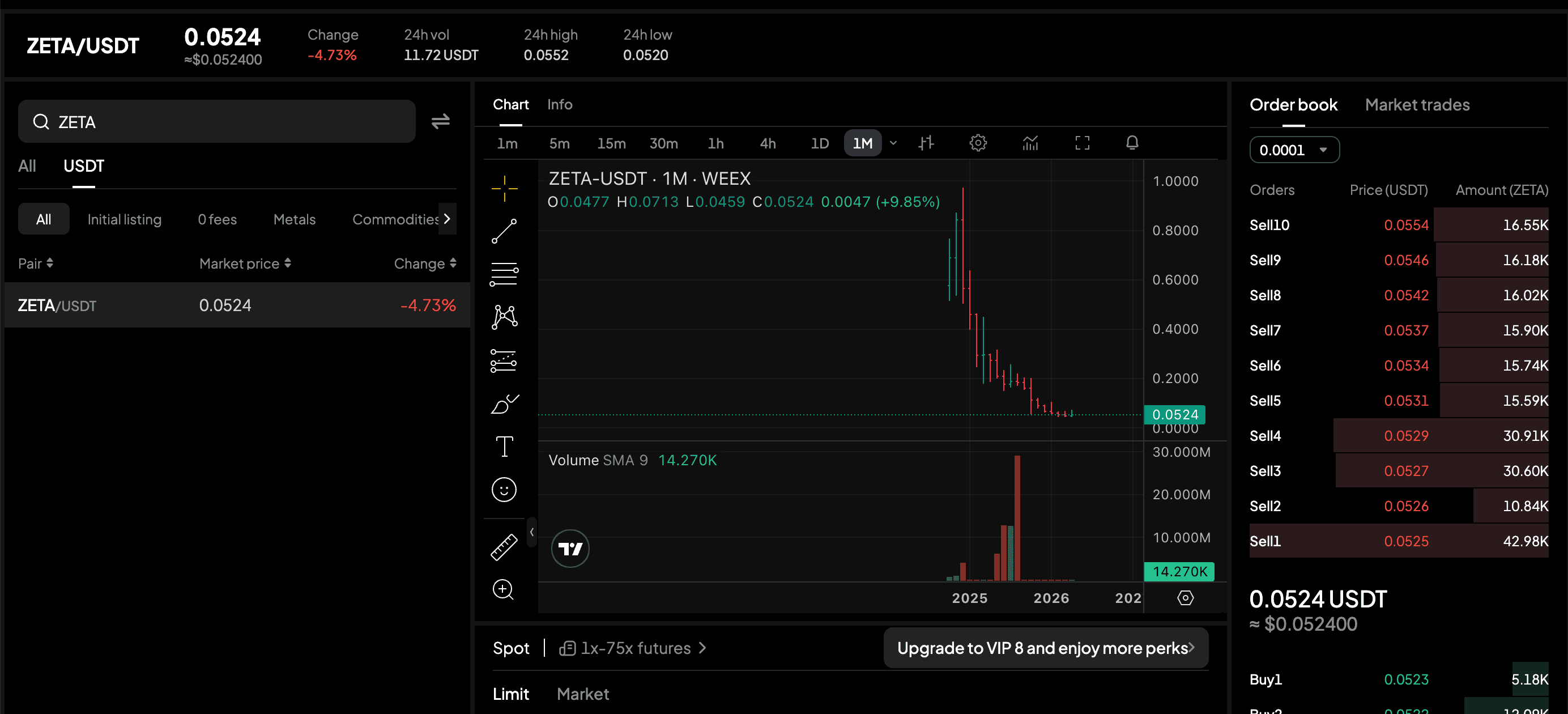
- Choose your order type and place the trade
WEEX also supports futures trading and strategy tools like grid trading, which can be useful when the market is moving quickly.
Frequently Asked Questions (FAQ)
What makes ZetaChain different from other cross-chain solutions?
ZetaChain uses chain abstraction instead of bridges, allowing applications to interact across multiple blockchains without moving assets through separate systems.
What does the Claude Opus 4.7 integration actually enable?
It allows AI agents to read, reason, and act across multiple chains within one environment, including executing transactions and managing state over time.
When did this integration happen?
ZetaChain integrated Claude Opus 4.7 within 24 hours of its release in April 2026.
What is ZETA used for?
ZETA is the native token used for transaction fees, staking, and network operations within the ZetaChain ecosystem.
Where can I trade ZETA?
You can trade ZETA on WEEX using the ZETA/USDT pair, with both spot and derivatives options available.
Conclusion
ZetaChain’s integration of Claude Opus 4.7 highlights how quickly AI and blockchain infrastructure are starting to converge. Instead of treating AI as an external tool, platforms are beginning to build it directly into their core systems.
Whether this approach becomes a standard for future Web3 applications will depend on real-world adoption. But it does point to a direction where cross-chain interaction and AI automation are more tightly connected.
Risk Disclaimer
This content is for informational purposes only and does not constitute financial advice. Cryptocurrency markets are volatile and involve risk. Always do your own research before making trading decisions.
Disclaimer: This content is provided for general branding and informational purposes only and doesn't constitute financial, investment, legal, or tax advice. Any events, rewards, online events, or related information mentioned herein should not be considered a recommendation, solicitation, or invitation to purchase, sell, trade, or otherwise deal in any crypto assets or to use any services. Crypto assets are highly volatile and may result in loss. WEEX services and online events may not be available in all regions and are subject to applicable laws, regulations, and eligibility requirements. You are responsible for ensuring that your use of WEEX services complies with local laws and for carefully assessing the risks before participating in any crypto-related activities.
You may also like
How to Use Grok AI for Crypto Trading: A Practical Guide for 2026
Polymarket vs. Kalshi: Which Prediction Market Platform Survives the Regulatory Crackdown?
How to Read Prediction Market Odds: A Complete Beginner's Guide

What Is Liquidity in Prediction Markets and Why Does It Matter?
How Accurate Are Prediction Markets? What the Research Actually Says
Is Polymarket Legal in the US? What the CFTC Approval Actually Means
Tokenization in Crypto vs Data Security: What Is Tokenization and How Both Protect Your Assets?
Can Crypto Copy Trading Really Make You Money? Is Copy Trading Legit or Scam? Full Guide to WEEX Copy Trading

Play-to-Earn Crypto Games: Complete Guide to P2E Gaming in 2026
How to Buy U.S. Stocks on WEEX: A Complete 2026 Guide to Trading with USDT

What Is TradFi? How Traditional Finance and Crypto Are Converging in 2026
WXT Token Total Supply: How WEEX Token Supply and Burns Work
WXT to USDT: A Beginner's Guide to Converting WEEX Token into USDT

What Is MetaMask? A Complete Guide to the World's Most Popular Web3 Wallet
How to Trade Presidential Election Betting Odds in 2026: The Complete Guide
What Is the US Election Prediction Market? How to Trade on Trump Odds in 2026
Top 4 Altcoins to Buy in July 2026: Top Crypto Picks for Investors
Who Is Jensen Huang? Nvidia CEO's Net Worth, Biography & NVDA Stock Analysis 2026. Is NVDA Stock a Good Buy Right Now?
Prediction Market Regulation: Polymarket, Kalshi and Future Trends
Polymarket vs Kalshi: The Future of Prediction Markets Explained
Polymarket vs Kalshi: The Future of Prediction Markets Explained
Prediction Market Arbitrage Explained: How Traders Find Profits

How Polymarket Market Making Works: Risks and Profit Strategies
What Is a Prediction Market? Complete 2026 Guide to Polymarket, Kalshi & Crypto Betting Platforms
Nvidia vs Microsoft Stock 2026: Which AI Giant Is the Better Buy in July?
MicroStrategy's STRC Unpegged: Buy the Dip or Brace for Impact?
How to Buy Cryptocurrency on WEEX Exchange 2026: Full Guide
Prediction Market Apps 2026: How Prediction Markets Work? Are They Safe and Legal?
Is Polymarket Legal in India in 2026? Key Legal Updates on Prediction Markets
14 Best Prediction Market Apps in 2026: The Ultimate Guide to Crypto-Native and Regulated Platforms
How to Use Grok AI for Crypto Trading: A Practical Guide for 2026
Polymarket vs. Kalshi: Which Prediction Market Platform Survives the Regulatory Crackdown?
How to Read Prediction Market Odds: A Complete Beginner's Guide
What Is Liquidity in Prediction Markets and Why Does It Matter?
How Accurate Are Prediction Markets? What the Research Actually Says
Is Polymarket Legal in the US? What the CFTC Approval Actually Means
Contents
Popular coins
Latest articles