
Prediction Market Arbitrage Explained: How Traders Find Profits

 Prefer us on Google
Prediction markets are moving beyond their old image as online betting platforms. They are developing into financial systems that transform uncertainty, public information, and future expectations into tradable probability markets.
This article explains how prediction market arbitrage works, why opportunities exist on platforms like Polymarket, and what risks traders should understand before analyzing these markets. It is designed for crypto users, Web3 researchers, and beginners interested in probability-based trading models.
KEY TAKEAWAYS
- Prediction market arbitrage comes from price inefficiencies between probability-based contracts, not from simply guessing event outcomes.
- Platforms like Polymarket turn future events into tradable markets where YES and NO contracts represent collective probability expectations.
- Common prediction market arbitrage strategies include YES/NO mispricing, multi-outcome arbitrage, cross-platform differences, and event structure arbitrage.
- Although some opportunities appear “risk-free” mathematically, traders still face execution risk, liquidity problems, and settlement uncertainty.
- Prediction markets are becoming a new financial layer for information discovery, where arbitrage helps prices move closer to real probabilities.
What Is a Prediction Market?
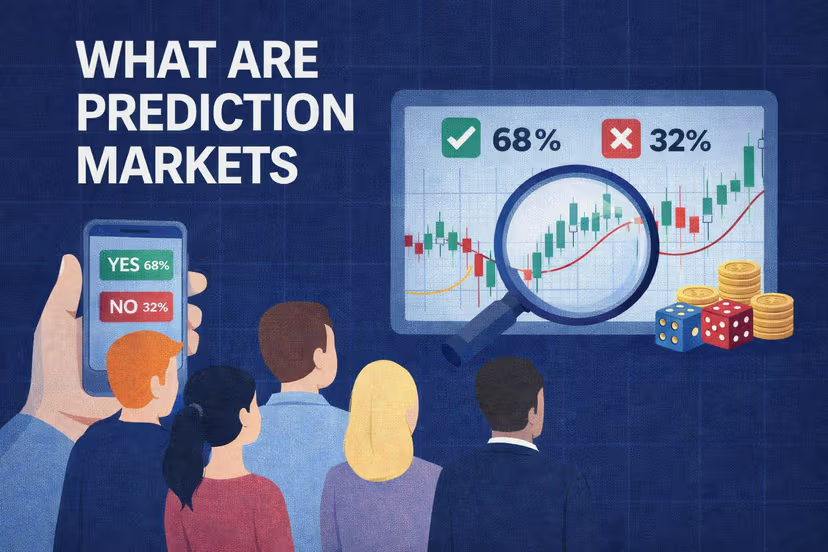
A prediction market is a trading system where users buy and sell contracts based on future event outcomes.
Instead of trading traditional assets such as stocks or cryptocurrencies, participants trade the probability of whether an event will happen.
A simple binary market usually contains two outcomes:
| Contract | Result |
|---|---|
| YES | Pays $1 if the event happens |
| NO | Pays $1 if the event does not happen |
The contract price represents the market’s implied probability.
For example, if a YES contract trades at $0.65, the market roughly suggests a 65% probability that the event will occur.
If a trader buys YES at $0.40 and the event happens, the contract settles at $1. If the event fails, the contract becomes worthless.
From a financial perspective, this structure is similar to an Arrow-Debreu security, where assets pay based on specific future states.
Prediction Market vs Gambling: Why They Are Different
Prediction markets are often compared with gambling, but their underlying mechanisms are different.
Traditional betting systems rely on a centralized operator setting odds. The bookmaker manages exposure, adjusts prices, and usually builds a long-term mathematical advantage.
Prediction markets operate through user-driven price discovery.
| Feature | Traditional Betting | Prediction Market |
|---|---|---|
| Pricing | Operator sets odds | Market supply and demand |
| Counterparty | Player vs house | Trader vs trader |
| Price changes | Controlled adjustment | Continuous trading |
| Exit | Often locked until result | Positions can be traded |
Platforms like Polymarket function more like probability exchanges. Users express beliefs through trades, and market prices continuously adjust as new information appears.
How Prediction Market Prices Reflect Information
The core idea behind prediction markets is simple: prices aggregate information.
Different traders may have different:
- Research methods
- Data models
- Opinions
- Private insights
When they trade, their beliefs influence prices.
If a market significantly misprices an event, participants with stronger information may buy undervalued contracts or sell overpriced ones.
Over time, this competition pushes prices closer to collective expectations.
This is why prediction markets are often studied as tools for forecasting elections, economic events, technology trends, and social outcomes.
Where Does Prediction Market Arbitrage Come From?
In a perfectly efficient market, arbitrage should disappear quickly.
However, real prediction markets are still developing. Inefficiencies exist because of:
- Fragmented liquidity
- Different user knowledge levels
- Emotion-driven trading
- Limited automated market making
- Separate platforms with different user groups
These factors create temporary price gaps that traders attempt to capture.
Prediction market arbitrage is not about predicting the future. It focuses on finding mathematical inconsistencies between related contracts.
YES and NO Arbitrage: The Basic Strategy
The simplest prediction market arbitrage comes from binary markets.
For a two-result event:
YES probability + NO probability should equal 100%.
In theory:
YES + NO = $1
However, market inefficiencies sometimes create situations where:
YES + NO < $1
Example:
| Contract | Price |
|---|---|
| YES | $0.48 |
| NO | $0.49 |
| Total Cost | $0.97 |
A trader buying both outcomes spends $0.97.
Since either YES or NO must settle at $1, the difference creates a theoretical $0.03 profit.
These opportunities are usually small and disappear quickly because automated trading systems search for them.
Multi-Outcome Prediction Market Arbitrage
Some prediction markets contain more than two outcomes.
Examples include:
- Election winners
- Award results
- Tournament outcomes
The same principle applies.
All possible outcomes should add up to approximately 100%.
If the combined cost of buying every possible outcome is below $1, a full-coverage arbitrage opportunity may exist.
However, execution is harder because traders must complete all positions before prices change.
Small markets may also lack enough liquidity to fill every order.
Cross-Platform Prediction Market Arbitrage
Another strategy comes from price differences between platforms.
For example:
Platform A:
YES = $0.60
Platform B:
YES = $0.70
A trader may attempt to buy the cheaper side and hedge using another platform.
The reason these gaps exist is that prediction markets are not fully connected. Different platforms may have different users, liquidity levels, and regional communities.
However, cross-platform arbitrage includes additional challenges:
- Transfer delays
- Trading fees
- Settlement differences
- Account restrictions
The price gap must be large enough to compensate for these costs.
Structural Arbitrage: Finding Logical Price Errors
More advanced traders analyze relationships between related markets.
For example:
Market A:
“Will interest rates decrease this year?”
Market B:
“Will interest rates decrease in March, June, September, or December?”
The probabilities between these markets should have a logical relationship.
If individual event markets imply a very different probability from the broader market, traders may identify a structural pricing mismatch.
This type of arbitrage depends more on understanding event relationships rather than simple calculations.
Why Prediction Market Arbitrage Opportunities Still Exist
Prediction markets remain younger and less efficient compared with mature financial markets.
Large traditional markets have:
- Professional institutions
- Deep liquidity
- Advanced algorithms
- Fast arbitrage systems
Prediction markets still include many retail participants who trade based on personal beliefs, emotions, or narratives.
This creates inefficiencies.
In some ways, today’s prediction markets resemble early commodity and futures markets before institutional participation increased.
The Hidden Risks of Prediction Market Arbitrage
Prediction market arbitrage is often described as low-risk, but “theoretical profit” does not always mean guaranteed profit.
Important risks include:
| Risk | Explanation |
|---|---|
| Execution risk | One side fills while another fails |
| Liquidity risk | Orders may move before completion |
| Settlement risk | Event rules may create disputes |
| Platform risk | Technical or regulatory problems |
| Capital efficiency | Returns may be small after costs |
Professional arbitrage usually requires automation, strict risk management, and careful market selection.
Final Thoughts: Prediction Markets as Probability Infrastructure
Prediction markets are not only about winning or losing predictions.
Their larger role is creating a marketplace for uncertainty.
They allow people to trade expectations, reveal information, and turn probability into a financial signal.
Arbitrage is not simply a loophole. It is one of the mechanisms that helps prediction markets become more efficient by correcting inaccurate prices.
As prediction markets continue growing, better liquidity systems, advanced trading models, and professional participants may continue shaping this new information-driven market category.
Users interested in crypto ecosystem developments can also learn about WEEX Token (WXT). New users may explore available platform incentives such as the WEEX welcome bonus, including rewards related to account activities and trading participation.
FAQ
1. What is prediction market arbitrage?
Prediction market arbitrage is a strategy that looks for pricing differences between related outcome contracts. Traders attempt to capture these gaps without relying only on predicting the final result.
2. How does Polymarket arbitrage work?
Polymarket arbitrage usually involves finding mismatches between YES and NO contracts, related events, or prices across different prediction markets. Execution speed and liquidity are important factors.
3. Are prediction markets the same as gambling?
Prediction markets differ because prices are determined by participants through trading rather than fixed by a centralized bookmaker. They operate more like probability exchanges.
4. Is prediction market arbitrage risk-free?
No. Even when a trade appears mathematically profitable, traders may face execution delays, liquidity problems, fees, or settlement uncertainty.
5. Why do arbitrage opportunities appear in prediction markets?
They appear because prediction markets are still developing. Differences in liquidity, information, user behavior, and platform separation can create temporary pricing errors.
Disclaimer: This content is provided for general informational and educational purposes only and should not be considered financial, investment, legal, or tax advice. Nothing in this article constitutes an offer, recommendation, solicitation, or invitation to buy, sell, or trade any crypto asset or use any specific service. Crypto assets are highly volatile and involve a high degree of risk. You may lose some or all of the value of your investment and should not invest funds you cannot afford to lose. WEEX services may not be available in all regions and are subject to applicable laws, regulations, and user eligibility requirements. Please carefully assess risks and confirm local requirements before making any financial decisions.
Disclaimer: This content is provided for general branding and informational purposes only and doesn't constitute financial, investment, legal, or tax advice. Any events, rewards, online events, or related information mentioned herein should not be considered a recommendation, solicitation, or invitation to purchase, sell, trade, or otherwise deal in any crypto assets or to use any services. Crypto assets are highly volatile and may result in loss. WEEX services and online events may not be available in all regions and are subject to applicable laws, regulations, and eligibility requirements. You are responsible for ensuring that your use of WEEX services complies with local laws and for carefully assessing the risks before participating in any crypto-related activities.
You may also like

How to Use Grok AI for Crypto Trading: A Practical Guide for 2026
Polymarket vs. Kalshi: Which Prediction Market Platform Survives the Regulatory Crackdown?

How to Read Prediction Market Odds: A Complete Beginner's Guide

What Is Liquidity in Prediction Markets and Why Does It Matter?
How Accurate Are Prediction Markets? What the Research Actually Says
Is Polymarket Legal in the US? What the CFTC Approval Actually Means

Tokenization in Crypto vs Data Security: What Is Tokenization and How Both Protect Your Assets?

Can Crypto Copy Trading Really Make You Money? Is Copy Trading Legit or Scam? Full Guide to WEEX Copy Trading

Play-to-Earn Crypto Games: Complete Guide to P2E Gaming in 2026

How to Buy U.S. Stocks on WEEX: A Complete 2026 Guide to Trading with USDT

What Is TradFi? How Traditional Finance and Crypto Are Converging in 2026

WXT Token Total Supply: How WEEX Token Supply and Burns Work
WXT to USDT: A Beginner's Guide to Converting WEEX Token into USDT

What Is MetaMask? A Complete Guide to the World's Most Popular Web3 Wallet
How to Trade Presidential Election Betting Odds in 2026: The Complete Guide
What Is the US Election Prediction Market? How to Trade on Trump Odds in 2026
Top 4 Altcoins to Buy in July 2026: Top Crypto Picks for Investors
Who Is Jensen Huang? Nvidia CEO's Net Worth, Biography & NVDA Stock Analysis 2026. Is NVDA Stock a Good Buy Right Now?
Prediction Market Regulation: Polymarket, Kalshi and Future Trends

Polymarket vs Kalshi: The Future of Prediction Markets Explained
Polymarket vs Kalshi: The Future of Prediction Markets Explained

How Polymarket Market Making Works: Risks and Profit Strategies
What Is a Prediction Market? Complete 2026 Guide to Polymarket, Kalshi & Crypto Betting Platforms
Nvidia vs Microsoft Stock 2026: Which AI Giant Is the Better Buy in July?
MicroStrategy's STRC Unpegged: Buy the Dip or Brace for Impact?
How to Buy Cryptocurrency on WEEX Exchange 2026: Full Guide
Prediction Market Apps 2026: How Prediction Markets Work? Are They Safe and Legal?
Is Polymarket Legal in India in 2026? Key Legal Updates on Prediction Markets
14 Best Prediction Market Apps in 2026: The Ultimate Guide to Crypto-Native and Regulated Platforms
Can Politicians Rig Election Prediction Markets? The Dark Side of Election Prediction Markets
How to Use Grok AI for Crypto Trading: A Practical Guide for 2026
Polymarket vs. Kalshi: Which Prediction Market Platform Survives the Regulatory Crackdown?
How to Read Prediction Market Odds: A Complete Beginner's Guide
What Is Liquidity in Prediction Markets and Why Does It Matter?
How Accurate Are Prediction Markets? What the Research Actually Says
Is Polymarket Legal in the US? What the CFTC Approval Actually Means
Contents
Popular coins
Latest articles






