What Is an Automated Market Maker (AMM)?

By: WEEX|2026-04-22 16:30:00
0
Share
copy

An Automated Market Maker (AMM) is a decentralized exchange mechanism that prices swaps automatically. In a traditional exchange, buyers and sellers post bids and asks to an order book. A matching engine executes trades when prices line up. In an AMM, there is no need for that direct counterparty. The counterparty is the liquidity pool itself.

A liquidity pool is a smart contract that holds two or more assets. For example, an ETH/USDC pool holds ETH on one side and USDC on the other. Liquidity providers deposit assets into the pool and, in return, may receive a share of trading fees. Traders use the pool to swap one asset for another.
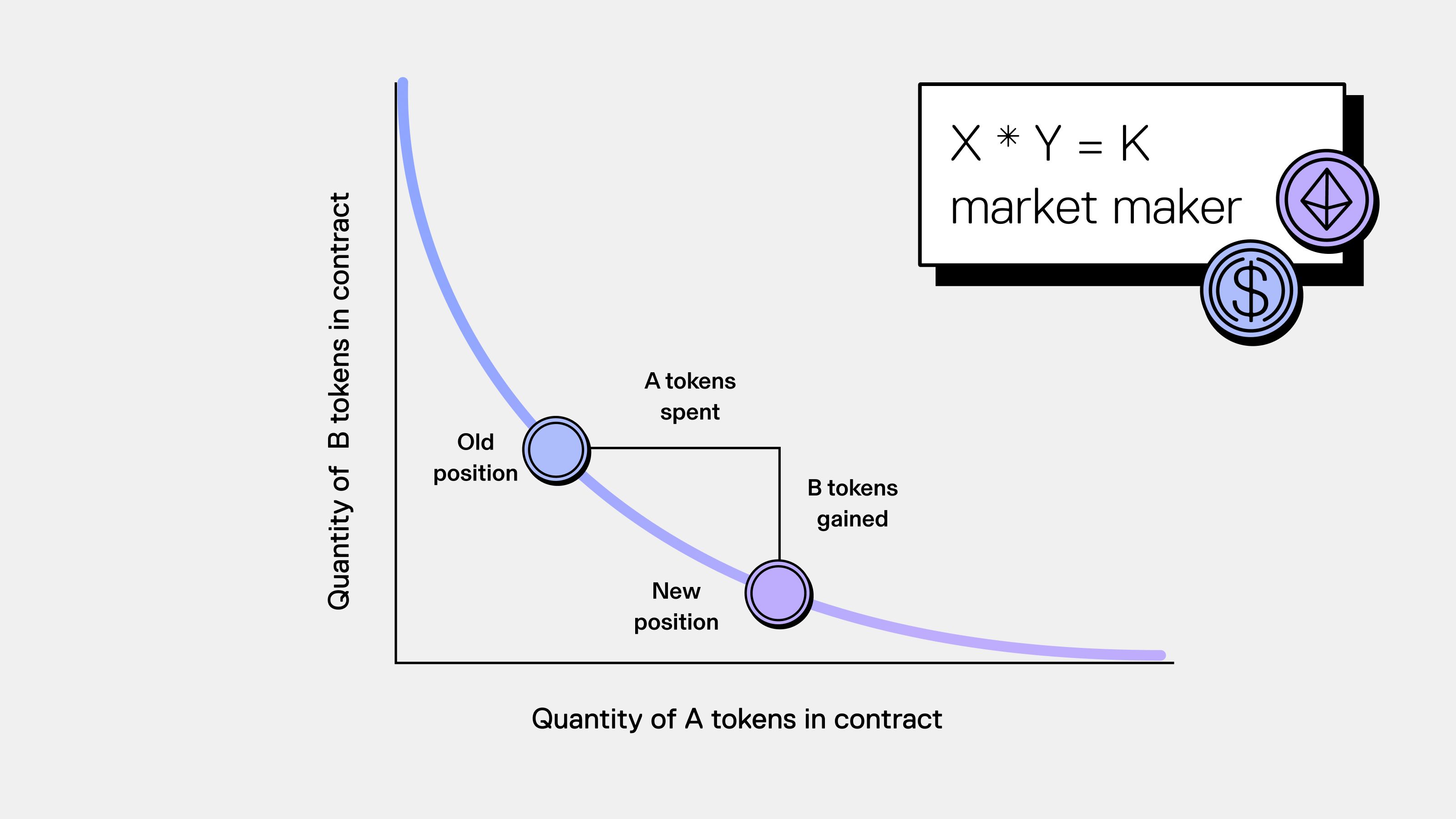
What Is an Automated Market Maker (AMM)?swap price impact between token A and token B.jpg">

AMMs are most closely associated with decentralized exchanges, or DEXs. If you are new to the category, WEEX's page on Decentralized Exchange (DEX) is a useful companion concept because it explains the broader trading venue that AMMs often power.

How an Automated Market Maker Works

Most AMMs have three moving parts:

  • A liquidity pool that stores reserves of tokens.

  • A pricing formula that adjusts the exchange rate as pool balances change.

  • Liquidity providers who supply assets and may earn fees from swaps.

The classic formula is the constant product model:

x * y = k

In this formula, x is the amount of one token in the pool, y is the amount of the other token, and k is the constant product that the pool tries to preserve. When a trader buys token X from the pool, the pool's supply of X decreases and its supply of Y increases. Because the pool must preserve the relationship between the two reserves, the price of X rises as it becomes scarcer inside the pool.

Here is a simplified example. Suppose a pool holds 100 ETH and 300,000 USDC. The implied pool price is roughly 3,000 USDC per ETH before fees and price movement. If a trader buys a large amount of ETH, the ETH side of the pool shrinks. The AMM must quote a higher average price for each additional unit because the pool is being pushed away from balance. That difference between the expected price and the executed average price is price impact.

In practice, arbitrage traders help keep AMM prices close to broader market prices. If the AMM price drifts too far from centralized exchange prices or other DEX pools, arbitrageurs can trade against the pool until the spread narrows. This is useful for price alignment, but it does not remove execution risk for ordinary users.

AMM vs Order Book: The Key Difference

The main difference is where liquidity comes from. In an order-book exchange, liquidity comes from posted buy and sell orders. In an AMM, liquidity comes from token reserves inside smart contracts.

FeatureAutomated Market Maker (AMM)Order-book exchange
Liquidity sourceLiquidity pools funded by LPsBids and asks from traders and market makers
Trade counterpartySmart contract poolAnother order or market maker
PricingFormula-based, driven by pool ratiosMarket-driven, driven by posted orders
Common useDEX swaps and DeFi appsCentralized spot, futures, and advanced trading
Main execution riskPrice impact, slippage, thin poolsSpread, order-book depth, failed fills

Neither model is automatically better. AMMs are powerful for permissionless on-chain swaps, especially when a token does not yet have deep centralized exchange liquidity. Order books are often more familiar for active traders who need limit orders, visible depth, and tighter execution on liquid markets. Readers who want to compare the order-book side can explore WEEX Spot after understanding how AMM execution differs.

Why AMMs Matter in DeFi

AMMs matter because they turned liquidity into open infrastructure. Before AMMs, decentralized exchanges struggled because thin order books made trading slow and inefficient. AMMs changed the problem by letting anyone create a pool and letting traders interact directly with that pool.

That matters for several reasons:

  • New tokens can become tradable without waiting for a centralized listing.

  • Liquidity providers can participate in market making without running a professional trading desk.

  • DeFi apps can compose with AMM pools for swaps, routing, collateral management, and yield strategies.

  • Markets can stay available 24/7 as long as the underlying blockchain and smart contracts operate.

This is why AMMs sit at the center of the wider Decentralized Finance (DeFi) stack. Lending markets, yield vaults, wallets, and portfolio tools often rely on AMM liquidity directly or indirectly.

-- Price

--

Benefits of an Automated Market Maker

The biggest benefit of an Automated Market Maker (AMM) is continuous access. A trader does not need to wait for a matching seller. If the pool has enough liquidity, the trade can execute against the pool.

AMMs also lower the barrier to liquidity provision. In traditional markets, market making is usually a specialized business with infrastructure, inventory management, and risk systems. In DeFi, a liquidity provider can deposit token pairs into a pool and earn a portion of fees, though that does not mean the strategy is simple or low risk.

Another benefit is transparency. Pool reserves, fee tiers, token contracts, and many swap paths are visible on-chain. This does not make every pool safe, but it gives users more raw information than they would have in a closed system.

The final benefit is composability. AMM pools can plug into other smart contracts. Wallets, aggregators, lending protocols, and portfolio dashboards can route through them. That is one reason AMMs became a base layer for DeFi rather than just a trading feature.

Risks: Slippage, Impermanent Loss, and Smart Contract Exposure

The most common trader-side risk is slippage. Slippage is the difference between the price a user expects and the price they actually receive when the transaction executes. In AMMs, slippage can happen because the trade itself moves the pool price, or because other transactions hit the pool before yours confirms.

Price impact is related but not identical. Price impact comes from your trade size relative to the pool's depth. If you trade $1,000 against a deep ETH/USDC pool, price impact may be small. If you trade the same amount against a shallow new-token pool, the average execution price can move sharply.

For liquidity providers, impermanent loss is the risk that providing assets to a pool leaves them with a lower value than simply holding the same assets outside the pool. The word "impermanent" can be misleading. If the provider withdraws when token prices have diverged, the loss becomes realized. Trading fees may offset it, but they may not.

WEEX's Liquidity Mining entry is relevant here because many users first encounter AMM pools through reward campaigns. The practical rule is simple: do not evaluate liquidity provision only by headline rewards. Check token volatility, pool depth, fee volume, lockup rules, smart contract risk, and whether one token in the pair could collapse faster than fees can compensate.

Smart contract risk also matters. AMMs run on code. Bugs, admin-key issues, oracle manipulation, malicious tokens, and bridge exposure can all turn a normal-looking pool into a loss event. This is why experienced DeFi users check contract addresses, audits, permissions, and pool history before approving tokens or supplying liquidity.

Types of AMMs

Not every Automated Market Maker (AMM) uses the same design. The constant product model is the best-known version, but newer models try to solve specific weaknesses.

Constant product AMMs use x * y = k. They are simple, durable, and good for general token pairs, but large trades can face high price impact when liquidity is thin.

Stable swap AMMs are designed for assets that should trade near the same value, such as stablecoin pairs or wrapped versions of the same asset. They concentrate liquidity around the expected price range, which can reduce slippage for similar assets.

Weighted AMMs allow more flexible pool weights, such as 80/20 instead of 50/50. This can give liquidity providers different asset exposure, though it changes the pool's risk and slippage profile.

Concentrated liquidity AMMs let LPs provide liquidity inside chosen price ranges. This can make capital more efficient, but it also requires more active management. If price moves outside the selected range, the position may stop earning fees and become heavily exposed to one asset.

Examples of AMM protocols include Uniswap for general token swaps, Curve for stable swap pools, Balancer for weighted pools, Bancor for early automated liquidity models, and PancakeSwap for BNB Chain trading. Some pools also support wrapped Bitcoin assets, which lets Bitcoin-linked liquidity move through DeFi without native Bitcoin leaving its own network. Those examples show why AMM crypto markets are not one uniform category: the formula, asset pair, chain, and liquidity depth all change the user experience.

The more important point is that AMM design is never just a technical detail. It changes who takes risk, how much capital is needed, and what kind of trader receives good execution.

How to Prevent Bad AMM Execution Before You Trade

Before using an AMM, look beyond the quoted output amount. A good pre-trade check should include:

  • Pool depth: deeper liquidity usually means lower price impact.

  • Slippage tolerance: too tight can fail the trade; too loose can expose you to poor execution.

  • Token contract: verify that the asset is the real token, not a copycat.

  • Route: aggregators may split trades across pools, but the route still matters.

  • Fees and gas: a small swap can become inefficient if network costs are high.

  • Pool history: new pools can be thin, volatile, or manipulated.

  • Approval risk: avoid unlimited approvals to unknown contracts when possible.

For liquidity providers, add another layer of checks: expected trading volume, fee tier, impermanent loss risk, token volatility, unlock mechanics, and whether rewards are paid in a token with real liquidity. The users who get hurt most often are not always the ones who take the biggest risks; they are the ones who mistake a pool's displayed APY for a full risk analysis.

To defend against common AMM mistakes, treat every pool quote as conditional. Check the route, review the minimum output, verify the asset contract, and be careful with thin Bitcoin wrapper pools or newly launched token pairs where one side can drain quickly.

The Bottom Line

An Automated Market Maker (AMM) replaces the traditional order book with liquidity pools and formula-based pricing. It is one of DeFi's most important inventions because it makes token swaps open, programmable, and available without a centralized matching engine.

But the same design that makes AMMs accessible also creates specific risks. Traders need to understand price impact and slippage before swapping. Liquidity providers need to understand impermanent loss, smart contract exposure, and the difference between earned fees and realized profit.

Use AMMs when their strengths fit the job: on-chain swaps, long-tail tokens, DeFi routing, and permissionless liquidity. Use order-book markets when you need visible depth, limit-order control, or centralized execution tools. To keep building the vocabulary, continue with WEEX Crypto Wiki's guides to DeFi, DEXs, and liquidity mining, then compare those concepts with live crypto markets on WEEX.

FAQ

What is an AMM in crypto?

An AMM in crypto is an Automated Market Maker, a smart contract mechanism that lets users swap tokens through liquidity pools instead of matching buy and sell orders through a traditional order book.

How does an Automated Market Maker set prices?

An AMM sets prices through a formula based on pool reserves. In the common x * y = k model, the price changes as one token becomes more or less available inside the pool.

Is an AMM the same as a DEX?

No. A DEX is the decentralized exchange interface or protocol category. An AMM is one mechanism a DEX can use to provide liquidity and execute swaps.

Can liquidity providers lose money in an AMM?

Yes. Liquidity providers can lose money through impermanent loss, token price collapses, smart contract exploits, poor fee volume, or withdrawing at an unfavorable time.

Why do AMM swaps have slippage?

AMM swaps have slippage because pool prices can change during execution. The trade itself may move the pool ratio, and other transactions may execute before yours confirms.

Are AMMs better than order books?

AMMs are better for permissionless on-chain swaps and long-tail DeFi liquidity. Order books are often better for advanced trading controls, visible market depth, and liquid centralized markets.

You may also like

What Is a Mempool and How Does It Work? A Beginner Guide

Key Takeaways

A mempool is a waiting room on a blockchain node where unmined transactions are stored before being added to the blockchain

Every node in a blockchain network has its own mempool; together they form a collective mempool

Miners and validators prioritize transactions with higher fees, creating a competitive market within mempools

Mempool congestion occurs when transaction demand exceeds block space capacity

Understanding mempool mechanics helps users optimize fees and avoid delays

Introduction

If you have ever executed a cryptocurrency transaction, such as sending funds to another wallet address, you may have noticed a delay. These delayed transactions are usually held in what is called a mempool.

This guide details what a mempool is, how it works, and why it is an essential part of a cryptocurrency transaction.

Before trading any crypto asset, you can register on WEEX to access a regulated trading environment.

What Is a Mempool?

A mempool is a sort of waiting room on a blockchain node where unmined transactions are stored. The term mempool is a combination of two words, memory and pool, and refers to the space where pending transactions wait in line before they are added to the blockchain.

Bitcoin was the first blockchain to introduce and utilize the concept of a transaction memory pool (mempool). Other blockchains like Ethereum also later adopted the term. All blockchains have some type of mempool, even though they may have a different term for it. For example, the Parity blockchain uses the term Transaction Queue to represent mempools on their chain.

  TermBlockchainMempoolBitcoin, EthereumTransaction QueueParityRole in Blockchain Transactions

Mempools play a major role in how blockchain nodes operate. For a transaction to be completed and recorded on a blockchain, it must first be added to a block. However, not all nodes on a blockchain network can create a new block.

  Consensus MechanismWho Adds TransactionsProof-of-Work (Bitcoin)MinersProof-of-Stake (Ethereum)Validators or Proposers

After initiating a transaction, users must depend on a miner or a validator to approve the transaction and add it to the blockchain. This does not happen instantly. There is a delay between the time a transaction was initiated and when it will be completed. During this time, the transaction is stored in a mempool awaiting confirmation.

How Does the Mempool Work?

First, you should note that blockchains do not have just one mempool. On the contrary, every node in a particular blockchain network has its own transaction memory pool. For instance, each node in the Bitcoin blockchain has its own pool of transactions waiting to be added to the public ledger. Together, mempools in individual nodes make up a collective mempool.

When a user initiates a transaction, it is sent to a node. The node will then add the transaction to its mempool and put it in a queue, awaiting validation. Once the transaction is validated, it will be marked as pending. Miners can only add transactions marked as pending to a new block.

Mempool Dynamics and Transaction Lifecycle

To illustrate mempool dynamics and transaction lifecycle, let us assume that you want to send 0.01 BTC to a friend.

Step-by-step process:

  StepDescription1Key in your friend wallet address, accept blockchain transaction fees, and hit Send2Transaction is added to the nearest mempool as a queued transaction3Transaction is broadcasted to other nodes but not yet on the blockchain4Each node performs tests to check that the transaction is genuine5If approved, transaction status changes from queued to pending6A miner picks the pending transaction and adds it to a new block7Miner broadcasts the block back to all nodes8Nodes that still have the transaction stored delete it from their mempools9Transaction is completed; recipient receives the fundsMempool Congestion and Backlog

Congestion in a transaction mempool occurs when the demand for transactions exceeds the number of transactions that can fit in one block. Several factors can trigger mempool backlog.

Causes of Mempool Congestion:

  FactorDescriptionNetwork CongestionHigh transaction volumes pressure available block spaceEvents or NewsToken launches, airdrops, or celebrity support cause sudden demand spikesForks or Network UpgradesNodes updating changes may cause momentary congestion

The average number of transactions in one block in the Bitcoin blockchain is currently around 2800. If the number of pending transactions greatly surpasses this number for several hours, the network will get congested, and as a result, the mempools will also get congested.

Understanding these factors and how they impact mempool congestion is important for users and developers. It enables them to anticipate potential delays and make the necessary adjustments to save on gas fees and avoid delays.

Managing Transaction Priority and Fees

With many transactions occurring at the same time, there are several factors that determine which transactions get prioritized within a mempool.

Fee Estimation and Transaction Inclusion:

One of the primary factors determining the order of executing transactions within a mempool is the fees attached to each transaction. Miners and validators are driven by profit, and they get to choose which transactions they want to add to a new block. Unsurprisingly, they favor transactions with higher fees attached to them since this translates to greater rewards.

Therefore, the fees associated with a transaction heavily influence its chances of being included in a block. Miners normally organize transactions inside their mempools in terms of fees per unit of transaction data, commonly represented as satoshis per byte. From there, they prioritize transactions with the highest rates of fees until the block is full.

This fee-based approach creates a competitive market within mempools. It forces users to choose between paying higher fees for fast transaction completion or lower fees at the expense of longer waiting periods.

Impact of Network Congestion:

  EffectDescriptionIncreased Confirmation TimesMiners prioritize higher fees; lowest fees may take hours or daysFee CompetitionUsers compete by paying higher fees for faster confirmationMempool Synchronization and Block Space

Mempools do not have to keep a matching list of all transactions waiting to be added to a block. However, they have to know which transactions have already been added to the blockchain so that they can remove them from their mempools if still stored there. When a miner broadcasts a new block to the nodes, they can check for this information and thus achieve mempool synchronization. This ensures that only unmined transactions are kept in mempools.

Block space is the capacity available to include transactions in a new block. Since this space is limited, miners or validators prioritize transactions with higher gas fees while the rest are sent to the mempools awaiting confirmations.

Mempool Size and Eviction

Every transaction added to a mempool is a piece of data not more than a few kilobytes (KB). The sum of all the bytes making up the transactions is the size of the mempool. A larger mempool size indicates that there are numerous transactions awaiting confirmation. It could also signify a spike in network traffic.

While mempools do not have a predefined maximum size, nodes can set size limits for their mempools. This is normally set at 300MB for Bitcoin. When the mempool reaches this threshold, nodes may enforce a minimum transaction fee requirement. Any transactions with a fee rate lower than this limit are evicted from the mempool. By doing so, nodes can avoid crashing due to an overload of pending transactions.

Understanding how mempool size affects transaction fees and times is important since it enables users to pick the best times to carry out a transaction. Several websites track the global mempool size on the Bitcoin network, such as mempool.space and BitcoinTicker.co.

Mempool in Bitcoin and Ethereum Networks

Bitcoin Mempool:

All valid transactions sent across the Bitcoin network are not added to the blockchain instantly. They have to wait in the Bitcoin mempool.

Originally, transaction fees in Bitcoin were measured in the number of satoshis per byte of transaction. However, this changed after the SegWit upgrade. Now, transactions in a Bitcoin mempool are measured in weight units. As a result of the upgrade, Bitcoin blocks can now accommodate up to four times more transactions.

Ethereum Mempool:

Like Bitcoin, the Ethereum blockchain initially utilized the Ethereum mempool to serve as temporary storage for transactions awaiting to be added onto a block by miners. However, after Ethereum move from a proof-of-work to a proof-of-stake consensus mechanism, the network introduced the concept of a block builder.

Block builders are specialized third-party entities that compile transactions to create an optimized transaction bundle that can form a block. They do so by reordering or including certain transactions in the bundle from a transaction memory pool. Eventually, they offer the bundles to proposers and validators for inclusion in a block at a fee.

The value of a block depends on the transactions it contains. This incentivizes block builders to create the most lucrative blocks as they are likely to be prioritized and confirmed quicker by validators.

  NetworkMempool FeatureBitcoinMeasured in weight units after SegWit; 4x more transactions per blockEthereumBlock builders create optimized transaction bundlesConclusion

A mempool is a vital component in blockchain transactions. It acts as a waiting room where unconfirmed transactions await validation and eventual inclusion in a new block. Understanding the mechanics of a mempool, such as transaction queuing, validation, and fee prioritization, is essential for cryptocurrency users.

For those looking to trade crypto with a better understanding of transaction mechanics, a regulated platform can provide a smoother experience.

If you want to buy WXT now, you can sign up for a WEEX account.
Welcome Bonus from WEEX — Claim Up to 30,000 USDT! Join Now!

Frequently Asked Questions (FAQ)Q1: What is a mempool in crypto?

A mempool is a waiting room on a blockchain node where unmined transactions are stored before being added to the blockchain. The term combines memory and pool.

Q2: How does a mempool work?

When a user initiates a transaction, it is sent to a node and added to its mempool as queued. After validation, it becomes pending. Miners or validators then pick pending transactions with the highest fees to add to a new block.

Q3: What causes mempool congestion?

Mempool congestion occurs when transaction demand exceeds block space capacity. Causes include network congestion, sudden events like token launches or airdrops, and network upgrades or forks.

Q4: How are transactions prioritized in a mempool?

Miners and validators prioritize transactions with higher fees. They organize transactions by fees per unit of data and select the highest-paying ones until the block is full.

Q5: What happens when a mempool is full?

Nodes can set size limits for their mempools (300MB for Bitcoin). When full, they may enforce a minimum transaction fee requirement and evict transactions with lower fees to avoid crashing.

Q6: How does Bitcoin mempool differ from Ethereum mempool?

Bitcoin mempool measures transactions in weight units after SegWit. Ethereum uses block builders that compile optimized transaction bundles from the mempool for validators.

Risk Disclaime:This article is for informational purposes only and does not constitute financial, investment, or legal advice. Cryptocurrency transactions involve network fees and potential delays. Always conduct your own research before making any investment decisions.

Bio Protocol Coin Price Prediction & Forecasts: Will It Rally to $0.45 by Q4 2025? +12% Surge Amid Market Recovery

I’ve been tracking cryptocurrencies like Bio Protocol Coin for years, and I remember back in 2023 when I first invested in a similar emerging token—it skyrocketed 50% in a month, but then regulatory news tanked it overnight. That experience taught me to always dig into the fundamentals before predicting prices. For Bio Protocol Coin, I’ve personally reviewed its white paper and recent CoinMarketCap data as of September 10, 2025, showing a current price of $0.28 with a 5% dip over the last week. Drawing from reports by CoinGecko, which highlight Bio Protocol Coin’s volatility amid biotech integrations, I’m forecasting a potential rally. Have you seen how these niche coins bounce back? Let’s break down the Bio Protocol Coin price prediction, including short-term forecasts and long-term potential—could it hit $0.45 by year-end, or will external factors pull it back?

Understanding Bio Protocol Coin Price Prediction Basics

When it comes to Bio Protocol Coin price prediction, I always start with the core metrics. Bio Protocol Coin, a token tied to blockchain-based biotech protocols, has shown promising adoption in decentralized health data sharing. According to a 2025 report from CoinMarketCap, Bio Protocol Coin’s market cap sits at around $150 million as of today, September 10, 2025, with trading volume up 8% in the last 24 hours. This positions Bio Protocol Coin for potential growth, but investors should watch for regulatory shifts in the biotech space.

Key Factors Influencing Bio Protocol Coin Forecast

In my analysis of Bio Protocol Coin forecast, partnerships play a huge role. I witnessed a case last year where a similar coin surged 30% after a major collaboration announcement—Bio Protocol Coin could follow suit if its rumored integrations with health tech firms materialize.

Technical Analysis for Bio Protocol Coin Price Prediction

Diving into the technical side, I’ve used tools like RSI and MACD to gauge Bio Protocol Coin price prediction. As of September 10, 2025, the RSI for Bio Protocol Coin is at 45, indicating it’s neither overbought nor oversold, per CoinGecko data. The MACD shows a bullish crossover, suggesting upward momentum in the Bio Protocol Coin forecast.

Bollinger Bands reveal Bio Protocol Coin trading near the lower band at $0.25, which could signal a rebound. Moving averages? The 50-day SMA is at $0.30, acting as resistance, while the 200-day SMA at $0.22 provides support. Fibonacci retracements point to a key level at $0.35—if Bio Protocol Coin breaks this, my price prediction sees it rallying to $0.40.

Support levels for Bio Protocol Coin are at $0.22, a historical low from Q2 2025, significant as it held during market dips. Resistance is at $0.32, where selling pressure has capped gains twice this year, impacting the overall Bio Protocol Coin price prediction.

Recent news, like Bio Protocol Coin’s integration with a major blockchain network announced last week, could boost the forecast by 10-15%, based on similar events tracked by CoinMarketCap.

Date Price % Change September 10, 2025 $0.28 0% September 11, 2025 $0.29 +3.57% September 12, 2025 $0.30 +3.45% September 13, 2025 $0.29 -3.33% September 14, 2025 $0.31 +6.90% September 15, 2025 $0.30 -3.23% September 16, 2025 $0.32 +6.67% September 17, 2025 $0.31 -3.13% Weekly and Monthly Bio Protocol Coin Price Prediction

For the Bio Protocol Coin price prediction on a weekly scale, I expect consolidation followed by a surge, driven by market trends.

Week Min Price Avg Price Max Price Week of September 9-15, 2025 $0.27 $0.29 $0.31 Week of September 16-22, 2025 $0.28 $0.30 $0.32 Week of September 23-29, 2025 $0.29 $0.31 $0.33 Week of September 30-October 6, 2025 $0.30 $0.32 $0.34

Shifting to the 2025 Bio Protocol Coin price prediction, monthly forecasts incorporate seasonal trends and potential ROI.

Month Min Price Avg Price Max Price Potential ROI September 2025 $0.27 $0.29 $0.31 +10.71% October 2025 $0.28 $0.30 $0.33 +17.86% November 2025 $0.30 $0.32 $0.35 +25.00% December 2025 $0.32 $0.34 $0.37 +32.14% Long-Term Bio Protocol Coin Forecast

Looking ahead, my long-term Bio Protocol Coin forecast draws from historical growth patterns in biotech cryptos, projecting steady climbs if adoption continues.

Year Min Price Avg Price Max Price 2025 $0.32 $0.38 $0.45 2026 $0.40 $0.48 $0.55 2027 $0.50 $0.60 $0.70 2028 $0.60 $0.72 $0.85 2029 $0.70 $0.85 $1.00 2030 $0.80 $0.95 $1.10 2035 $1.20 $1.50 $1.80 2040 $2.00 $2.50 $3.00 Analyzing Recent Bio Protocol Coin Price Drop

Bio Protocol Coin experienced a 7% price drop last month, dipping from $0.30 to $0.28 as of September 10, 2025, per CoinMarketCap. This mirrors the movement of Polkadot (DOT), which saw a similar 8% decline in Q3 2024 amid broader market corrections.

Both were affected by global economic uncertainty, including rising interest rates and a crypto market downturn influenced by regulatory scrutiny on DeFi projects. A CoinGecko report notes that such events caused a 10% sector-wide dip.

My hypothesis for Bio Protocol Coin’s recovery? It could follow a V-shaped pattern, like DOT’s 15% rebound after its low, supported by upcoming protocol upgrades. If market conditions stabilize, Bio Protocol Coin price prediction suggests a 12% surge by October.

FAQ: Common Questions on Bio Protocol Coin Price Prediction What is the current Bio Protocol Coin price prediction for 2025?

Based on my analysis, Bio Protocol Coin price prediction for 2025 averages $0.38, with potential to reach $0.45 if adoption grows, per CoinMarketCap trends.

How does Bio Protocol Coin forecast look for the next year?

The Bio Protocol Coin forecast indicates a steady rise to $0.48 average in 2026, driven by biotech integrations.

Is Bio Protocol Coin a good investment based on price prediction?

From what I’ve seen, Bio Protocol Coin price prediction shows strong ROI potential, but always assess risks like market volatility.

What factors affect Bio Protocol Coin price prediction?

Market sentiment, news events, and technical indicators heavily influence Bio Protocol Coin price prediction.

When might Bio Protocol Coin reach $1 according to forecasts?

Long-term Bio Protocol Coin forecast points to $1 by 2029 if trends hold.

How to buy Bio Protocol Coin amid current price predictions?

Research exchanges like those listed on CoinGecko, and time purchases during dips for better Bio Protocol Coin price prediction outcomes.

What is the short-term Bio Protocol Coin price prediction?

Short-term Bio Protocol Coin price prediction sees it hitting $0.31 next week.

Are there risks in the Bio Protocol Coin forecast?

Yes, regulatory changes could alter the Bio Protocol Coin forecast negatively.

How reliable is the long-term Bio Protocol Coin price prediction?

It’s based on data, but Bio Protocol Coin price prediction isn’t guaranteed—I’ve lost on sure bets before.

What tools help with Bio Protocol Coin forecast analysis?

Use RSI and MACD for accurate Bio Protocol Coin forecast insights.

Conclusion: Final Thoughts on Bio Protocol Coin Price Prediction

Wrapping this up, I’ve poured over the data and my own experiences with volatile coins like Bio Protocol Coin, and I believe its forecast holds real promise for patient investors. If it navigates the biotech regulatory landscape smartly, we could see that $0.45 mark by Q4 2025—I’ve bet on underdogs before and won big, but remember, timing is everything in crypto.

Disclaimer: This article is for informational purposes only and does not constitute financial advice. Always conduct your own research and consult with a licensed financial advisor before making investment decisions.

Beginner's Guide to Spot Trading on WEEX 2026 (Latest Version)

Learn how to trade spot on WEEX from scratch. Crypto trading for beginners using USDT as an example. No experience needed.TL;DRThis guide walks you through how to start spot trading on WEEX using USDT as an example.Spot trading means buying or selling an asset at the current market price for immediate delivery. You own the asset instantly.What Is Spot Trading?Before jumping into how to trade spot, let me define the term clearly.Spot trading is the purchase or sale of a cryptocurrency for immediate delivery. You pay the current market price (the "spot price"), and the asset lands in your account instantly. No waiting. No contracts. No expiry dates.This differs from futures or margin trading, where you speculate on price direction without owning the underlying asset.For beginners asking what is crypto trading at its most basic level, spot trading is the answer. You buy low. You sell high. You own the coins in between.How to Trade Spot on WEEX: Step-by-Step GuideWEEX offers one-stop trading for cryptocurrencies, stocks, and gold. But for new traders, spot trading is the safest starting point.Here is why:No leverage required – You trade with funds you actually haveOwn the asset – Coins go directly to your walletLower risk than futures – No liquidations unless you choose marginReal-time execution – Buy and sell at current market prices instantlyIf you are searching crypto trading for beginners, spot trading on WEEX is the right place to start.Here is the complete guide to trade spot on WEEX:Step 1: Go to WEEX official website and click on the "Spot" section.Step 2: Select the cryptocurrency you want to trade.Step 3: Select the order type. Market Order is the simplest for beginners and Limit Order is more precise.Step 4: Enter the amount and review all the details. Once finished, select [Buy]/ [Sell].

Common Mistakes New Spot Traders MakeBuying at the peak of a green candle. New traders see a coin up 50% and FOMO in. That is often when early buyers take profits. Price corrects. You hold a bag.Selling immediately on a red candle. Panic selling locks in losses. If your thesis hasn't changed, waiting often makes more sense.Ignoring fees on small trades. On a $10 trade, a 0.1% fee is negligible. On 100 small trades, fees add up. Size your trades appropriately.ConclusionSpot trading on WEEX is the simplest way to start your crypto journey. You buy real coins at market price. You own them instantly. You sell when ready.For beginners searching how to trade spot, follow the steps above: fund your account, navigate to Spot, pick a trading pair (BTC/USDT is best to start), choose market or limit order, and execute.Start small. One $50 trade teaches you more than reading ten guides. Use limit orders to learn price action. Add stop-losses once you understand volatility.Trade with funds you can lose. Learn with small sizes. Scale up only when you understand the moves.Ready to trade? WEEX offers zero fees, instant execution, and the security you need. Sign up on WEEX Now and Start Trading!FAQWhat is spot trading on WEEX?Spot trading on WEEX means buying or selling cryptocurrencies for immediate delivery at the current market price. You own the actual coins, not a contract or derivative.How to trade spot on WEEX for beginners?Fund your account, navigate to Trade > Spot, select a trading pair (e.g., BTC/USDT), choose market or limit order, enter amount, and click Buy or Sell.What is the difference between market order and limit order?A market order executes instantly at the current best price. A limit order executes only when the market reaches the price you set. Market = speed. Limit = precision.Does WEEX charge fees for spot trading?Yes. WEEX charges a small maker/taker fee per trade. Check the platform for current rates. Holding platform tokens may reduce fees.

Why Choose WEEX Futures? Low Fees, Deep Liquidity, and 400x Leverage

Crypto futures trading attracts two types of people: those who understand leverage and those about to learn a hard lesson. Choosing the right exchange separates the first group from the second.WEEX futures products offer four specific advantages that matter for active traders: competitive fees, deep liquidity, security infrastructure, and flexible trading options. This article breaks down each one with hard numbers, not marketing fluff.

WEEX Futures Fees: Among the Lowest in CryptoFee structures quietly kill returns. A 0.05% taker fee on a 100,000 position costs 50 per round trip. Do that 20 times a month and you lose $1,000 to the exchange.WEEX keeps fees lean. Maker fee: 0%. Taker fee: 0.02%.Industry comparison (USDT-margined perpetual futures for standard accounts):All competitors listed rank among the top 20 exchanges on CoinMarketCap. The math is simple: competitors charge between 2.25x and 3x higher taker fees than WEEX.Real example: A trader opens a 10,000 position with 10x leverage.Position value:10,000. Open as Maker, close as Taker.That $40-60 difference per trade adds up fast for active futures traders.WEEX also runs a 0-Fee Fest on select pairs. Over 140 futures pairs currently charge zero fees for both makers and takers.Deep Liquidity on WEEX FuturesLow fees mean nothing if you cannot enter or exit positions without slippage. This is where smaller exchanges fail.WEEX operates in over 170 countries with tens of millions of users. Recent 24-hour futures volume exceeded $25 billion. That is not top-tier Binance numbers, but it is deep enough for most retail traders.BTCUSDT liquidity comparison:Calculate total limit order volume within ±5 basis points of the mid-price. WEEX averages approximately 82 million USDT. A top 3 global competitor averages around 33 million USDT. WEEX depth is roughly 2.5x deeper than that industry leader.Practical meaning: you can enter and exit larger positions without moving price against yourself. Slippage kills leveraged trades faster than bad entries.The exchange covers USDT-margined futures across multiple categories: Metaverse, Layer-2, NFT, Meme, and DeFi. New listings appear regularly as WEEX maintains a reputation for early project discovery.Security and Stability: How WEEX Protects Futures PositionsFutures trading introduces two types of risk: market risk and exchange risk. Most traders obsess over the first and ignore the second.WEEX uses three specific safeguards:Reserve ratio above 100% – Assets are fully backed. No fractional reserve games. No withdrawal freezes from liquidity crunches.Cold storage + hot wallet hybrid – Most user funds sit offline. Only operational liquidity stays warm.Risk margin account – Covers losses beyond margin levels across all futures pairs. As of recent data, the risk margin account holds over $560 million in crypto assets. In plain terms: even if a trader goes negative, the exchange covers it from this pool, not from other users' funds.The trading engine handles up to 1.4 million transactions per second. Built by banking-tech veterans, not fresh bootcamp grads.Security basics are also covered: 2FA, identity verification, anti-phishing codes. Servers sit in independent facilities across multiple countries. Nothing unusual here, but nothing missing either.Flexible Trading Options on WEEX Futures: Leverage and Strategy ToolsLeverage ranges from 1x to 400x on USDT-M futures.Order types:Limit orders (post liquidity, pay 0% maker fee)Market orders (immediate execution)Trigger orders (pre-set price activates automatic placement)Margin modes:Cross margin (entire wallet balance supports positions)Isolated margin (fixed amount per position, limits losses)Hedged positions allowed – Hold long and short positions simultaneously on the same contract with independent leverage per direction.For beginners:Copy trading: Automatically replicate experienced traders' moves. Useful while learning execution.Mobile apps (iOS/Android), web platform, and Windows desktop terminal are all available. No major missing options.Why WEEX Futures Stands Out td {white-space:nowrap;border:0.5pt solid #dee0e3;font-size:10pt;font-style:normal;font-weight:normal;vertical-align:middle;word-break:normal;word-wrap:normal;}FeatureWEEXMaker fee0%Taker fee0.02%BTCUSDT depth (±5 bps)~82M USDTMax leverage400xRisk margin pool$560M+Copy/grid tradingYesThe competitive edge is clear: lower fees than most top 20 exchanges, deeper BTC liquidity than some larger competitors, and a funded risk margin account that actually covers losses.No exchange is perfect. But WEEX competes where it matters most for active futures traders: lower fees than Binance and tighter execution spreads than Bybit. For traders who value cost savings and order book depth over brand size, WEEX futures belongs on the shortlist.FAQWhat are WEEX futures fees?Maker fee is 0%. Taker fee is 0.02% for standard USDT-margined perpetual futures. Over 140 pairs currently offer 0% for both makers and takers during promotional periods.How does WEEX futures liquidity compare to competitors?BTCUSDT depth within ±5 bps of mid-price is approximately 82 million USDT on WEEX. That is roughly 2.5x deeper than a top 3 global exchange.What leverage does WEEX futures offer?USDT-M futures support up to 400x leverage.Is WEEX safe for crypto futures trading?WEEX maintains a reserve ratio above 100%, uses cold storage for most funds, and holds a risk margin account of over $560 million to cover losses beyond margin levels.Does WEEX offer copy trading for futures?Yes. WEEX supports copy trading and grid trading for users who prefer automated or beginner-friendly strategies.What order types are available on WEEX futures?Limit orders, market orders, and trigger orders. Margin modes include cross margin and isolated margin. Hedged positions are also supported.How do I start futures trading on WEEX?Create an account, complete KYC, deposit funds, navigate to the Futures section, choose a trading pair (e.g., BTCUSDT), set leverage, and place your first order. Mobile app, web platform, and Windows desktop terminal are all available.

WEEX Deposit Guide: 3 Best Ways to Fund Your Account

From crypto deposit to p2p trading. Here is how to fund your WEEX account using web browser only. No app steps included.TL;DRWEEX supports multiple deposit methods including direct crypto wallet transfers, credit/debit card purchases, and p2p trading.Always confirm the correct network before transferring. Mismatched networks = funds do not arrive automatically.This guide walks through all web-based methods to deposit crypto into your WEEX account and start trading. Examples use USDT (TRC20 Tron blockchain).How to Find Your WEEX Deposit AddressStep 1: Go to the WEEX website, log in to your account and navigate to the Deposite Page.Step 2: Click on Deposit and then select the crypto and network.Step 3: Then the page will show the minimum deposit address and QR code.

Method 1 — On-chain DepositIf you already have a Web3 wallet, transferring crypto to your WEEX account is simple.Network mismatch warning: Assets on different blockchains are not compatible. Sending funds from one network to a WEEX deposit address on a different network means your funds will not arrive automatically. Always double-check the network before transferring.Step 1: Go WEEX official website and Log in. On the home page, tap "Deposit" and choose on-chain deposit.Step 2: Choose which cryptocurrency you want to deposit. Common options include: USDT/BTC/ETH/SOL.Step 3: Choose the Correct Network and enter the amount.Step 4: Copy the Deposit Address and Send the Crypto.Step 5: Wait for network confirmations. The funds will appear in your WEEX account once confirmed.

Method 2 — Buy Crypto With FiatWEEX offers several ways to fund your account using traditional fiat currencies. The two most straightforward methods for web users are:Quick Buy: Buy crypto instantly with bank card, Apple Pay, Google Pay, PIX or SEPA.P2P trading: Buy crypto directly from other users with competitive rates and multiple payment methodsBuy Crypto With Quick BuyStep 1: On the WEEX website, hover over Quick Buy in the navigation bar.Step 2: Choose the fiat currency you want to use. Select the cryptocurrency you want to buy.Step 3: Enter the amount of fiat you wish to spend. The expected crypto amount will be displayed.Step 4: Select your payment method (bank card, Apple Pay, Google Pay, PIX or SEPA).Step 5: Click Buy and follow the payment provider's flow to complete the transaction.

Buy Crypto via P2P TradingIf you are searching for crypto p2p or weex p2p, here is how it works. P2P trading lets you buy cryptocurrency directly from other users, not from the exchange. The exchange holds the crypto in escrow until the seller confirms receipt of your payment.How to deposit via P2P on WEEX:Step 1: On the WEEX website, hover over P2P Trading in the navigation bar.Step 2: Review seller's current limit, price, expected payment time, the number of their completed trades, the average release time, and their terms.Step 3: Enter the amount of fiat you want to pay and select the method.Step 4: Review all terms carefully and click on "Buy".Note: Available payment methods vary by fiat currency and region. Always communicate through the WEEX only — never off-platform.

ConclusionDepositing funds into WEEX is straightforward once you understand the options. Crypto wallet transfers work best if you already hold crypto. Credit/debit cards are fastest for new users. P2P trading offers the most payment flexibility and zero platform fees.The one rule that never changes: always confirm the network before sending. Network mismatches are the #1 reason deposits go missing.If you are searching how to deposit on weex for the first time, start with a small test transaction. Once it clears, repeat with the full amount. That extra step saves headaches if something goes wrong.Once your deposit arrives, you are ready to trade. Head to spot market, futures, or P2P to put your funds to work.

Block Explorer: What It Shows and How to Use It

A block explorer is a search tool for a blockchain. It lets anyone look up transactions, wallet addresses, blocks, token transfers, fees, confirmations, and other public on-chain records without running a full node.

The simple version: if a blockchain is the ledger, a block explorer is the public interface for reading it. When you send crypto, withdraw from an exchange, receive a token, or interact with a smart contract, the block explorer is where you check what actually happened on-chain.

That makes a blockchain explorer one of the most practical tools in crypto. It does not protect you from every mistake, but it gives you receipts when wallets, exchanges, or apps show incomplete information.

What Does a Block Explorer Show?

A block explorer turns raw blockchain data into readable pages. The exact layout depends on the network, but most explorers let you search by transaction hash, wallet address, block number, token contract, or smart contract address.

Search itemWhat it tells youWhy it mattersTransaction hash or TxIDStatus, sender, receiver, amount, fee, timestamp, block numberConfirms whether a transfer happenedWallet addressPublic balance, token holdings, and transaction historyHelps review activity tied to an addressBlock heightA specific block's place in chain historyShows confirmations and network sequencingToken contractToken supply, transfers, holders, and contract detailsHelps verify whether a token is officialGas or network feeCost paid to process the transactionExplains expensive, delayed, or failed transfers

For Bitcoin, a block explorer usually focuses on blocks, transaction IDs, fees, mempool activity, and confirmations. For Ethereum and other smart contract chains, explorers also show contract calls, token transfers, approvals, gas usage, and sometimes decoded transaction data.

The important point is that each blockchain needs the correct explorer. A Bitcoin transaction will not appear on Etherscan, and an Ethereum transaction will not appear on a Bitcoin explorer. Wrong-network confusion is one of the easiest ways beginners misread their own transfers.

How To Use a Block Explorer To Check a Transaction

The most common use case is checking whether a crypto transfer arrived.

First, copy the transaction hash, also called a TxID, from your wallet or exchange withdrawal page. Then open the explorer for the network you used. Paste the TxID into the search bar and check the transaction status.

A confirmed or successful transaction means the network processed it. A pending transaction usually means it is waiting for inclusion in a block or still needs enough confirmations. A failed transaction means the action did not complete, though network fees may still be spent on some chains.

Before moving assets into spot trading on WEEX, the practical checklist is simple: confirm the network, copy the TxID, verify the receiving address, and wait for the required confirmations. Do not rely only on a wallet's "pending" screen if meaningful money is involved.

Block Explorer vs Crypto Wallet

A crypto wallet lets you hold private keys, sign transactions, and manage assets. A block explorer does not hold funds, sign messages, or move assets. It only reads public blockchain data.

That distinction matters. If your wallet says a transfer is missing but the block explorer shows the transaction as confirmed to the correct address, the issue may be with wallet indexing, exchange crediting, or network confirmation requirements. If the explorer shows the wrong destination address, the problem is much more serious.

A block explorer is not customer support. It can show what happened, but it cannot reverse a transaction, identify a scammer with certainty, or recover funds sent to the wrong address.

What a Block Explorer Cannot Prove

A block explorer is transparent, but it is not omniscient.

It can show that an address received funds. It cannot automatically prove who controls that address. Some explorers label exchange wallets, bridges, contracts, or known entities, but labels can be incomplete, delayed, or wrong. Ownership usually requires external evidence, such as a signed message, official project documentation, or exchange confirmation.

It also cannot guarantee that a token is legitimate. Scammers can create fake tokens with familiar names and send them to visible wallets. The explorer may show the token transfer, but that does not make the token safe, valuable, or official.

The better habit is to treat explorer data as evidence, not interpretation. The data tells you what happened on-chain. You still need judgment to understand whether it was expected, safe, or relevant.

Common Block Explorer Mistakes

The mistakes that cost users money are usually operational, not theoretical.

MistakeWhy it happensSafer habitUsing the wrong network explorerUser sent assets on one chain but checks anotherMatch the chain before searching the TxIDTrusting fake token transfersScam tokens appear in wallet historyVerify contract addresses through official sourcesAssuming "confirmed" means recoverableConfirmed transactions are usually finalCheck recipient and network before sendingIgnoring failed transaction feesSome failed smart contract calls still consume gasReview status and fee fields carefullyTreating labels as proofAddress labels may be incompleteUse labels as clues, not final evidence

Experienced users do not use a block explorer only after something goes wrong. They use it before signing risky contract approvals, after exchange withdrawals, when checking large transfers, and when verifying whether a token contract matches the official source.

Conclusion

A block explorer is one of the clearest windows into crypto activity. It helps users verify transactions, inspect wallet activity, check confirmations, understand fees, and spot obvious mismatches between what an app says and what the blockchain records.

The main lesson is practical: use the right explorer for the right network, read the status fields carefully, and remember that public data still needs context. Before depositing, withdrawing, or trading on WEEX, a block explorer can help you confirm the transaction trail instead of guessing from wallet notifications alone.

FAQ

What is a block explorer in crypto?

A block explorer is a tool that lets users search and read public blockchain data, including transactions, wallet addresses, blocks, token transfers, fees, and confirmations.

Is a block explorer the same as a wallet?

No. A wallet signs transactions and manages private keys. A block explorer only displays public blockchain records. It cannot move your funds or recover a mistaken transfer.

Why can't I find my transaction on a block explorer?

You may be using the wrong network explorer, the transaction may not have been broadcast yet, or the explorer may not have indexed the latest block. Check the network and TxID first.

Can a block explorer show who owns a wallet?

Usually no. It can show public address activity, but it cannot prove real-world identity unless there is external evidence, such as a verified label or signed message.

Can a block explorer reverse a crypto transaction?

No. A block explorer is read-only. It can show whether a transaction succeeded, failed, or remains pending, but it cannot reverse confirmed blockchain activity.

Risk Warning

Crypto assets are volatile and blockchain transactions can result in partial or total loss if funds are sent to the wrong address, wrong network, fake token contract, or unsupported deposit route. A block explorer can help verify public on-chain activity, but it cannot reverse confirmed transfers, prove identity by itself, or remove custody, liquidity, smart-contract, counterparty, or regulatory risk.

iconiconiconiconiconiconicon
Customer Support:@weikecs
Business Cooperation:@weikecs
Quant Trading & MM:bd@weex.com
VIP Program:support@weex.com