
Stock Spot vs Perpetuals vs Real Stocks: Key Differences

 Prefer us on Google


As traditional finance and digital asset markets continue to merge, investors now have more ways to gain exposure to stock prices. Besides buying U.S. stocks through traditional brokers, users can also explore new products such as stock tokens and stock perpetual contracts.
Although these products may follow the price movements of popular companies like NVIDIA (NVDA), Tesla (TSLA), and Apple (AAPL), they work very differently in terms of ownership, trading methods, risks, and accessibility.
For beginners, understanding the differences between traditional U.S. stocks, stock tokens, and stock perpetual contracts can help determine which type of product matches their trading goals.
This guide explains how each product works and compares their key differences.
What Are Traditional U.S. Stocks?
Traditional U.S. stocks represent actual ownership in a publicly listed company.
When investors purchase shares of companies such as NVIDIA, Tesla, or Apple through a brokerage account, they own a portion of that company. Depending on the company and applicable rules, shareholders may receive certain rights, including voting rights and potential dividend payments.
For example, if an investor buys NVIDIA shares through a traditional brokerage account, the investor owns actual NVIDIA stock and participates in the company’s equity ownership structure.
Traditional stock investing usually requires:
- Opening a brokerage account;
- Funding the account with supported currencies;
- Trading during stock market hours.
This approach remains the preferred choice for many long-term investors who want direct ownership of companies.
What Are Stock Tokens or Spot Stocks?
Stock tokens are digital assets designed to track the price performance of specific stocks or ETFs.
Unlike traditional stocks, stock tokens do not represent direct ownership of company shares. Instead, they provide exposure to price movements of selected assets through a digital trading platform.
For example, if a user trades an NVDA-related stock token:
- When NVIDIA’s stock price rises, the stock token price may also increase;
- When NVIDIA’s stock price declines, the stock token price may decrease.
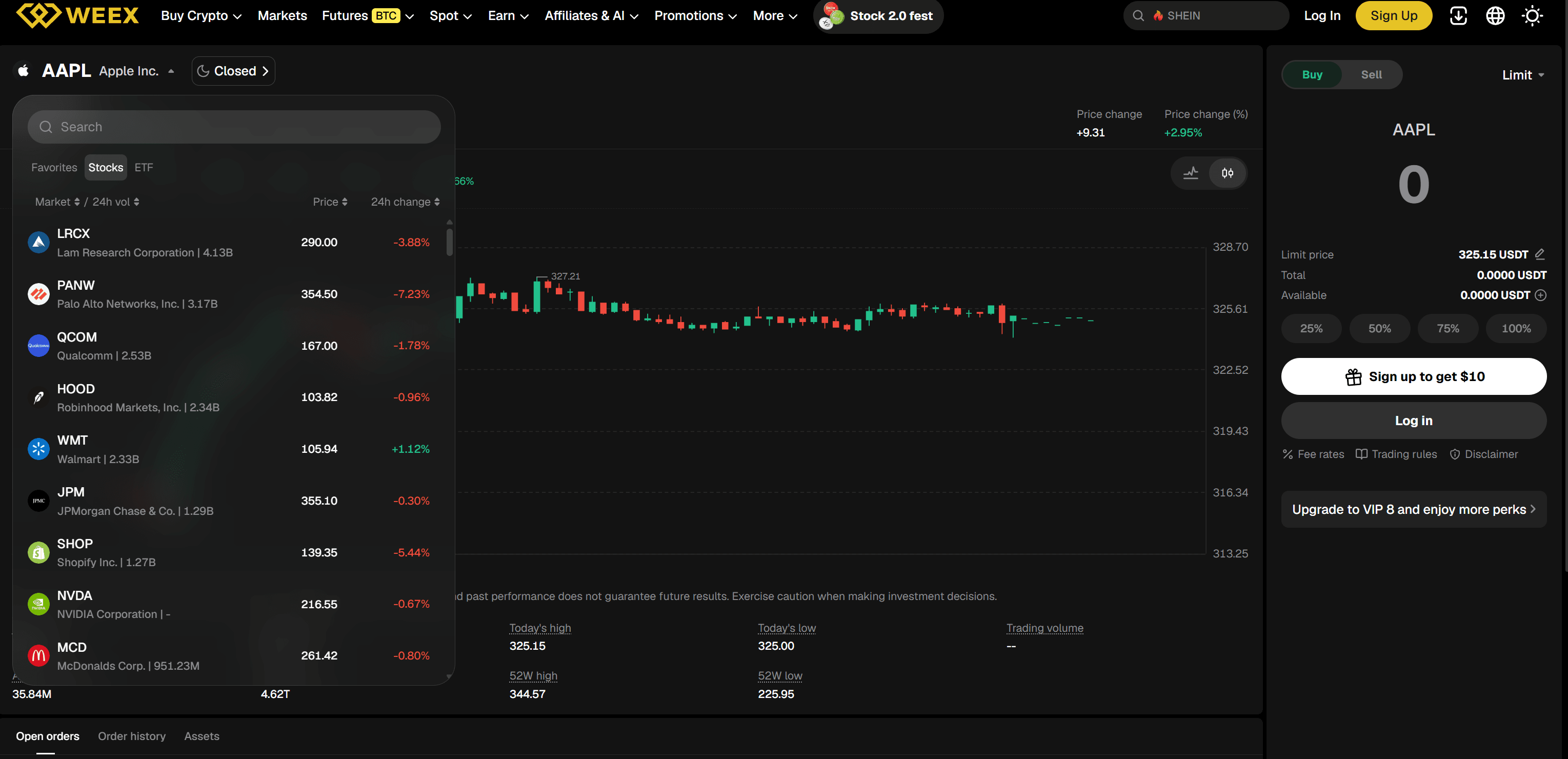
WEEX Stock Spot 2.0 provides access to stock-related trading assets, allowing users to trade popular markets using USDT without opening a traditional brokerage account.
Users can explore assets linked to companies and ETFs such as:
- NVIDIA (NVDA);
- Tesla (TSLA);
- Apple (AAPL);
- AMD;
- SanDisk (SNDK);
- Semiconductor and leveraged ETF products.
Users can access these markets through WEEX Stock Spot 2.0:
Key Features of Stock Tokens
Compared with traditional stocks, stock tokens provide a different trading experience.
Feature | Stock Tokens |
|---|---|
Trading currency | USDT |
Account type | Digital asset platform |
Ownership | No direct ownership of shares |
Trading method | Price-tracking asset trading |
Starting amount | Can support smaller positions |
For example:
Traditional stock trading usually requires: Broker account → Deposit funds → Buy company shares
Stock token trading can work as: Crypto account → Use USDT → Trade stock-related assets
This creates a more familiar experience for users who already participate in digital asset markets.
What Are Stock Perpetual Contracts?
Stock perpetual contracts are derivative products that allow traders to speculate on stock price movements without owning the underlying asset.
Unlike traditional stocks or stock tokens, perpetual contracts are based on agreements between traders and the trading platform. They are commonly used for short-term trading strategies, including both long and short positions.
A trader who expects a stock price to rise may open a long position, while a trader expecting a decline may open a short position.
For example:
Assume Tesla’s price is $300.
A trader believes Tesla may increase and opens a long perpetual contract position.
If Tesla rises to $330, the position may generate a profit.
However, if Tesla falls to $270, the trader may experience losses.
Many perpetual contract products also support leverage, which means both potential gains and losses can increase. Therefore, stock perpetual contracts usually require stronger risk management and trading experience.
Users interested in broader financial market trading products can explore WEEX TradFi markets:
-- Price
Stock Tokens vs Perps vs Real Stocks: Key Differences
Although all three products are linked to stock prices, their purposes are different.
| Traditional Stocks | Stock Tokens | Stock Perpetual Contracts |
Ownership | Yes | No | No |
Main purpose | Long-term investment | Price exposure | Price speculation |
Trading platform | Brokerage | Digital asset platform | Derivatives platform |
Funding method | Fiat currency | USDT or digital assets | Margin-based trading |
Long/short trading | Limited | Depends on product | Usually available |
Leverage | Usually unavailable | Usually limited | Commonly available |
Complexity | Lower | Medium | Higher |
The biggest difference is ownership.
Traditional stocks represent actual company ownership, while stock tokens and perpetual contracts focus on price exposure.
For example:
A long-term investor interested in owning part of NVIDIA may prefer traditional shares.
A crypto user who already holds USDT and wants exposure to NVIDIA price movements may consider stock tokens.
An experienced trader looking for leveraged strategies may explore perpetual contracts.
Popular Stock Assets Available Through WEEX Stock Spot 2.0
WEEX Stock Spot 2.0 covers multiple popular sectors, allowing users to explore different market themes.
Technology and AI Companies
Examples include:
These companies attract attention due to their roles in areas such as artificial intelligence, cloud computing, and consumer technology.
Semiconductor and Storage Companies
Examples include:
These assets are closely followed due to trends in AI computing, semiconductor demand, and data storage growth.
ETF Products
WEEX also provides access to selected ETF-related products, including:
- TQQQ;
- SQQQ;
- SOXL;
- SOXS;
- Semiconductor and sector-focused ETFs.
How to Trade Stock Tokens on WEEX?
Trading stock-related assets through WEEX Stock Spot 2.0 is designed to be simple.
Users can follow these steps:
First, create and verify a WEEX account.
Next, deposit USDT and open the Stocks section.
Then search for a preferred ticker, such as:
- NVDA;
- TSLA;
- SNDK.
After selecting the trading pair, users can enter the trading amount and place an order.
WEEX Stock Spot 2.0 supports trading from as low as 5 USDT, allowing users to access global stock-related markets with a smaller starting amount.
Important Things to Know Before Trading Stock Tokens
While stock tokens provide convenient access to stock price movements, they are different from owning real shares.
WEEX stock tokens are price-tracking synthetic assets linked to selected stocks or ETFs.
They do not provide:
- Voting rights;
- Shareholder meeting participation;
- Direct ownership of underlying shares;
- Traditional stock dividends.
The final trading price is based on the matching results of the corresponding WEEX trading pair.
Users should understand these differences before choosing a trading method.
Conclusion
Traditional stocks, stock tokens, and stock perpetual contracts all provide exposure to stock price movements, but they serve different purposes.
Traditional stocks focus on ownership and long-term investment.
Stock tokens provide a digital way to access stock-related markets using USDT without a traditional brokerage account.
Stock perpetual contracts offer flexible trading strategies, including long and short positions, but involve higher complexity and risk.
Understanding these differences helps investors choose a trading method that matches their experience, risk tolerance, and trading objectives.
FAQ
1. Are stock tokens the same as real stocks?
No. Stock tokens track the price performance of related stocks but do not represent ownership of the underlying shares.
2. Can I trade stock tokens without a brokerage account?
Yes. Stock tokens allow users to access stock-related markets through digital asset platforms without opening a traditional brokerage account.
3. What is the difference between stock tokens and stock perpetual contracts?
Stock tokens generally provide spot-style exposure to stock prices, while perpetual contracts are derivatives that allow traders to speculate on price movements and may include leverage.
4. Does trading stock tokens give me shareholder rights?
No. Stock tokens do not provide voting rights, shareholder meeting access, or direct ownership of company shares.
This content is provided for general informational purposes only and doesn't constitute financial, investment, legal, or tax advice. Any events, rewards, online promotions, or related information mentioned herein should not be considered a recommendation, solicitation, or invitation to purchase, sell, trade, or otherwise deal in any crypto assets. Crypto assets are highly volatile and may result in loss. The availability of WEEX services, products, and related events may vary by region. You are responsible for ensuring that your participation is in accordance with applicable local laws and regulations.
You may also like
WEEX Stock Spot 2.0 Rewards Guide: Trade & Share $100K

MetaMask Seed Phrase & Private Key Security Guide

How to Install and Set Up MetaMask (2026 Updated Guide)

What Is MetaMask? A Complete Beginner's Guide
What Is Arbitrum (ARB) and How Does This Ethereum Layer 2 Work?
Is Arbitrum (ARB) Worth Buying After Its 30% Rally? An Analysis About Utility, Supply and Risks
GoPro Stock Soared 40%: What the $1.14 Merger Actually Pays
Stealth XST Coin: The $1,806 Daily Volume Behind a $2.3M Cap
Dell Earnings: $95B AI Backlog Now Dwarfs Its Own Guidance
Fable 5.1: What Anthropic's New Model Means for AI Tokens

Dell Stock Surges 9.4% After Smashing Earnings Estimates: What Drove the AI Server Beat

Why Is GoPro Stock Surging 80%? A YouTuber's 8.5% Stake and a Short Squeeze Collide

XST ETF vs XST Coin (XSolut): Don't Confuse These Two Completely Different Assets
What Is PONS? Inside the "100x Coin" Taking Over Robinhood Chain
ARK Invest Crypto Stocks vs ARKB: How Cathie Wood Gets Crypto Exposure
Which ARK ETFs Hold Coinbase Stock? COIN Exposure in ARKK, ARKW and ARKF

How Much Coinbase Stock Does Cathie Wood Own? ARK’s COIN Position Explained

Why Is Cathie Wood’s ARK Invest Buying Coinbase, Circle, BitMine and Bullish?

Cathie Wood’s $50 Million Crypto Stock Bet Explained: What Did ARK Invest Buy?
AIINU: How a "100x Coin" on Robinhood Chain Turned NVDA Stock Into a Memecoin
"We're Back": Why Strategy's Return to Bitcoin Buying Is Moving More Than Just MSTR Stock
Does Robinhood Chain Have Its Own Token? What CASHCAT, PONS, and Stock Tokens Actually Are
Anthropic Tokenized Stock: What ANTHROPIC Actually Gives You
CSOPSAMSUNG2L Explained: 2x Samsung Leverage, Two Wrappers
SQQQ Explained: Why the 3x Inverse Nasdaq ETF Bleeds Value
KSTR ETF Explained: Inside China's STAR 50 Chip Index Bet
When Can You Trade U.S. Stock Tokens? Trading Hours Explained
Can You Trade U.S. Stocks With 5 USDT? Here's the Real Math

Robinhood Built a Chain for Tokenized Stocks: Did It Just Become a Meme Coin Casino?
Should You Buy RST (Raini Studios Token)? What Low Liquidity and No Migration Plan Actually Mean
WEEX Stock Spot 2.0 Rewards Guide: Trade & Share $100K
MetaMask Seed Phrase & Private Key Security Guide
How to Install and Set Up MetaMask (2026 Updated Guide)
What Is MetaMask? A Complete Beginner's Guide
What Is Arbitrum (ARB) and How Does This Ethereum Layer 2 Work?
Is Arbitrum (ARB) Worth Buying After Its 30% Rally? An Analysis About Utility, Supply and Risks
Contents
Popular coins
Latest articles


