
LSK Short Squeeze: How $33.7M of Bears Blew Up in a Day

 Prefer us on Google


The LSK short squeeze on September 13, 2026 was the largest single liquidation event in crypto over a 24-hour window, and almost none of it was buying. Lisk spiked above $2 — more than 900% above its August lows, and over 500% in one intraday stretch — then collapsed back near $0.80 within hours. Of $41.13 million in liquidations, $33.68 million came from forced short closures against $7.44 million of longs, a four-to-one ratio. This piece breaks down the mechanics that produced it, the October 31 deadline that makes LSK futures structurally different from any other altcoin perpetual right now, and how to size a position when the derivatives market is deeper than the spot market it prices.
As of September 14, 2026, the LSK/USDT perpetual on WEEX was quoted at 0.90181, with the contract page listing leverage up to 50× — half the ceiling WEEX allows on ZEC and well below the 100× on its largest contracts.
What triggered the LSK short squeeze on September 13
The catalyst was not a partnership or a listing. On August 25, 2026, Lisk announced that its blockchain will shut down on October 31, 2026, alongside a proposal to burn 100 million LSK from the treasury — a cut of roughly 25% to maximum supply. Token holders had not yet voted on the burn when the squeeze happened.
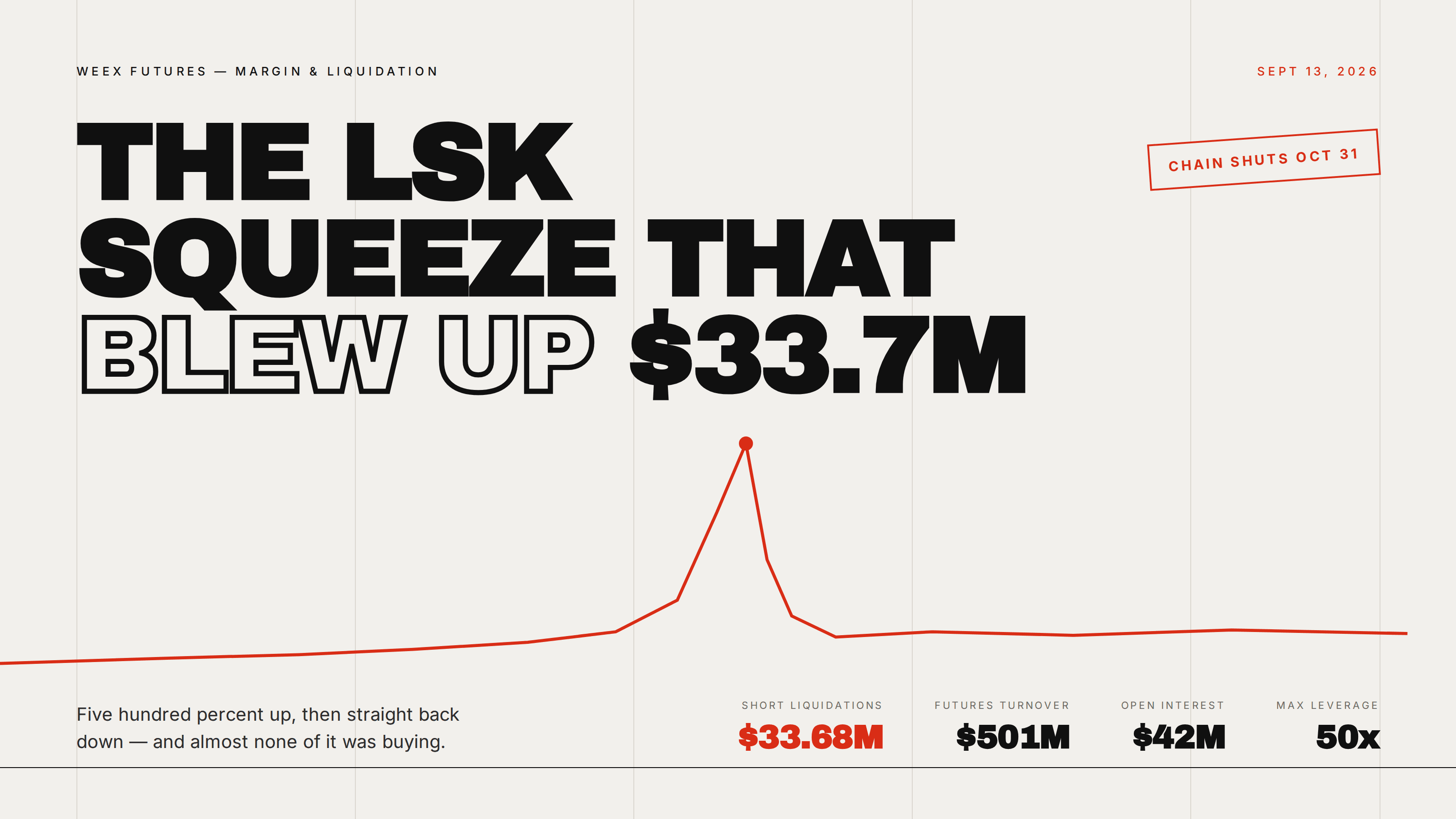
Read that combination the way a short seller did: a chain announcing its own shutdown looks like a terminal story, and shorts piled in. Then read it the way the squeeze did: a forced migration plus a potential 25% supply burn is a supply shock with a fixed date on the calendar. Both readings are defensible. Only one of them was positioned for a 900% move.
Daily futures turnover hit $501 million against open interest of roughly $42 million. A turnover-to-open-interest ratio near twelve means positions were being opened and destroyed within hours, not held — the signature of a liquidation cascade rather than an accumulation trend.
Why $33.68 million in short liquidations moved LSK more than real buying
A short liquidation is a market buy order the trader did not choose to send. When the exchange closes a short, it buys the asset at whatever price the book offers. In a thin book, that buy prints higher, which pushes the next short past its liquidation price, which sends another forced buy.
LSK's spot order books were far thinner than its derivatives market during the move. That asymmetry is the whole story. The derivatives market was pricing an asset whose spot liquidity could not absorb the hedging flow those derivatives generated, so a modest amount of forced buying moved price a multiple of what the same money would have moved in a liquid name.
This is also why the move round-tripped. Forced buying is not demand; it terminates when the shorts are gone. Once the liquidation queue emptied, there was nobody left who had to buy, and LSK gave back most of the spike within the same session. The token still trades roughly 97% below its 2018 peak.
The practical lesson for anyone trading the aftermath: in a name where derivatives turnover is ten-plus times open interest and spot depth is thin, the chart is not showing you supply and demand. It is showing you margin calls.
The October 31 deadline that makes LSK futures different
Most altcoin perpetuals have no hard date attached. LSK has two.
The chain shutdown on October 31, 2026 forces holders to migrate, which creates a mechanical deadline for anyone holding spot LSK — and a deadline is the one thing a trend-following short cannot ignore, because the float available to borrow or deliver against changes as the date approaches.
The 100 million token burn is the second date, and it is still unresolved. Holders had not voted at the time of the squeeze. An approved burn removes about a quarter of maximum supply; a rejected burn removes the supply-shock narrative that justified the September spike. Either outcome is a step-function repricing, and it will land inside the window when most leveraged positions are open.
That is why the venue's 50× cap on LSK matters more than it looks. Leverage tiers are a venue's own risk assessment of an asset — WEEX allows 100× on ZEC and 75× on FIL but only 50× on LSK. When an exchange quietly rates an asset as higher risk than its peers, that is information about liquidity and gap risk, not a marketing decision.
-- Price
How to size an LSK futures position when spot liquidity is thin
Three adjustments that specifically fit this setup:
- Size off the gap, not the stop. In a thin book, a stop-loss can fill far below its trigger price. Assume the worst fill is 15–25% beyond your stop and liquidation levels on an LSK-sized asset and size so that outcome is still survivable.
- Use isolated margin and add margin deliberately rather than raising leverage. Adding collateral pushes the liquidation price away without increasing notional exposure. WEEX's explainer on how adjusting margin changes your liquidation price covers the arithmetic.
- Treat the calendar as a position input. Any position held into late October carries binary event risk from the migration deadline and the burn vote. If you would not hold the position through a gap in either direction, close it before the date rather than trusting a stop to protect you through one.
The entry itself is straightforward: the LSK/USDT perpetual contract was quoted at 0.90181 on September 14, 2026, roughly 12% above where the spike unwound and roughly 55% below the intraday high.
Can the LSK squeeze happen again?
The fuel is partly rebuilt but not fully. The conditions that made September 13 possible — a heavily shorted low-float token, a fixed catalyst date, and a derivatives book bigger than its spot book — have not changed. What has changed is that the most aggressive shorts have already been liquidated, which removes the ammunition a second squeeze would need.
The better reading is that LSK is now a two-sided event trade rather than a one-sided squeeze candidate. The October 31 shutdown and the burn vote can each produce a violent move in either direction, and the same thin liquidity that amplified the upside will amplify a failed catalyst on the way down. Traders who made money on September 13 were mostly early shorts who cut fast and momentum traders who took profit into the spike — not people who held for a target.
FAQ
1. Why did LSK pump 500% in one day?
A short squeeze. Lisk announced on August 25, 2026 that its chain shuts down October 31, 2026, with a proposal to burn 100 million LSK — roughly 25% of max supply. Heavy short positioning met that supply-shock narrative, and $33.68 million of forced short covering pushed price above $2 before it collapsed back near $0.80.
2. What is the LSK liquidation total from the squeeze?
$41.13 million in total 24-hour liquidations: $33.68 million from shorts and $7.44 million from longs. It was the largest single liquidation event in crypto over that period.
3. Can I still trade LSK futures after the squeeze?
Yes. The LSK/USDT perpetual was quoted at 0.90181 on WEEX as of September 14, 2026, with leverage available up to 50×. Liquidity conditions remain thin relative to derivatives turnover, so position sizing matters more than direction.
4. What happens to LSK on October 31, 2026?
The Lisk blockchain is scheduled to shut down and holders are required to migrate. The separate proposal to burn 100 million treasury tokens had not been voted on at the time of the squeeze. Both are date-bound events that can reprice the token sharply.
5. Why does WEEX cap LSK leverage at 50× when other pairs allow 100×?
Leverage tiers reflect a venue's assessment of an asset's liquidity and gap risk. A lower cap on LSK than on ZEC or FIL indicates the contract is treated as higher risk, which is itself a signal worth reading before sizing a position.
Risk Warning
LSK is a low-liquidity token trading into a scheduled chain shutdown on October 31, 2026 and an unresolved supply-burn vote, and either event can gap the price in a direction no stop-loss reliably protects against. Spot order books are materially thinner than the derivatives market, so leveraged positions face slippage well beyond the trigger price and liquidation cascades in both directions — the September 13 session destroyed $41.13 million of positions in 24 hours. Migration risk is specific here: holders who fail to migrate before the deadline may lose access to their tokens entirely, which is a custody and operational risk on top of price risk. Crypto assets are volatile and leveraged futures positions can result in partial or total loss of capital. Size positions on the assumption that the worst fill, not the intended fill, is the one you get.
This content is provided for general informational purposes only and doesn't constitute financial, investment, legal, or tax advice. Any events, rewards, online promotions, or related information mentioned herein should not be considered a recommendation, solicitation, or invitation to purchase, sell, trade, or otherwise deal in any crypto assets. Crypto assets are highly volatile and may result in loss. The availability of WEEX services, products, and related events may vary by region. You are responsible for ensuring that your participation is in accordance with applicable local laws and regulations.
You may also like
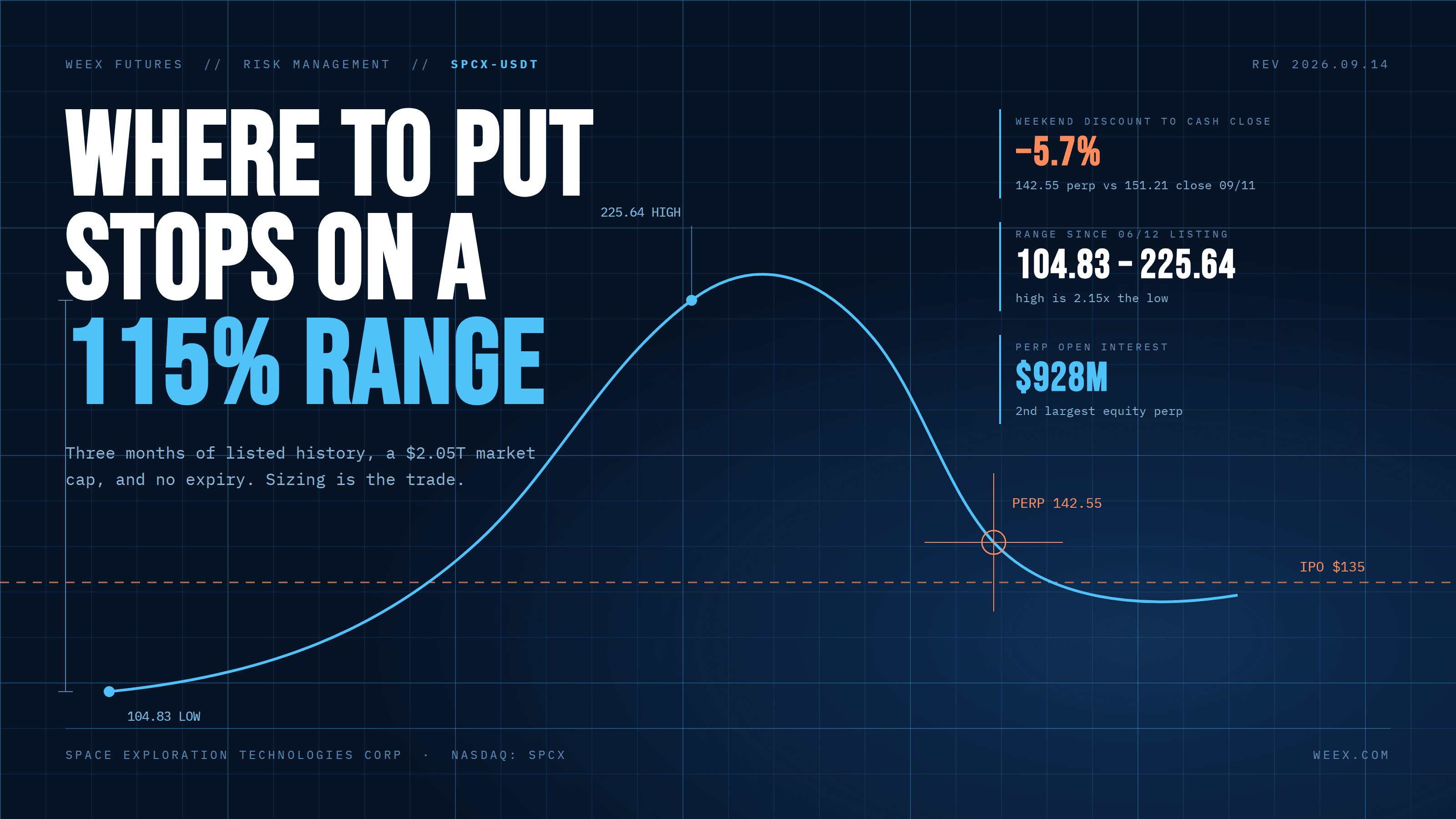
SpaceX Stock Futures: Where to Put Stops on a 115% Range
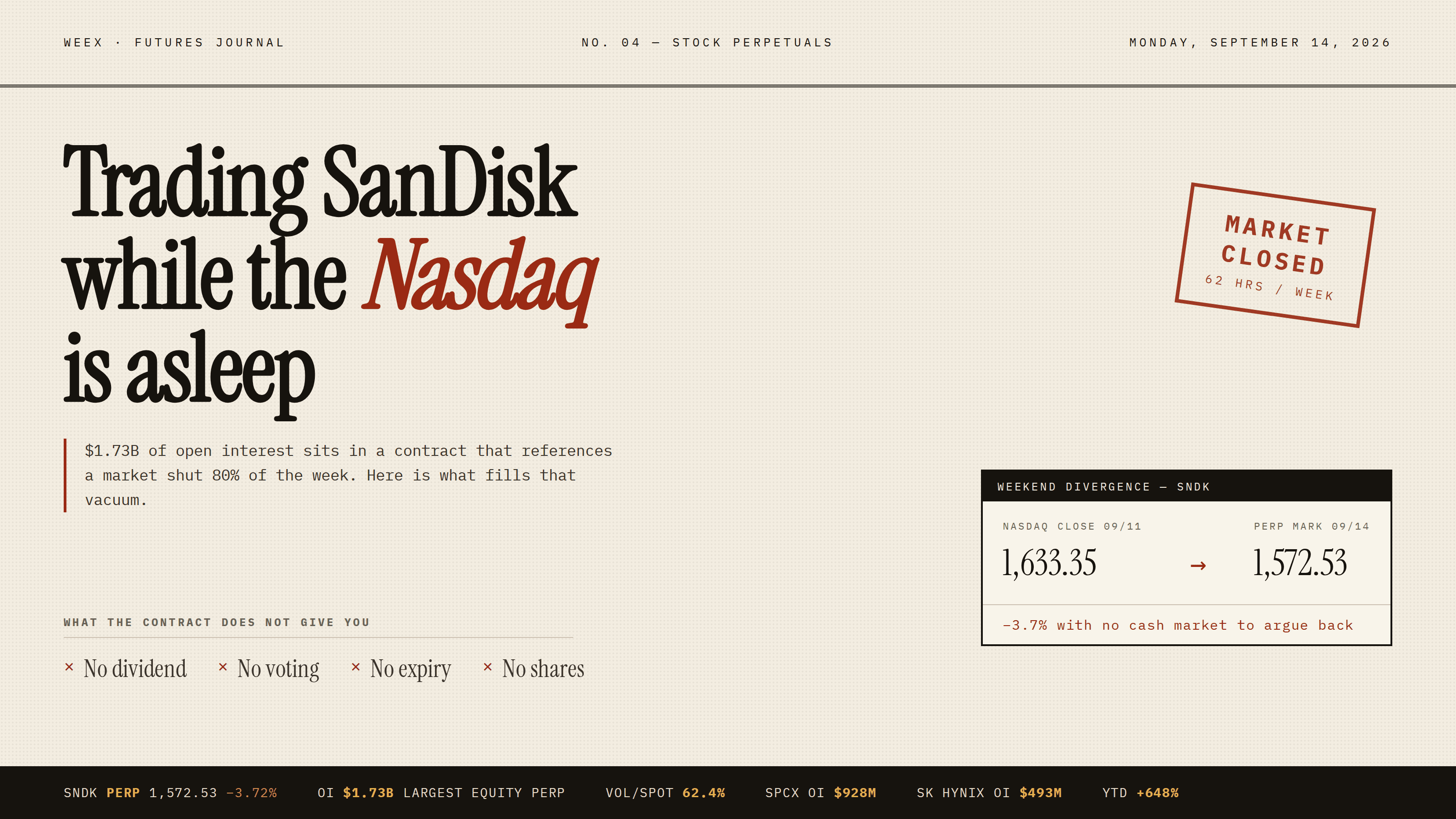
SanDisk Stock Perpetuals: Trading SNDK While Nasdaq Sleeps
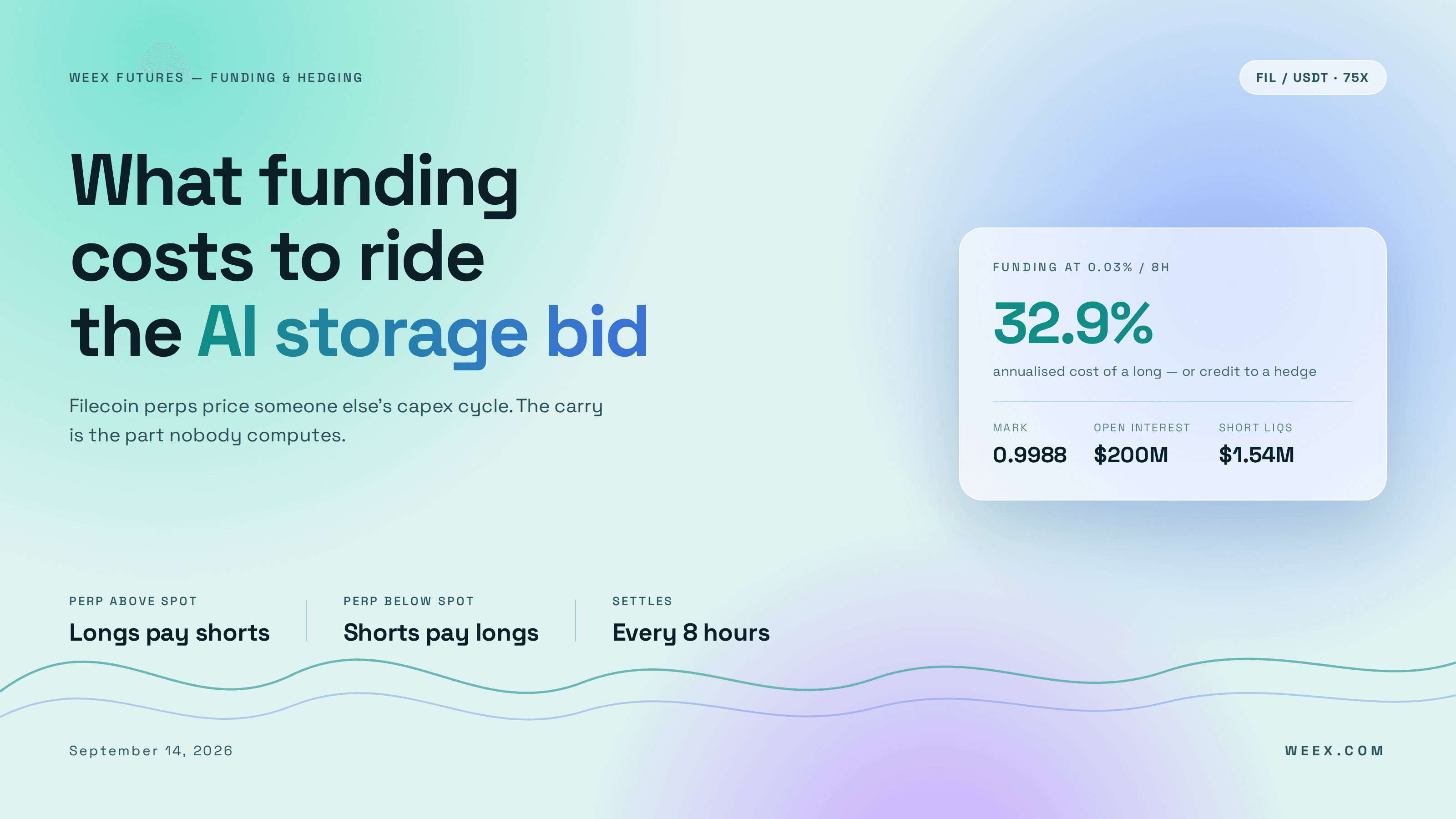
Filecoin Futures: What Funding Costs to Ride the AI Bid
Zcash Futures: What the $34.5M Short Squeeze Cost the Bears
Nintendo Stock Futures: What Leverage Survives a 10% Gap
4Stock Explained: Why the Ticker Is Not the Backed Asset

Cathie Wood Robinhood Stock: What Her 2026 Trades Really Show
GPT-6 Astra and Crypto: The AI Token Bid and the Cyber Risk
Pi Network in 2026: Why Supply, Not Users, Sets PI's Price
Amazon Stock and the Plane Crash: AMZN Pricing With NYSE Shut

NVIDIA Stock: What the $108B Q3 Guide Means for NVDA Next
PONS Robinhood Chain Token: What the Buyback Rally Rests On

PEP Stock Analysis: Why PEPon Trades Above PepsiCo Shares
Cathie Wood Nvidia Stock Purchase: What ARK's August Buys Show

Micron (MU) Earnings Date: When Q4 FY2026 Reports and What to Watch
Oracle (ORCL) Earnings Date: When Q1 FY2027 Reports and What to Watch
NVIDIA (NVDA) Earnings Date: When Q2 FY2027 Reports and What to Watch
BitMEX Is Closing September 23, 2026: Timeline and How to Withdraw Before the Deadline

Micron Stock (MU): Price, Outlook and How to Buy

How to Log In to MetaMask: Unlock, Troubleshooting and Recovery (2026)

SanDisk Stock (SNDK): Price, Outlook and How to Buy
Bybit Japan Service Termination: The Complete Timeline and What Happens on July 22, 2026
Bitcoin Price Over 10 Years: Historical Recap and Long-Horizon Outlook
BitMart Is Closing: Shutdown Timeline and How to Withdraw Before August 26, 2026
SOXSB Explained: Why the 3x Chip Bear ETF Resets Without You
CLARITY Act: What Happens in the Senate's September Window
How to Call a Crypto Exchange API Without Getting Blocked
Crypto Exchange API: Permissions, Signing and Rate Limits
How to Trade Unitree Stock When You Can't Buy 688836
QQQB and the Fed: What the FOMC Minutes Mean for Nasdaq-100
SpaceX Stock Futures: Where to Put Stops on a 115% Range
SanDisk Stock Perpetuals: Trading SNDK While Nasdaq Sleeps
Filecoin Futures: What Funding Costs to Ride the AI Bid
Zcash Futures: What the $34.5M Short Squeeze Cost the Bears
Nintendo Stock Futures: What Leverage Survives a 10% Gap
4Stock Explained: Why the Ticker Is Not the Backed Asset
Contents
Popular coins
Latest articles


