
SpaceX Stock Futures: Where to Put Stops on a 115% Range

 Prefer us on Google



SpaceX stock futures give leveraged, round-the-clock exposure to a company that has been public for three months, has never reported a full year of results as a listed issuer, and carries a $2.05 trillion market capitalization on $23.04 billion of trailing revenue and a net loss of $8.89 billion. That combination — enormous size, thin trading history, negative earnings — is why stop placement and position sizing matter more here than direction. This article covers what SPCX perpetuals track, where they sit against the $135 IPO price, how to set stop-loss and take-profit levels on an asset whose range spans 115% of its low, and what can gap the contract overnight.
As of September 14, 2026, the SPCX/USDT perpetual on WEEX was quoted at 142.55 with leverage listed up to 100×, while SpaceX shares last closed at $151.21 on Friday, September 11 — the contract was trading roughly 5.7% below the cash market it references.
SpaceX stock futures explained: What SPCX perpetuals track
SPCX perpetuals are cash-settled contracts referencing the Nasdaq-listed shares of Space Exploration Technologies Corp. They have no expiry, no delivery, and no shareholder rights attached. They track price and nothing else.
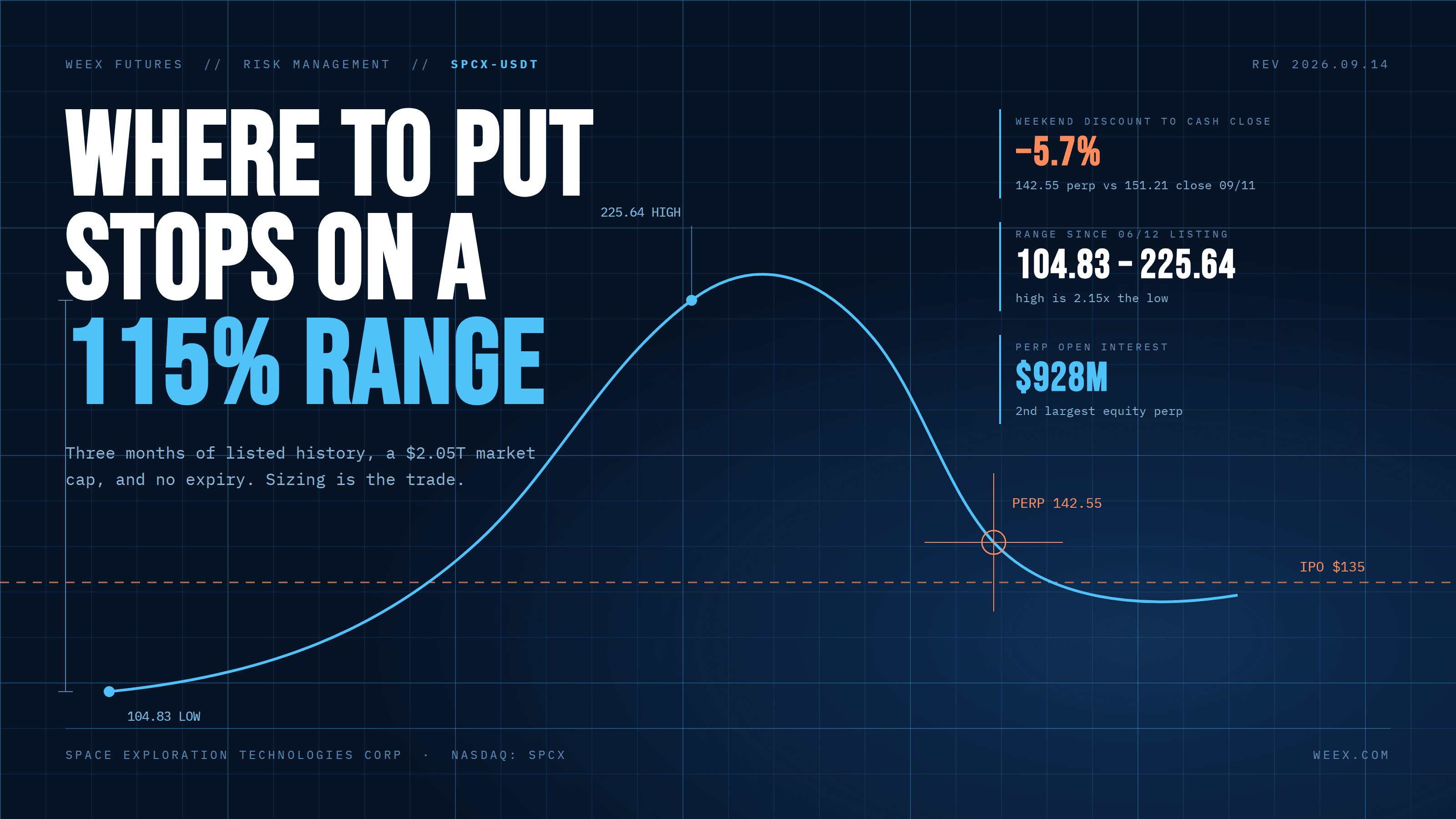
They also trade continuously, which is the source of most of their distinct behaviour. SpaceX perpetual open interest reached $928 million on August 16, 2026, second only to SanDisk among equity perps. That is a substantial book running against a cash market that is shut roughly 80% of the week.
What SpaceX actually is matters for how the contract behaves. The company runs three segments — Space, covering reusable launch; Connectivity, covering satellite broadband; and AI. Recent disclosures point to AI compute agreements worth over $1 billion monthly and a stated target of $100 billion in annual recurring revenue by year-end. Trailing revenue grew 121.9%. None of that is priced with the precision of a mature industrial: 36 analysts cover the stock with a consensus Buy and an average target of $220.68, about 46% above the last close. A wide analyst dispersion on a high-growth loss-maker is exactly the condition under which stops get hit in both directions.
Where SPCX perps sit versus the $135 IPO price
SpaceX listed on Nasdaq on June 12, 2026 at $135. The stock fell below that level and only closed back above it in August, then ran and retraced; the range since listing spans $104.83 to $225.64.
The $135 line is the most useful reference on the chart precisely because it is not technical. It is the price at which the book was built, the price institutional allocations were struck at, and the level a large cohort of holders measures their position against. Levels like that tend to attract activity in both directions — defended on the way down, sold into on the way back up.
Against that, the perpetual at 142.55 sits about 5.6% above the IPO price and about 5.7% below Friday's cash close. A weekend discount of that size on a $928 million open-interest contract is not an arbitrage you can capture, because there is no delivery mechanism into shares. It is positioning, and it resolves at the Monday open.
Setting stop-loss and take-profit on a stock with a 115% annual range
The mistake is choosing a stop from the chart and the leverage from the venue. Do it the other way around.
Start from the asset's actual movement. A range of $104.83 to $225.64 means the high is more than double the low — roughly 115% of the low in absolute terms — inside a three-month listed history. A stop placed 3% from entry on an asset like that is not risk management, it is a donation to noise.
A workable method:
- Pick the invalidation level first. Decide what price proves the trade wrong — below the IPO price at $135, below the listing-period low at $104.83, or a level the structure gives you. That is where the stop goes, regardless of how far it is.
- Fix the maximum loss in account terms. One to two percent of account equity per trade is the standard discipline, and it is the only number in this process you control completely.
- Derive position size from those two. Size equals maximum acceptable loss divided by the distance from entry to stop. Entering at 142.55 with a stop at 135 is a 5.3% distance; risking 1% of a $20,000 account means $200 divided by 5.3%, or about $3,770 of notional.
- Set leverage last. That notional on, say, $1,000 of margin is under 4×. The contract's 100× ceiling never enters the calculation, and it should not — at 100× a 1% move ends the position, and SPCX moved 2.04% on Friday alone.
- Place take-profit at a defined multiple, not a headline. With a 5.3% stop distance, a 2:1 target sits near 157.7 and a 3:1 near 165.2. The $220.68 analyst consensus is a twelve-month view, not a trade target, and sizing a leveraged position to reach it means sitting through drawdowns that leverage cannot survive.
WEEX's explainer on using liquidation prices in a trading strategy is a useful cross-check here: the liquidation price the platform shows you after sizing should sit well beyond your stop, never near it. If they are close together, the position is too large.
-- Price
Position sizing for SPCX futures: A worked example
Take a trader with a $10,000 account who wants long exposure on the SPCX/USDT perpetual at 142.55, with invalidation below the IPO price at 134.00.
Stop distance is 8.55 points, or exactly 6% of entry. Risking 1.5% of the account is $150. Position size is $150 divided by 0.06, or $2,500 of notional — about 17.5 SPCX-equivalents. Posting $500 of isolated margin puts the position at 5× and places liquidation near 114, roughly 20 points below the stop — and topping up margin rather than cutting leverage is how you push that level further away if price grinds against you.
That is the shape you want: the stop is hit long before the liquidation, so the exchange never makes the exit decision for you. Traders who invert this — small margin, tight leverage buffer, wide stop — discover that their stop was decorative, because liquidation arrived first.
The uncomfortable part of the arithmetic is that a $2,500 position on a $10,000 account feels too small to bother with. That feeling is the reason most leveraged accounts do not survive their first genuine drawdown on a name like this.
What can gap SPCX overnight
The perpetual runs 24/7; the news flow that moves it does not.
Launch and mission outcomes are the obvious one, and they are binary, unscheduled and visible to everyone at once. Starlink subscriber and AI compute contract disclosures move the growth narrative, which is most of the valuation given the company loses money. Post-IPO share supply is a slower but real overhang — lockup expiries on a June 2026 listing fall into a window that leveraged holders should know the date of rather than discover. And because SPCX is now a top-weight index constituent at $2.05 trillion, broad market risk-off transmits into it mechanically, whether or not anything happened at the company.
Any of these can print while the Nasdaq is closed, and the perpetual will reprice without a cash market to check it against. That is the case for keeping weekend and overnight size smaller than intraday size — not a general caution, a specific one.
FAQ
1. What are SpaceX stock futures?
Cash-settled perpetual contracts referencing SPCX shares, traded on crypto venues around the clock with no expiry. They provide price exposure only — no shares, no dividends, no voting rights.
2. Why is the SPCX perpetual price different from the SPCX share price?
The perpetual keeps trading while the Nasdaq is closed. On September 14, 2026 the WEEX SPCX/USDT perpetual was quoted at 142.55 against a last cash close of $151.21 on September 11, a gap of about 5.7%. The two reconcile when the cash market reopens.
3. Where should I place a stop-loss on SPCX?
At the price that invalidates your reason for being in the trade — commonly below the $135 IPO price or below the listing-period low of $104.83 — and then size the position so that stop costs no more than 1–2% of your account.
4. What leverage is appropriate for SPCX perpetuals?
Whatever falls out of your stop distance and risk budget, which for most stop placements on this asset lands in the low single digits. The 100× ceiling on the contract liquidates on a 1% move, and SPCX moved 2.04% in a single session on September 11.
5. How large is the SPCX perpetual market?
Open interest reached $928 million on August 16, 2026, the second-largest equity perpetual market after SanDisk's $1.73 billion.
Risk Warning
SpaceX has been publicly traded since June 12, 2026, which means SPCX has no multi-year volatility history to size against, no full reporting cycle as a listed issuer, and a $2.05 trillion valuation supported by 121.9% revenue growth alongside an $8.89 billion net loss. Its price has ranged from $104.83 to $225.64 in that short window. SPCX perpetual futures add leverage to that: at the contract's 100× ceiling a 1% adverse move liquidates, and unscheduled launch outcomes, contract disclosures and post-IPO lockup supply can all move the price while the Nasdaq is shut and no cash market exists to anchor it — the contract was quoted about 5.7% below Friday's close this weekend. Perpetuals confer no shareholder rights, no dividends and no guaranteed handling of corporate actions, and they carry crypto-venue counterparty and regulatory risk on top of equity risk. Leveraged positions can result in partial or total loss of funds.
This content is provided for general informational purposes only and doesn't constitute financial, investment, legal, or tax advice. Any events, rewards, online promotions, or related information mentioned herein should not be considered a recommendation, solicitation, or invitation to purchase, sell, trade, or otherwise deal in any crypto assets. Crypto assets are highly volatile and may result in loss. The availability of WEEX services, products, and related events may vary by region. You are responsible for ensuring that your participation is in accordance with applicable local laws and regulations.
You may also like
How to Trade Microsoft (MSFT) Stock Token with USDT on WEEX
How to Trade Apple (AAPL) Stock Token with USDT on WEEX
Crypto Futures Trading Explained: Leverage, Funding, Liquidation
Crypto Futures Trading: Leverage, Funding and Apple Perps
How to Trade Tesla (TSLA) Stock Token with USDT on WEEX: A Trading Guide for Beginers in 2026
How to Trade NVIDIA (NVDA) Stock Token with USDT on WEEX
How to Trade U.S. Stocks Without a Brokerage Account Using USDT

Nike Stock Price Prediction 2026: What the $50 Target Actually Requires to Happen
CLARITY Act Enters a Critical Window: What the September 15 Senate Vote Actually Means

What Are Spot Stock Tokens? How Synthetic Stock Trading Works

XST Coin Price Bounced 19% Off a New Low in Hours: Is This the Bottom or Just Noise?

What to Do After Buying USDT in Pakistan: Spot, Futures or Hold?

What Is the WEEX Mini App? A Lightweight Way to Trade Inside Telegram
XST Coin Price Crosses Into Deep Capitulation Territory: What a 90%+ Decline Actually Signals

CyberLeek Is Trending—but Why Are People Searching for CYBERLINK?

Nvidia After-Hours Stock Price: What Moved NVDA After the Earnings Report?

Crypto Futures Liquidation in Pakistan: How It Works and How to Manage Risk
Bank Account Freeze Risk for Crypto Traders in Pakistan 2026
Crypto Tax in Pakistan: What FBR Rules Mean for PKR Traders
Humanity Protocol Unlocked 266 Million H Tokens Today—Where Did They Go?
DGAI Has Trading Volume but No Reported Circulating Supply—So What Is Its Real Market Cap?
MORTY After Viral Meme Rally: Overvalued or Growth Story?

Best Futures Exchange in Pakistan for 2026? What Leverage, Liquidity, and Liquidation Risk Actually Require
XST Coin Liquidity Risk: What Low DEX Depth Actually Means for Buyers Who Want to Exit
MSTR Stock Surges 12% in a Single Session: What Strategy Inc's Bitcoin Treasury Model Actually Amplifies
Is SOXL a Good Investment? What 3x Leverage Actually Does to Your Returns in Both Directions
XST Coin and Stargate: What XSolut's AI Infrastructure Narrative Has to Do With the $500 Billion OpenAI Project
XST Coin Rebounds From Its Post Peak Low: What the Recovery to a $45M Market Cap Actually Signals
Why Did Sahara AI (SAHARA) Drop? The 600M Token Transfer, Tokenomics and What Comes Next
Can XST Crypto Reach $0.10? XSolut Price Prediction 2026
How to Trade Microsoft (MSFT) Stock Token with USDT on WEEX
How to Trade Apple (AAPL) Stock Token with USDT on WEEX
Crypto Futures Trading Explained: Leverage, Funding, Liquidation
Crypto Futures Trading: Leverage, Funding and Apple Perps
How to Trade Tesla (TSLA) Stock Token with USDT on WEEX: A Trading Guide for Beginers in 2026
How to Trade NVIDIA (NVDA) Stock Token with USDT on WEEX