
Amazon Stock Surged 10% Overnight. Free Cash Flow Went Negative.

 Prefer us on Google


Amazon stock closed at $235.50 on 30 July 2026, up 3.9% on the day. Then the Q2 report landed after the bell and the price went to roughly $258 in extended trading — about 10% higher — without the Nasdaq being open for a single second of it.
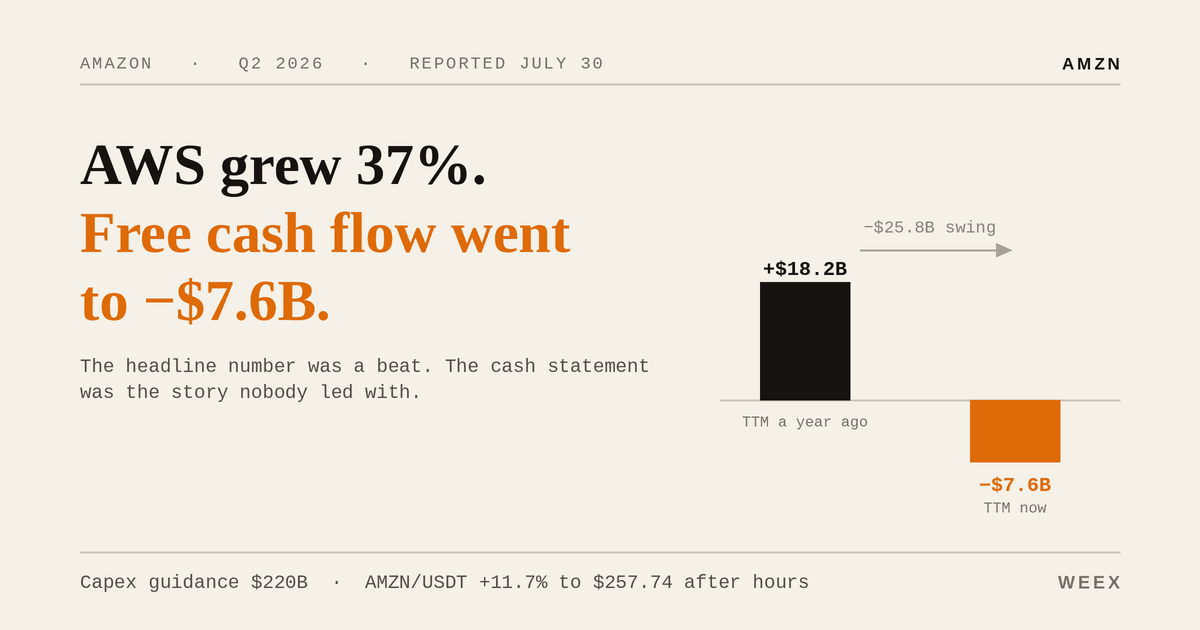
That is the first thing worth noticing about Amazon stock this morning. The repricing was real, it was large, and it happened in venues that most retail investors were locked out of. The second thing worth noticing is that the quarter that caused it contained a number the headlines mostly skipped: Amazon's trailing twelve-month free cash flow is now an outflow of $7.6 billion, against an inflow of $18.2 billion a year earlier.
Both things are true. The business is compounding faster than expected and the cash is going out the door faster than it comes in. How you weigh those two facts is the whole argument over Amazon stock right now.
What Actually Moved Amazon Stock on 30 July
AWS did the heavy lifting. Cloud revenue came in at $42.2 billion, up 37% year over year — the fastest growth in eighteen quarters and comfortably ahead of the roughly 31% the street had penciled in. AWS operating income reached $16.6 billion at a 39.4% margin, up from $10.2 billion.
Everything else beat too, which is why the reaction was as clean as it was.
| Metric (Q2 2026) | Reported | Consensus | Year-ago |
|---|---|---|---|
| Net sales | $200.61B | $196.47B | $167.7B (+20%) |
| AWS revenue | $42.2B | $40.54B | +37% YoY |
| AWS operating income | $16.6B | — | $10.2B |
| Total operating income | $27.5B | $23.57B | $19.2B (+43%) |
| Advertising revenue | $19.8B | — | +26% YoY |
Advertising at $19.8 billion, growing 26%, is the segment that gets least attention and deserves more. It is high-margin revenue that scales off traffic Amazon already owns, and it is now large enough to matter to consolidated profitability on its own.
Why the $5.75 EPS Figure Is Misleading
Reported earnings per share came in at $5.75 against an LSEG consensus of $1.82. A beat of that magnitude does not come from selling more cloud capacity.
The gap is a revaluation. Amazon carries a large stake in Anthropic, and gains on that investment flow through the income statement as non-operating income. When a private AI company marks up, Amazon's EPS marks up with it — on paper, without a dollar of cash changing hands.
The better number to anchor on is the $27.5 billion operating income line, which grew 43% and reflects what the business actually earned. Treat the EPS headline as an accounting event, not an operating one. Anyone building a valuation off $5.75 and annualizing it is going to reach a conclusion the business does not support.
The Cash Flow Reversal Behind the AWS Headline
Andy Jassy raised 2026 capital expenditure guidance to roughly $220 billion, up from about $200 billion, blaming higher memory chip prices. He also said that even at $220 billion Amazon will not have enough capacity to meet demand this year, and expects the same to be true in 2027.
Here is what that spending has done to the cash profile.
| Cash measure | Now | One year ago |
|---|---|---|
| Trailing 12-month free cash flow | −$7.6B (outflow) | +$18.2B (inflow) |
| 2026 capex guidance | ~$220B | ~$200B (prior guide) |
| Stated reason for the raise | Higher memory chip costs | — |
A $25.8 billion swing in trailing free cash flow is not a rounding error, and the market's response was to buy the stock 10% higher. That is a coherent trade if you believe the spending converts into AWS revenue at the rate the last four quarters imply. It is an expensive mistake if capacity arrives into softer demand, because the depreciation shows up on the income statement whether or not the servers are busy.
The practical point: Amazon stock is now, functionally, a leveraged bet on AI infrastructure demand holding up. That is a different risk profile from the retail-and-cloud compounder it was three years ago, and position sizing should reflect it.
Is Amazon Stock a Buy at $258?
Consensus says yes, with the usual caveat that consensus is a lagging indicator. Roughly 64 analysts polled by S&P Global carry an average target near $313, with the high around $370 and the low around $207. Most of those targets were set before this print and will be revised in the next fortnight.
The near-term check is management's own guidance. Q3 net sales are guided to $197–202 billion, growth of 9–12% — a sharp deceleration from Q2's 20%, largely because Prime Day fell in Q2 this year. More telling is the operating income guide of $22.5–26.5 billion, the midpoint of which sits below the $27.5 billion Amazon just delivered.
So the company is signalling a sequentially weaker quarter while the stock trades near an all-time high. That does not make Amazon stock a sell. It does mean the easy part of the re-rating has probably happened, and the next leg needs Q3 to beat a guide management has already framed conservatively.
Trading Amazon Stock 24/7: The AMZN-USDT Market
Because the move happened after hours, the only continuously priced AMZN markets overnight were derivatives. On WEEX, the AMZN-USDT perpetual contract tracked the whole repricing in real time. Here is the live snapshot, read directly from the order book on 31 July 2026.
| WEEX AMZN-USDT perpetual | Reading (31 July 2026) |
|---|---|
| Mark / last price | 257.74 |
| 24h change | +11.71% |
| 24h high / low | 260.43 / 229.47 |
| 24h volume | 1,340,186.71 USDT |
| Funding rate | −0.010760% |
| Margin | USDT-margined, cross available |
Two details in that table are worth reading carefully.
The 24h range of 229.47 to 260.43 is a 13.5% swing. That is the earnings gap, priced continuously by traders while cash equity was closed — the mechanism that produced the number everyone quoted this morning.
The funding rate is the more interesting one. At −0.01076%, shorts are paying longs. After an 11.7% rally you would normally expect crowded longs and positive funding. Slightly negative funding says the contract has not run away from its index and that positioning is not one-sided — largely a residue of where the perp sat before the print. It is a small signal, but it argues against the idea that the move was purely leveraged chasing.
The number that should give you pause is volume: 1.34 million USDT over 24 hours, on a company worth well over $2 trillion. When I read the book, visible bids across the top ten price levels totalled about 41.5 AMZN — roughly $10,700 — inside twelve cents of mid. The spread is tight, but the depth behind it is thin. A market order of any size will walk the book. Use limits.
WEEX lists AMZN alongside its other TradFi perpetual products, which cover equities, indices, metals and energy in a single USDT-margined account.
What Tokenized AMZN Exposure Does Not Give You
This is where people get hurt, so it is worth being blunt.
A perpetual contract on AMZN gives you price exposure. It does not give you a share. No voting rights, no dividend claim, no position on the cap table. For Amazon, which pays no dividend, the dividend point is academic — for other tickers it is not.
Beyond that, WEEX's own listing notice for US stock perpetuals sets out the operational risks plainly, and they are the ones that actually cost traders money:
- Liquidity varies by session. The contract runs 24/7; the underlying does not. Spreads widen and slippage rises when Nasdaq is shut — exactly the window most people want to trade an earnings reaction.
- Corporate actions can force early settlement. Splits and dividends on the underlying can produce sharp moves and, in some cases, early settlement of the contract.
- Trading halts propagate. If the underlying stock halts, the futures market can be affected while you are still holding a leveraged position.
- Availability is regional. These products are restricted in some jurisdictions.
Add funding costs to a multi-day hold and leverage to a thin book, and the failure mode is familiar: correct on direction, liquidated on the wick.
The Bottom Line on Amazon Stock
Amazon stock is priced for the AI capex to work. AWS growing 37% with a 39.4% margin is strong enough evidence to justify optimism, and the advertising line quietly adds high-margin ballast. But the trailing free cash flow figure of −$7.6 billion is the honest cost of that growth, the Q3 operating income guide points sequentially lower, and the EPS headline that made the print look spectacular was an accounting mark rather than cash earned.
If you want exposure to what happens next, the useful question is not whether Amazon stock is a good company — it plainly is — but whether $258 already pays for four more quarters of everything going right. Position accordingly, and if you are trading the move rather than owning the business, respect the size of the book you are trading into.
FAQ
1. Why did Amazon stock jump 10% after hours on 30 July 2026?
Q2 net sales came in at $200.61 billion against a $196.47 billion consensus, and AWS grew 37% versus roughly 31% expected. Operating income of $27.5 billion beat the $23.57 billion forecast. The combination of cloud acceleration and margin expansion was read as evidence that Amazon's AI infrastructure spending is converting into revenue.
2. Is Amazon's free cash flow really negative?
Yes. Trailing twelve-month free cash flow is an outflow of approximately $7.6 billion, compared with an inflow of $18.2 billion a year earlier. The swing is driven by capital expenditure, which management now guides to roughly $220 billion for 2026, up from about $200 billion.
3. Why was Amazon's EPS $5.75 when analysts expected $1.82?
The beat is largely non-operating. Amazon's stake in Anthropic was revalued upward, and that gain flows through the income statement. It is a paper mark, not cash from operations. Use the $27.5 billion operating income figure to assess the underlying business.
4. What is the analyst price target for Amazon stock?
Around 64 analysts polled by S&P Global carry an average twelve-month target near $313, with a high near $370 and a low near $207. These targets predate the Q2 print and are likely to be revised.
5. Can I trade Amazon stock 24/7 without a US brokerage account?
You can take price exposure through USDT-margined perpetual futures such as AMZN-USDT on WEEX, which trade continuously. This is not stock ownership — there are no voting rights or shareholder claims — and liquidity is thinner outside US market hours.
6. What does a negative funding rate on AMZN-USDT mean?
Negative funding means short positions pay long positions. On 31 July 2026 the rate was −0.010760%, which indicates the perpetual was not trading at a premium to its index despite the rally, and that long positioning was not extreme.
Risk Warning
Crypto assets and derivative products are highly volatile and can result in partial or total loss of capital. AMZN perpetual futures carry risks that differ from owning Amazon shares: leverage can liquidate a position on a short-lived price wick; the 24h volume of 1,340,186.71 USDT observed on 31 July 2026 means the order book is thin and large market orders will suffer slippage; funding payments accrue against multi-day holds; corporate actions on the underlying stock may trigger sharp moves or early settlement; and a trading halt in AMZN shares can disrupt the futures market while your position remains open. Tokenized and perpetual products confer no equity ownership, voting rights, or dividend entitlement. Availability is subject to regional regulatory restrictions. Nothing here is investment advice — size positions to what you can afford to lose and use limit orders and stops.
This content is provided for general informational purposes only and doesn't constitute financial, investment, legal, or tax advice. Any events, rewards, online promotions, or related information mentioned herein should not be considered a recommendation, solicitation, or invitation to purchase, sell, trade, or otherwise deal in any crypto assets. Crypto assets are highly volatile and may result in loss. The availability of WEEX services, products, and related events may vary by region. You are responsible for ensuring that your participation is in accordance with applicable local laws and regulations.
You may also like

USAR Stock: Is a 67% Drawdown a Buy or a Dilution Trap?

SpaceX Stock Price: Why SPCX Trades Below Its $135 IPO — and Which Price You're Actually Seeing
USAR Stock and the 53% Share Count Jump Coming August 28

Arm Earnings Q1 FY2027: The $1 Billion Supply Gap to Watch
SK Hynix Stock and the KOSPI Record Two Day Crash: What a 40% Drop From Peak Means

SNDK Stock Price Prediction 2026-2027: Can SanDisk Recover to $2,000 After the 50% Crash?

SNDK Stock Has Crashed 50% in a Month: Is Now the Time to Trade the Volatility?
Is SK Hynix Stock a Buy After Falling to All Time Lows on Record Earnings?

Hyperliquid (HYPE) July 30 Unlock: What Time Does the $198M Unstake Hit and How Will It Impact Price?
SK Hynix Stock Price Prediction 2026-2027: Can SKHY Reach $250 After the Q2 Earnings Miss?
How Do Crypto Brokers Make Money From Fee Sharing? What the Economics Actually Look Like
SOXS Stock Analysis: The 3x Chip Bear Fund in a 25% Drawdown
How to Avoid Crypto Broker Scams: What Legitimate Brokers Actually Look Like
WEEX API Rate Limits Explained: The Numbers Beginners Miss

SK Hynix Stock Crash: Why Seoul, Nasdaq and Tokens Disagree
Sony Digital Ownership: What Blockchain Actually Fixes in 2028
Microsoft Stock Forecast After Q4 Earnings: Short and Long-Term Outlook

Nvidia Stock Price Is Up Only 5% While AMD Is Up 160%: What the Underperformance Actually Means
Nvidia Stock Price and the $250 Billion OpenAI Supply Deal: Opportunity or Red Flag?
SPCX Stock Price Has Fallen 43%: Is It a Buying Opportunity or Still Overvalued?
SPCX Stock Price Hits All Time Low After Starship Flight 13 Success: What Is Going On?

Is MU Stock a Buy After Falling 30% From Its Peak? What the Selloff Left Behind
Micron Stock Price Prediction 2026-2027: Can MU Reach $2,000 After the CXMT Threat?
MU Stock Falls as China's CXMT Surges 500% on Debut: Should Investors Worry?
AMD Stock Price Prediction 2026-2027: Can AMD Reach $700 After the Anthropic Deal?

AMD Stock Has 20% Upside According to Wall Street: Is Now the Time to Buy?
AMD Stock Falls 6% as Wedbush Raises Target to $600: What the Disconnect Means for Investors
How to Call an Exchange API: Keys, Signatures and Error Codes
TradFi Perpetual Futures API: 26 Symbols and How to Wire Them
Stock Market Today: Chip Rout Hits Asia as Fed Meeting Opens
USAR Stock: Is a 67% Drawdown a Buy or a Dilution Trap?
SpaceX Stock Price: Why SPCX Trades Below Its $135 IPO — and Which Price You're Actually Seeing
USAR Stock and the 53% Share Count Jump Coming August 28
Arm Earnings Q1 FY2027: The $1 Billion Supply Gap to Watch
SK Hynix Stock and the KOSPI Record Two Day Crash: What a 40% Drop From Peak Means
SNDK Stock Price Prediction 2026-2027: Can SanDisk Recover to $2,000 After the 50% Crash?




