
Is Election Prediction Market Betting Legal in the US? The Complete 2026 Guide

 Prefer us on Google
Key Takeaways
- Election prediction markets occupy a legally contested, rapidly evolving space in the United States: federally regulated platforms like Kalshi operate under CFTC oversight as designated contract markets, while Polymarket navigated a winding path to US legality and still runs its most controversial markets offshore; neither operates uniformly across all 50 states.
- The Trump administration's CFTC, under Chairman Michael Selig confirmed in December 2025, has taken an aggressive "federal preemption" stance, suing Arizona, Connecticut, and Illinois on April 2, 2026 to block state-level gambling enforcement against prediction market operators, marking the most consequential regulatory development in the industry's history.
- Insider trading is not a theoretical concern — it is a documented, prosecuted reality: a US Army soldier was criminally charged after turning a $33,000 bet on Polymarket into $400,000 using classified information about the Venezuela operation; Israeli Air Force officers were indicted; and campaign staffers told NPR they made "thousands" trading on unreleased polling data.
- Polymarket faces a serious credibility crisis after a Wall Street Journal investigation found the platform paid social media creators to produce fake trading videos showing phony wins totaling $1.9 million, prompting a class-action lawsuit filed June 26, 2026, and FTC scrutiny.
- Whether prediction markets are legal for you personally depends almost entirely on your state of residence: 13 states, including Nevada, Arizona, Illinois, Michigan, and Minnesota, have active enforcement actions or court battles underway, and Nevada became the first state to obtain a federal court-ordered temporary ban in March 2026.
Election prediction markets have exploded into one of the most controversial financial products in the United States, crossing billions of dollars in quarterly trading volume while simultaneously facing criminal charges in Arizona, federal litigation in three states, a Justice Department probe into insider trading, and a deceptive marketing scandal. Platforms like Kalshi and Polymarket allow users to buy yes-or-no contracts on the outcomes of elections, sports events, and geopolitical events, with prices functioning as real-time probability estimates. Kalshi operates as a CFTC-regulated Designated Contract Market. Polymarket, valued at $9 billion by February 2026 after a $2 billion investment from Intercontinental Exchange, operates partly offshore and partly through a US regulatory pathway established in late 2025. This article delivers a thorough, data-grounded breakdown of the current legal landscape, the documented manipulation risks, the blockchain architecture behind how these platforms work, and a practical framework for anyone considering participating in political event contract trading.
WEEX Registration Link — If you're looking to explore the broader digital asset ecosystem, including crypto-based trading products and market instruments, WEEX offers a regulated, high-liquidity environment where beginners can start learning and trading with professional-grade tools.
What Is an Election Prediction Market, and How Does It Actually Work?
An election prediction market is a financial platform where participants buy and sell binary contracts tied to the outcome of future events, with political elections representing the highest-volume category. The mechanics are straightforward at the surface level: a contract is priced between $0.01 and $0.99, and that price reflects the collective market estimate of the probability that a given event will occur. If you buy a "Yes" contract on "Will Candidate X win the Senate race?" at $0.30, you believe the market is underpricing the probability at 30%, and you profit if the contract settles at $1.00 when the event resolves in your favor. If the market disagrees and sells the same contract down to $0.20, you face a paper loss. This is not gambling in the traditional casino sense — there is no house taking a fixed edge against every bet — but it behaves similarly to speculative financial trading and creates economic incentives structurally identical to gambling in most practical situations.
The deeper architecture differs between the two dominant US platforms. Kalshi operates as a traditional financial exchange, with an order book, standardized contract sizes, and CFTC reporting requirements. Its event contracts are legally classified as "swaps" under the Commodity Exchange Act, which places them under federal jurisdiction. Polymarket was built on blockchain infrastructure, originally on the Polygon network, using USDC stablecoins for settlement. This crypto-native design allowed Polymarket to operate without a US license for years by routing transactions through decentralized smart contracts and targeting non-US users, while its offshore operations continued servicing US-based traders who could access the platform through standard crypto wallets. The crypto backend creates faster settlement, borderless access, and lower operational overhead compared to a traditional exchange, but it also removes the compliance infrastructure that federally regulated markets must maintain, creating the regulatory ambiguity that has defined Polymarket's history.
In March 2026, Polymarket acquired Brahma, a crypto and DeFi infrastructure startup, to simplify its blockchain architecture for users, signaling its intent to deepen its on-chain infrastructure while simultaneously pursuing the US regulatory pathway established through the QCEX Designated Contract Market acquisition in December 2025.
The Federal Legal Framework: CFTC, Swaps, and Preemption
The central legal argument that has allowed election prediction markets to expand nationally despite state-level gambling laws rests on a single regulatory theory: federal preemption through CFTC jurisdiction over commodity contracts. The 2024 court ruling in KalshiEX LLC v. CFTC was the watershed moment. The DC District Court found that election event contracts were not "gaming" under the narrow legal definition, which requires an underlying "game," and that the Commodity Exchange Act's coverage of derivatives included political event contracts. The DC Circuit affirmed this ruling, and the CFTC subsequently dropped its appeal in May 2025, functionally conceding Kalshi's right to operate election markets.
In early 2026, the CFTC formally designated prediction market contracts as "swaps," giving the agency explicit and exclusive federal jurisdiction over these instruments. This move, combined with the confirmation of CFTC Chairman Michael Selig in December 2025, set the stage for the federal government's most aggressive intervention yet: on April 2, 2026, the CFTC simultaneously sued Arizona, Connecticut, and Illinois in their respective federal district courts, seeking declaratory judgments and permanent injunctions blocking state enforcement against Kalshi and Polymarket. On April 10, 2026, a federal judge issued a temporary restraining order halting Arizona's criminal prosecution of Kalshi, which had involved 20 felony-level charges. The pattern is one of direct federal-state conflict, with the Trump administration choosing prediction markets as a clear battleground for expanding CFTC authority at the expense of state gambling regulatory power.
The political dimension cannot be separated from the legal one. Donald Trump Jr. serves as a paid strategic advisor to Kalshi and holds an investment in Polymarket through his venture capital firm. CFTC Chairman Selig's Wall Street Journal op-ed in 2026 explicitly stated the CFTC would "no longer sit idly by while overzealous state governments undermine the agency's exclusive jurisdiction," language that reads as a direct policy directive rather than neutral regulatory commentary. Federal prosecutors at the Southern District of New York, however, are simultaneously exploring whether prediction market activity can trigger criminal insider trading liability, a posture that runs parallel to, and potentially in tension with, the CFTC's permissive stance on the existence of these markets.
State-by-State Enforcement: Where It Is and Is Not Legal for You
The state-level legal picture is the most practically important variable for anyone considering participation in election prediction markets in 2026. The following table summarizes the enforcement status of the states where documented regulatory or legal actions have occurred.
| State | Enforcement Action | Status as of Mid-2026 | Risk Level |
|---|---|---|---|
| Nevada | Gaming Control Board cease-and-desist; federal court temporary ban (March 2026); Ninth Circuit upheld | Active ban on sports/election contracts | High |
| Arizona | 20-count criminal information filed against Kalshi (March 2026) | Federal judge halted prosecution (April 10, 2026) | Medium-High |
| Illinois | Gaming Board cease-and-desist to Kalshi, Polymarket, Robinhood | Active enforcement; CFTC litigation ongoing | Medium |
| Connecticut | Cease-and-desist to Kalshi, Polymarket, Crypto.com (December 2025) | CFTC suing state (April 2026) | Medium |
| Michigan | AG civil enforcement action against Kalshi (March 2026) | Active parallel litigation; no operational block yet | Medium |
| Massachusetts | State judge ordered Kalshi user block; paused on appeal | Uncertain access; Polymarket already blocking IPs | Medium |
| Minnesota | New state law specifically banning prediction markets; CFTC and DOJ suing to block | Law not yet in effect; active litigation | High |
| Maryland, Ohio, Montana | Cease-and-desist or enforcement posture | No court challenge yet | Medium |
Thirteen states in total have active enforcement postures, litigation, or both. For users in these states, accessing election prediction markets carries material legal risk, even if the federal preemption argument is technically viable, because the resolution of these court battles is ongoing and the outcomes are not guaranteed. Nevada, in particular, stands out as the most advanced enforcement jurisdiction: the Ninth Circuit's decision in March 2026 upholding Nevada's temporary ban means federal preemption has not uniformly prevailed in court, and the Supreme Court's eventual engagement with the sports contract case, which prediction markets themselves price at 64% probability by year-end 2026, will likely be the definitive legal checkpoint.
Insider Trading: The Industry's Most Serious Structural Problem
The most substantive "scam" risk associated with election prediction markets is not fake platforms or theft — it is the structural vulnerability to insider trading, which has produced documented criminal cases in 2026 and created a credibility crisis that fair-market advocates cannot ignore. The economic logic is straightforward: a binary contract that accurately prices probabilities only functions properly when information advantages are distributed evenly across the market. When a participant holds nonpublic information, they can buy contracts at market prices that drastically underprice the true probability, then profit when public disclosure moves the price to reflect reality. This is textbook insider trading, and prediction markets have proven uniquely attractive to individuals with access to classified, policy, or campaign information.
The Venezuela/Maduro case became the most high-profile example of this structural flaw. A US Army soldier involved in planning the operation to capture former Venezuelan President Nicolás Maduro bet $33,000 on Polymarket that the raid would occur before a specific date, then cashed out approximately $400,000 when it did. Federal prosecutors charged him with five felonies. An anonymous trader who bet $553,000 on Iran's Supreme Leader Ayatollah Khamenei's death reportedly placed the bet shortly before an Israeli strike publicly killed him. An anonymous trader made roughly $300,000 correctly predicting four specific pardons Biden would issue in his administration's final hours. A Google employee was federally charged in May 2026 for making more than $1.2 million using confidential business information. In the Israeli military, multiple Air Force officers were indicted for betting on the timing of strikes on Iran during the Twelve-Day War, with one crewmember reportedly stating during interrogation that "the entire squadron is on Polymarket, the entire air force is betting."
Kalshi responded directly in April 2026 by fining and suspending three federal candidates who had bet on their own elections. Polymarket updated its terms in March 2026 to prohibit trades based on "stolen confidential information" or illegal tips. Both platforms argue that these are self-policed exceptions, not the norm, and that the broader market functions as an efficient information aggregator. Critics including Representative Ritchie Torres and Harvard election law researchers counter that self-regulation by for-profit platforms with financial incentives to maximize trading volume creates an inherent conflict of interest that independent oversight cannot replicate.
Polymarket's Deceptive Marketing Scandal: Is It a Scam?
Directly addressing the question embedded in this article's title requires examining the specific evidence of deceptive conduct associated with Polymarket, which is distinct from but related to the insider trading problems described above. In June 2026, a Wall Street Journal investigation based on interviews with social media content creators and an analysis of more than 1,100 TikTok videos found that Polymarket had paid online content creators to produce videos showing phony trades executed on dummy websites designed to resemble the real Polymarket platform. The videos showed creators winning a combined total of $1.9 million. When the WSJ analyzed what would have happened if those identical bets had been placed on the actual platform, roughly 10% of the analyzed videos, or 118 of them, depicted creators winning nearly $900,000 when in reality those positions would have produced losses exceeding $166,000. One video showed a college-aged student winning $100,000 by betting that Trump would say the word "McDonald's" publicly during a given month; all 50 accounts that actually made this bet on Polymarket lost.
On June 26, 2026, consumer protection firm Vaca Daffan Law filed a class-action lawsuit against Blockratize (Polymarket's operating entity), Polymarket founder Shayne Coplan, and chief marketing officer Matthew Modabber. The FTC declined to confirm whether it is formally investigating. Polymarket told CBS News it is auditing its promotional content. The platform's response has been to announce an internal audit, not to dispute the WSJ's factual findings.
This specific conduct — paying for fake wins content designed to attract users to a platform offering real financial risk — fits a clear definition of deceptive marketing, regardless of whether the underlying trading platform is technically legal under federal oversight. Whether it rises to the legal standard of "scam" will be determined in part by the class-action litigation and any regulatory action that follows. What it unambiguously represents is a serious violation of the reasonable expectation that a financial platform's marketing accurately represents the risk and reward profile of its products.
How Prediction Market Contracts Differ From Traditional Crypto Trading
For readers who arrived at this topic from the cryptocurrency trading world, a precise comparison helps clarify why election prediction markets occupy such a unique and contested regulatory space.
| Feature | Election Prediction Markets | Cryptocurrency Spot Trading | Sports Betting |
|---|---|---|---|
| Legal classification (US) | Commodity "swaps" (CFTC) | Virtual commodities (varies) | State-regulated gambling |
| Federal regulator | CFTC | No unified regulator | No federal regulator |
| Settlement | Binary (yes = $1.00 / no = $0.00) | Market-determined price | Odds-based fixed return |
| Blockchain use | Polymarket: USDC on Polygon; Kalshi: off-chain order book | Native blockchain | None |
| Insider trading risk | Extremely high (classified info, campaign intel) | High (token insiders, pump-and-dump) | Low-medium |
| State legality | 13 states with active enforcement | Mostly permitted nationally | Regulated state-by-state |
| Tax guidance | No IRS formal guidance; Kalshi not issuing 1099-B | Capital gains standard (short/long term) | Gambling winnings treatment |
| Profit potential | High but binary | Unlimited upside, unlimited downside | Fixed by odds |
The blockchain dimension of prediction markets creates a specific risk that crypto-experienced traders will recognize immediately: on Polymarket's offshore, crypto-native platform, the smart contract architecture means that once a trade is executed, reversal is technically impossible without the counterparty's agreement. This creates a higher-stakes version of the irreversibility problem familiar from decentralized exchange trading. If a market resolves incorrectly due to oracle manipulation, a dispute over the outcome's classification, or a decision by the platform to remove the market (as Polymarket did with nuclear detonation bets in 2026 after hundreds of thousands of dollars were wagered), the resolution depends entirely on the platform's internal governance process, not on a regulated arbitration or consumer protection mechanism.
What "Scam" Risk Actually Looks Like in Practice
The search query "is election prediction market a scam" typically reflects one of three separate concerns, each requiring a distinct answer. The first concern is platform legitimacy: Kalshi is genuinely regulated by the CFTC and operates transparently as a designated contract market with auditable order books. Polymarket is a for-profit platform that has operated both within and outside US regulatory boundaries depending on the contract type and time period, and whose marketing conduct as of June 2026 has been specifically documented as deceptive by an independent journalism investigation. The second concern is market manipulation: this is real and documented, with specific criminal prosecutions in 2026 confirming that participants with inside information can and do extract profits at the expense of uninformed traders. The third concern is regulatory shutdown: in 13 states, users who access these platforms face the possibility of their positions becoming stranded if state enforcement succeeds in blocking the platforms' operations, which Nevada has already demonstrated is achievable.
What election prediction markets are not is a straightforward fraud where a nonexistent entity takes deposits and disappears. The underlying technology, market mechanics, and contract settlement infrastructure on the major regulated platforms are real and function as described. The risks are more nuanced: information asymmetry that structurally disadvantages uninformed retail participants, deceptive marketing that misrepresents profit potential, and a legal environment that could materially restrict access depending on your state of residence.
A Practical Framework for New Participants
Anyone new to election prediction markets should treat their participation as a structured financial decision rather than a casual wager. Verifying your state's current legal status is the most important first step, since the distinction between living in California versus Nevada, for example, currently represents the difference between accessible markets and a platform-enforced IP block. On Kalshi, choosing regulated election and political markets rather than sports contracts reduces exposure to the more contested regulatory territory where state enforcement has been most aggressive. Using limit orders rather than market orders in thin prediction market pools limits slippage, which is especially important in lower-volume political markets outside the major national races. Understanding that binary contracts have a known maximum profit (the distance from purchase price to $1.00) and a known maximum loss (the full purchase price), prediction market positions are actually more precisely defined in their risk profile than most cryptocurrency trades, which have theoretically unlimited downside in leveraged positions. Finally, the IRS's current silence on prediction market tax classification is a risk, not a benefit: when formal guidance eventually arrives, it may apply retroactively and could reclassify trading gains under gambling income rules rather than capital gains rules, with materially different tax consequences.
The prediction market ecosystem in 2026 is simultaneously one of the fastest-growing financial sectors and one of the most legally contested. Its growth from a niche academic experiment to a multi-billion-dollar industry in under three years has outpaced both the regulatory framework designed to govern it and the cultural norms designed to prevent its misuse. For traders and researchers who want to engage with it intelligently, the edge lies not in chasing the highest-probability contracts but in understanding the structural information advantages that exist in this market and positioning accordingly — which is exactly the discipline that distinguishes a skilled financial participant from a speculator.
If you want to build the analytical skills needed to navigate complex financial instruments like prediction markets and expand your understanding of digital asset markets more broadly, now is the right time to start. The markets are moving faster than ever, and informed participation begins with choosing the right educational and trading environment.
Frequently Asked Questions About Election Prediction Markets
1. Are election prediction markets legal in the United States?
Election prediction markets are federally legal under CFTC regulation when operated as Designated Contract Markets, a status held by Kalshi and, through the QCEX acquisition pathway, by Polymarket. However, 13 states, including Nevada, Arizona, Illinois, and Minnesota, have active enforcement actions or laws targeting these platforms. Nevada became the first state to secure a federal court-ordered temporary ban in March 2026, meaning legality depends on your state of residence. The Trump administration's CFTC is suing three states to establish federal preemption, but that litigation remains unresolved.
2. Is Polymarket a scam?
Polymarket is not a disappearing-funds fraud, but it has documented credibility problems. A June 2026 Wall Street Journal investigation found the platform paid content creators to produce fake trading videos showing phony winnings totaling $1.9 million, prompting a class-action lawsuit filed on June 26, 2026. Additionally, multiple cases of insider trading on Polymarket have resulted in federal criminal charges, including a US Army soldier who turned $33,000 into $400,000 using classified information. The platform's marketing practices were described as deceptive by independent investigators, even if its underlying contract settlement infrastructure is technically functional.
3. What is the difference between Kalshi and Polymarket?
Kalshi is a US-based, CFTC-regulated Designated Contract Market operating under strict federal financial law, with a traditional exchange order book and predictable fee structures, though it is unavailable in 8+ states. Polymarket was built on blockchain infrastructure using USDC stablecoins on the Polygon network, originally operated primarily offshore and outside US regulation, and received a US regulatory pathway through a DCM license in late 2025. Kalshi charges small standardized transaction fees; Polymarket's dynamic fee model reaches up to 1.80% for crypto category contracts as of March 2026.
4. Can you really make money on election prediction markets?
Yes, but the structural information asymmetry is the most important factor to understand. People with access to nonpublic information — campaign staffers with unreleased poll data, military officers with classified operation details, employees with confidential corporate intelligence — have a demonstrated edge over retail participants. Documented cases in 2026 show individuals turning tens of thousands into hundreds of thousands using information advantages unavailable to ordinary traders. Retail participants who rely only on public information are effectively competing against a subset of market participants who know outcomes before the market prices them, which represents a structural disadvantage that no amount of public research eliminates.
5. How are prediction market winnings taxed in the United States?
The IRS has issued no formal guidance on prediction market contract classification as of mid-2026. Kalshi does not issue 1099-B forms. Legal and tax professionals are currently divided on whether prediction market gains should be treated as capital gains from derivatives trading, ordinary income from contract trading, or gambling income — each with materially different tax rates and reporting requirements. The risk for current participants is that formal IRS guidance, when it arrives, could apply retroactively and require amended returns. Anyone trading significant amounts on prediction market platforms should document all transactions and consult a tax professional familiar with derivatives and digital asset taxation.
Disclaimer
This article is provided for informational and educational purposes only and does not constitute financial, investment, legal, or tax advice. Participation in election prediction markets, cryptocurrency trading, and related digital asset instruments carries a high risk of financial loss. The legal status of prediction markets varies by state and is subject to ongoing litigation that could change access or legality without notice. Information in this article reflects publicly available data as of early July 2026 and may have changed since publication. Neither the author nor the publisher is responsible for any losses incurred from trading or participation in any financial market based on this content. Always conduct independent research and consult qualified legal and financial professionals before making any financial decisions.
Disclaimer: This content is provided for general branding and informational purposes only and doesn't constitute financial, investment, legal, or tax advice. Any events, rewards, online events, or related information mentioned herein should not be considered a recommendation, solicitation, or invitation to purchase, sell, trade, or otherwise deal in any crypto assets or to use any services. Crypto assets are highly volatile and may result in loss. WEEX services and online events may not be available in all regions and are subject to applicable laws, regulations, and eligibility requirements. You are responsible for ensuring that your use of WEEX services complies with local laws and for carefully assessing the risks before participating in any crypto-related activities.
You may also like

France vs Morocco Prediction Crypto Odds
France vs Morocco Prediction Crypto Odds explained. Learn how Polymarket market data, blockchain prediction markets, liquidity, and crypto odds work during FIFA 2026.

Why Does SpaceX Own 18,712 Bitcoin? Here's What SPCX's Nasdaq 100 Entry Means for Crypto
SpaceX owns 18,712 Bitcoin worth $1.2B+. SPCX joined Nasdaq 100 on July 7 triggering $4.3B in passive buying. What it means for crypto and BTC price in 2026.

What Is Aptos (APT) Crypto and How Does It Work? The 2026 Complete Guide
What is Aptos (APT) crypto? Learn how it works, Block-STM tech, tokenomics, April 2026 reforms, current price, ecosystem, and whether APT is a good investment in 2026.

Where and How to Buy MSTR Futures: A Complete Trading Guide
Learn where and how to buy MSTR Futures, explore traditional stock access methods, and discover USDT-based MSTR price exposure through WEEX TradFi trading. Join the TradFi Trading Challenge for potential rewards.
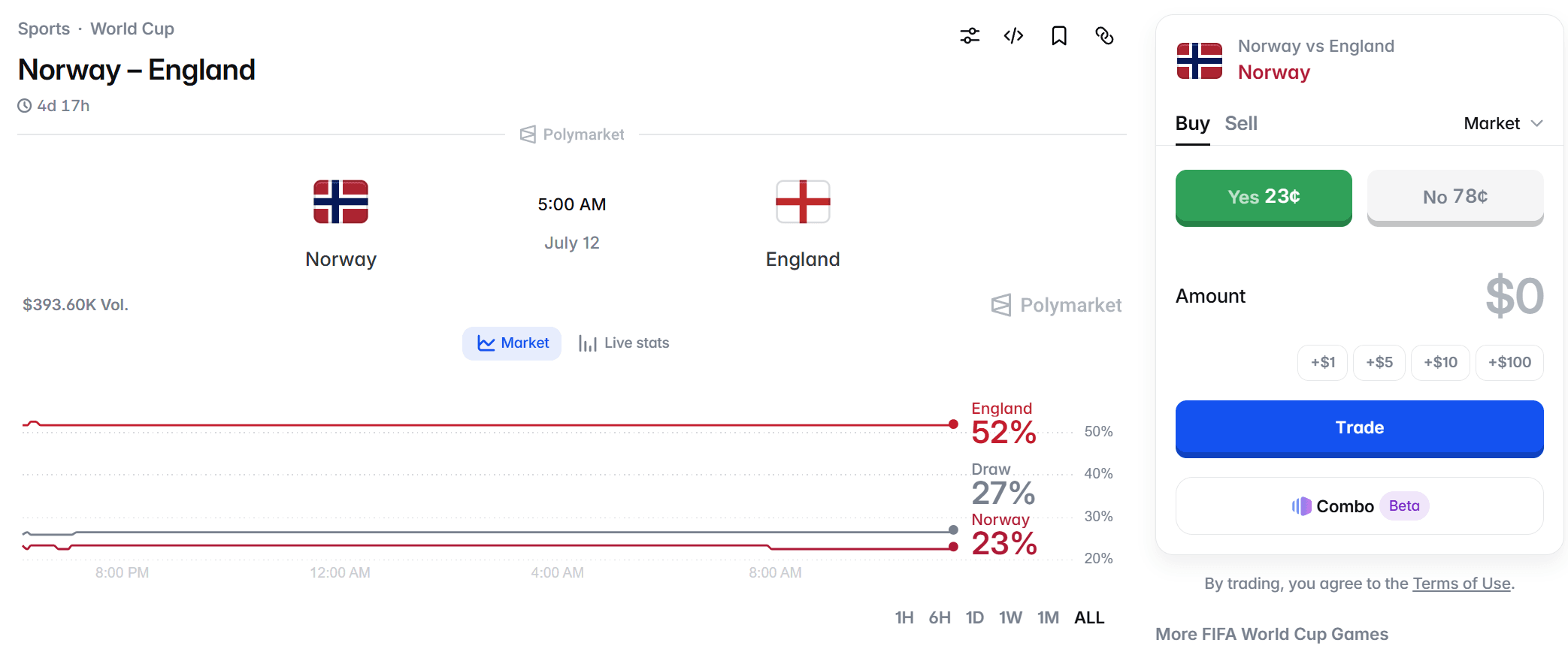
Norway vs England Prediction: Can Haaland Shock England?
Explore Norway vs England prediction, Polymarket crypto odds, Haaland impact, team analysis, and key factors shaping this World Cup clash.
Prediction Market Regulations: What WEEX Users Should Know Before Trading Event Contracts
Prediction market regulations vary by country, state, event type, and platform structure. This WEEX-style education guide explains the main regulatory issues around event contracts, election markets, sports outcomes, crypto prediction markets, and user risk checks without treating prediction markets as a WEEX trading product.
How to Make Money on Prediction Markets: Strategies, Risks, and What WEEX Users Should Know
Prediction markets can create profit opportunities when traders price future events better than the crowd, but they also carry liquidity, legal, settlement, and behavioral risks. This WEEX-style education guide explains how prediction market profits work, why they are not guaranteed, and how crypto users can treat prediction markets as an external research theme rather than a WEEX trading product.

How to Buy WXT Token: A Beginner’s Guide to WEEX Token Trading
WXT is the native platform token of the WEEX ecosystem. This beginner-friendly guide explains how to buy WXT on WEEX, what to check before trading, how to manage risk, and how users can review WXT’s role within the exchange ecosystem before placing an order.
Is WXT Token a Good Investment? Benefits, Risks, and Key Factors to Watch
WXT may interest users who want exposure to the WEEX ecosystem, but it is still a volatile crypto asset with platform, liquidity, and market-cycle risks. This WEEX-style guide explains how beginners can evaluate WXT’s potential benefits and risks before making any trading decision.

Polymarket vs. Polls: What Prediction Markets Say About the 2026 Midterm Races
Polymarket-style prediction markets and traditional polls measure different things. This WEEX-style market review explains how users can compare election odds, polling data, liquidity, and political risk signals around the 2026 U.S. midterm races without treating prediction markets as a WEEX trading product.
Is Election Prediction Market Legal? State Bans vs. CFTC Lawsuits Explained
Election prediction markets sit between federal derivatives law, state gambling rules, and crypto-native event trading. This WEEX-style guide explains why legality depends on platform structure, jurisdiction, CFTC oversight, and state enforcement, while reminding users to treat election markets as an external regulatory topic rather than a WEEX trading product.

AI Memory Supercycle Debate: Why Big Tech's Margin Panic Just Confirmed SanDisk's NAND Advantage
Why is SanDisk (SNDK) surging in 2026's AI memory supercycle? See how Apple, Microsoft, and Big Tech's margin panic confirmed NAND pricing power, plus Bernstein's $3,000 target, key risks, and what to watch next.
SNDK Stock Dip After Apple's Price Shock: Trap or Last Chance Before $3,000?
SNDK stock dipped 12%+ after Apple's price hike shock — but Bernstein just raised its target to $3,000. Is the SanDisk dip a trap or a buying opportunity? Full analysis with latest data, analyst targets, and risks.

United States Water Reserve (USWR): Can You Buy It Now? Price Outlook and Risk Guide
United States Water Reserve (USWR) has attracted attention because of its water-reserve narrative, but users should first confirm whether the token is actually tradable before looking for a buy route. This guide explains how WEEX users can track USWR, avoid fake links, and evaluate its price outlook with caution.

Is America 250 Coin a Cryptocurrency? Official Commemorative Coin vs Meme Token Explained
America 250 Coin can refer to official U.S. commemorative coinage or unofficial crypto tokens using similar patriotic branding. This guide explains the difference between physical commemorative coins and speculative meme tokens, and what WEEX users should verify before trading any America 250-themed crypto asset.

Gold Crash or Buying Opportunity? What the Market Is Really Telling Us
Gold crash or buying opportunity? Learn why gold prices fell, how Fed policy and crowded trades affect the market, and how PAXG and XAUT fit into tokenized gold trading.
WXT Token Trading Risks: Liquidity, Platform Dependence, and Price Volatility Explained
WXT is connected to the WEEX ecosystem, but traders still need to understand liquidity, platform dependence, volatility, market cycles, and execution risk before entering a position. This guide explains how WEEX users can evaluate WXT with a practical risk framework.

Why Are Prediction Markets Booming? Polymarket, Kalshi, and the On-Chain Trading Narrative
Prediction markets are gaining attention because they turn real-world uncertainty into tradable probabilities. This WEEX-style market review explains why Polymarket, Kalshi, stablecoins, social media, and on-chain trading narratives are pulling more traders toward event-based markets.

Are Prediction Markets Investing or Gambling? Key Regulatory Risks Before Trading
Prediction markets sit between finance, forecasting, speculation, and gambling. This WEEX Wiki article explains why the regulatory line is blurry, what beginners should check before trading event contracts, and why users should treat prediction market odds as external research rather than a WEEX trading product.

QCOM Stock Forecast 2026: Will Qualcomm's AI Push Revalue the Stock?
QCOM stock forecast 2026: Explore Qualcomm’s AI data center push, AI phones, growth drivers, risks, and USDT-based TradFi trading on WEEX.

SpaceX Starlink Launch Vandenberg June 2026: Southern California Visibility Guide
SpaceX Starlink launch Vandenberg June 2026 visibility guide for Southern California with today’s liftoff time, best viewing areas, weather-based outlook, and live update details.
SpaceX Starlink Launch Vandenberg: Live Updates and Liftoff Time for Today
SpaceX Starlink launch Vandenberg live updates and liftoff time for today’s launch. Get the latest timing, Starlink 17-28 details, 24-satellite payload info, and current countdown updates.
Why SpaceX and OpenAI IPOs Are Draining Bitcoin Liquidity
Why SpaceX and OpenAI IPOs are draining Bitcoin liquidity in 2026, including IPO flow impact, BTC ETF outflows, AI stock rotation, and market implications.
Is SpaceX IPO a Good Investment? SpaceX Stock, Valuation, Risks & Future Growth Explained
Is SpaceX IPO a good investment? Explore SpaceX stock valuation, Starlink growth, IPO risks, future potential, and whether buying SpaceX shares makes sense in 2026.
What Is Project Oasis Coin (PXR) Crypto? Latest 2026 Guide to PXR Price, Solana Contract And More
What is Project Oasis Coin (PXR) crypto? Read the latest 2026 guide to PXR price, Solana contract, market cap, legitimacy, risks, and how to trade safely.
Rardden Token AI Transaction Framework: Why It Matters in 2026
Why Rardden Token is introducing a new AI transaction framework, what RDN claims to solve, latest project update, risks, contract details, and AI crypto insights.

USWR Price Prediction: Can United States Water Reserve Hit $1?
Can United States Water Reserve hit $1 in 2026? USWR has started attracting attention because it combines several powerful crypto narratives: Solana tokens, AI infrastructure, water demand, real-world asset language, and scarcity around natural resources. That mix can create strong market interest, but it also makes careful research more important.
Can CDOF Reach $1 in 2026? Chinese Digital Oil Fund Price Prediction
Can CDOF reach $1 in 2026? That question has started appearing because Chinese Digital Oil Fund, or CDOF, has gained attention as a Solana-based token with an energy-themed narrative. The name sounds serious, but traders should separate the branding from the actual market structure before making any price prediction.

Can XRP Reach $10 in 2026? XRP Price Prediction and Market Cap Analysis
Can XRP reach $10 in 2026? It is one of the most searched questions around large-cap crypto assets because XRP has a long market history, deep liquidity, and one of the strongest brand names in digital assets. But a $10 target is not just about popularity. It depends on supply, valuation, market demand, XRP Ledger adoption, and whether the broader crypto market can support another major altcoin expansion.
Futu Penalty Shock Exposes Brokerage Risk — Why WEEX TradFi Fits Traders Who Want Faster Global Market Access
Futu stock falls after China penalty news. Learn why FUTU shares dropped, how the latest crackdown affects traders, and why WEEX TradFi offers USDT-margined access to stocks, gold, oil, forex, and indices in one account.
France vs Morocco Prediction Crypto Odds
France vs Morocco Prediction Crypto Odds explained. Learn how Polymarket market data, blockchain prediction markets, liquidity, and crypto odds work during FIFA 2026.
Why Does SpaceX Own 18,712 Bitcoin? Here's What SPCX's Nasdaq 100 Entry Means for Crypto
SpaceX owns 18,712 Bitcoin worth $1.2B+. SPCX joined Nasdaq 100 on July 7 triggering $4.3B in passive buying. What it means for crypto and BTC price in 2026.
What Is Aptos (APT) Crypto and How Does It Work? The 2026 Complete Guide
What is Aptos (APT) crypto? Learn how it works, Block-STM tech, tokenomics, April 2026 reforms, current price, ecosystem, and whether APT is a good investment in 2026.
Where and How to Buy MSTR Futures: A Complete Trading Guide
Learn where and how to buy MSTR Futures, explore traditional stock access methods, and discover USDT-based MSTR price exposure through WEEX TradFi trading. Join the TradFi Trading Challenge for potential rewards.
Norway vs England Prediction: Can Haaland Shock England?
Explore Norway vs England prediction, Polymarket crypto odds, Haaland impact, team analysis, and key factors shaping this World Cup clash.
Prediction Market Regulations: What WEEX Users Should Know Before Trading Event Contracts
Prediction market regulations vary by country, state, event type, and platform structure. This WEEX-style education guide explains the main regulatory issues around event contracts, election markets, sports outcomes, crypto prediction markets, and user risk checks without treating prediction markets as a WEEX trading product.

Latest articles



Latest coin listings on WEEX


