
The world's largest social platform Telegram has a major update: Your GPU can now mine TON.

 Prefer us on Google



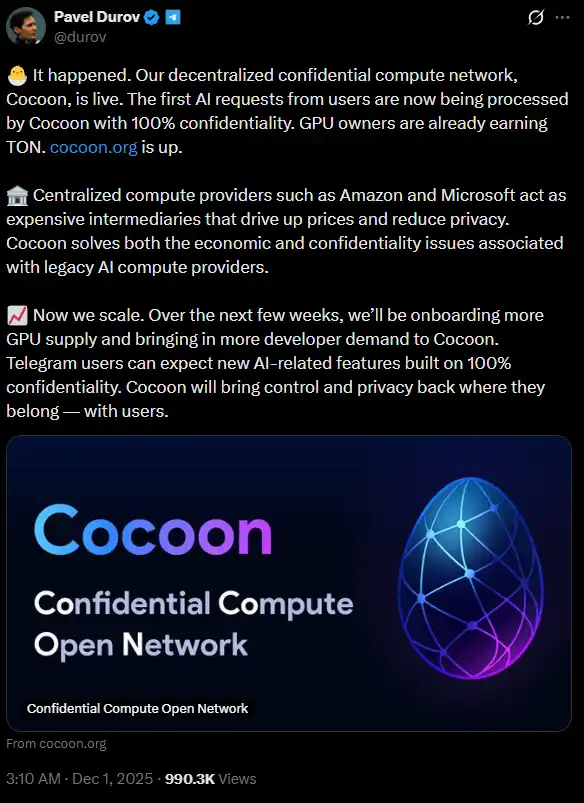
Yesterday, Telegram founder Pavel Durov tweeted to announce that their decentralized privacy computing network, Cocoon, has officially launched.
The Cocoon network consists of 3 parts:
Client: Initiates work requests to the agent and pays the agent upon request completion.
Agent: Routes work requests to work nodes. The agent, protected by TEE, will select an appropriate node based on the device model, load, and reputation of the work node, and will transfer the fee collected from the client to the node, which will also deduct a certain commission. Telegram plans to allow anyone to run their own agent in the future, making the Cocoon network fully decentralized.
Work Node: Executes AI inference requests in a TEE-protected virtual machine and is paid by the agent the fee from the client upon completion of the execution.
In other words, anyone can become a work node with their GPU to earn $TON. Cocoon enables GPU owners to contribute AI computing power to the decentralized network on TON by running the Cocoon protocol stack on a TEE-supported GPU server, providing private, verifiable AI model execution, and transparently receiving $TON payment for each processed request.
Pavel Durov stated that some AI-related features of Telegram, such as message translation, are already partially supported by Cocoon. He also mentioned Telegram's in-app features like speech-to-text and summarization, indicating that Cocoon initially lacks practical applications and believes that Telegram mini-programs will bring more demand for the Cocoon network in the future.
Compared to the previously hyped Telegram gift NFT in the crypto community, Cocoon is more like a decentralized AI computing network built by Telegram integrating blockchain and $TON as a payment method, stemming from the functional requirements within Telegram, with limited hype potential as it is unlikely to issue a coin. However, this project may reflect a long-term trend where there is increasing attention to the privacy concerns of exposing data directly to centralized AI giants when using AI. In the crypto community, we have seen more and more projects in the privacy track advocating for "protecting data sovereignty." (Related Read: 12 New Projects, an Overview of the Privacy Projects Officially Recognized by Solana)
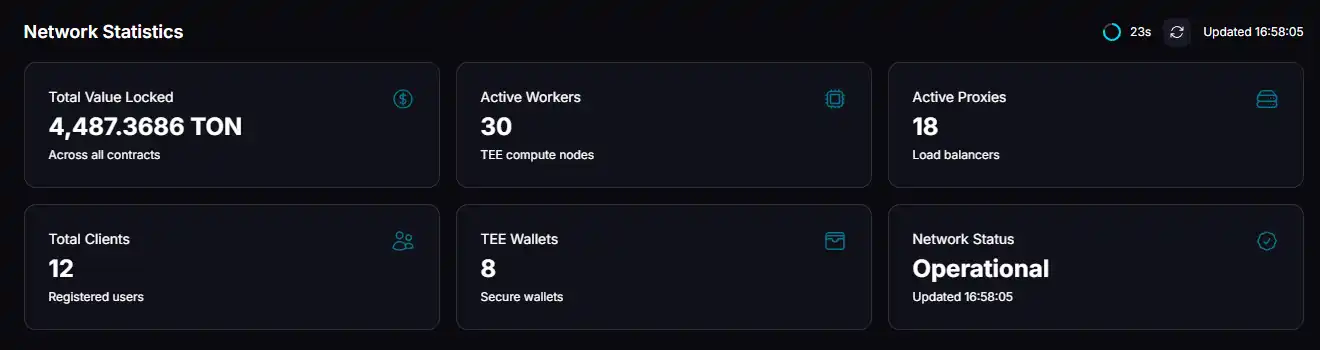
Currently, the total TVL of the Cocoon Network has reached around 4487 TON, with 30 working nodes, 18 delegates, and 12 clients. This data is from just over 1 day since its official launch, still very early.
There is practical application demand supported by Telegram's built-in features and TON incentives. However, due to the presence of TON incentives, the expectation of coin issuance has also been reduced. Whether the Cocoon Network can follow a development pace different from that of typical cryptocurrency projects in the industry remains to be seen and will require time to validate.
Disclaimer: This content is provided for general branding and informational purposes only and doesn't constitute financial, investment, legal, or tax advice. Any events, rewards, online events, or related information mentioned herein should not be considered a recommendation, solicitation, or invitation to purchase, sell, trade, or otherwise deal in any crypto assets or to use any services. Crypto assets are highly volatile and may result in loss. WEEX services and online events may not be available in all regions and are subject to applicable laws, regulations, and eligibility requirements. You are responsible for ensuring that your use of WEEX services complies with local laws and for carefully assessing the risks before participating in any crypto-related activities.
You may also like

Bank of America: Keep an Eye on the Japanese Market, It Will Be the "Canary in the Coal Mine" for a Global Decline

AscendEX Exchange Announces Shutdown! Concerns Over Insufficient Hot Wallet Assets Rise, Users Panic Withdrawals
Computing Capital Markets
IPCA Below Expectations in June: What It Means for the Dollar and Interest Rates
SemiAnalysis Latest Interview: Storage Has Room to Double, Be Cautious with CPO in the Short to Medium Term, CPU is Just a Supporting Role

FDV vs market cap: The two numbers that decide if a token is cheap

Is Ethereum Really a 'World Computer'?

An Investor's 17 Judgments on Embodiment, Models, and Computing Power
The Intellectual Arbitrage Trap of Bittensor: Capital Only Speculates on Tokens, Quality AI Goes Unnoticed

Litecoin Wallet Addresses Grow by Over 22 Million in Just 6 Months

Shiba Inu: After a Pause, Eternity and Metaverse Projects Prepare for Their Return

What are wallet drainers? Inside the approval-phishing industry
The Era of AI Trading Has Arrived: LTP Launches the World's First AI Agent Live Quantitative Trading Championship

Can Changing Chains Really Change the Game?
Revolut integrates its crypto exchange with AI assistants as agentic trading spreads
DOJ charges inmate over alleged $290K forfeited crypto theft

June Trading Volume Doubles: x402 Ecosystem Continues to Expand, Content Monetization Narrative Faces Key Test

Walsh's 'Unified Front': Aiming for Rate Cuts?

Ethereum vs Solana Whitepaper Comparison (2026)

French Tech: AI and Quantum on the Rise, Crypto Absent

Home Robot NEO Grows "Dexterous Hands": How Do Hands Become the API to the Physical World?

What is SCEX? The Cryptocurrency Exchange for Vietnam's Market by Sacombank
Major Update for ChatGPT: Cross-Platform Functionality, One-Click Website Creation, and Lower Costs

BTC Challenges 64,000 After Breaking 63,000, Market Trading 'Manageable Risks'
As the Bubble Bursts, Who Dominates Attention in the AI Era? A 2026 Guide to Influential AI KOLs in China and the UK

Old Money in Crypto Shifts: Paradigm Raises $1.2 Billion, Half Bet on AI and Robotics

Bitdeer unveils $36M Nevada factory to shake up Bitcoin mining
Perplexity Fine-Tuned a Chinese AI Model to Match Claude Opus 4.8 at One-Third the Cost

Bank of Korea defends bank-first stablecoin plan amid bill deadlock
JPMorgan says bitcoin's main risk isn't Strategy, but blockchain adoption that doesn't benefit public chains and tokens
Bank of America: Keep an Eye on the Japanese Market, It Will Be the "Canary in the Coal Mine" for a Global Decline
AscendEX Exchange Announces Shutdown! Concerns Over Insufficient Hot Wallet Assets Rise, Users Panic Withdrawals
Computing Capital Markets
IPCA Below Expectations in June: What It Means for the Dollar and Interest Rates
SemiAnalysis Latest Interview: Storage Has Room to Double, Be Cautious with CPO in the Short to Medium Term, CPU is Just a Supporting Role
FDV vs market cap: The two numbers that decide if a token is cheap

Contents
Latest articles






Latest coin listings on WEEX


