
The person who helped TAO rise by 90% has now single-handedly crashed the price again today

 Prefer us on Google
Original Title: "The Person Who Helped TAO Surge 90% Today Personally Crashed the Price Again"
Source: DeepTech TechFlow
TAO suddenly plummeted by 15% today, now trading at around $277, with a downward trend.
The cause of the sudden price drop may be an open letter.
The letter was written by Sam Dare, the founder of Covenant AI. Bittensor is currently the highest-valued project in the AI+Crypto track, and Covenant AI is the most important subnet team in its ecosystem.
Just last month, this team achieved a major milestone by running a 72B parameter mega-model called Covenant-72B using civilian hardware from over 70 contributors, claiming to be the largest decentralized AI training ever.
A month ago, this event made TAO the brightest narrative in the entire crypto circle, exuding a sense of AI glory.
NVIDIA CEO Jensen Huang publicly praised it, and Silicon Valley prominent investor Chamath mentioned it on his podcast. The price of $TAO even surged by 90% in a month, shining brightly in the current bear market environment.
However, today, Sam Dare announced the departure of the team from Bittensor, conveniently dismantling the foundation of this narrative.
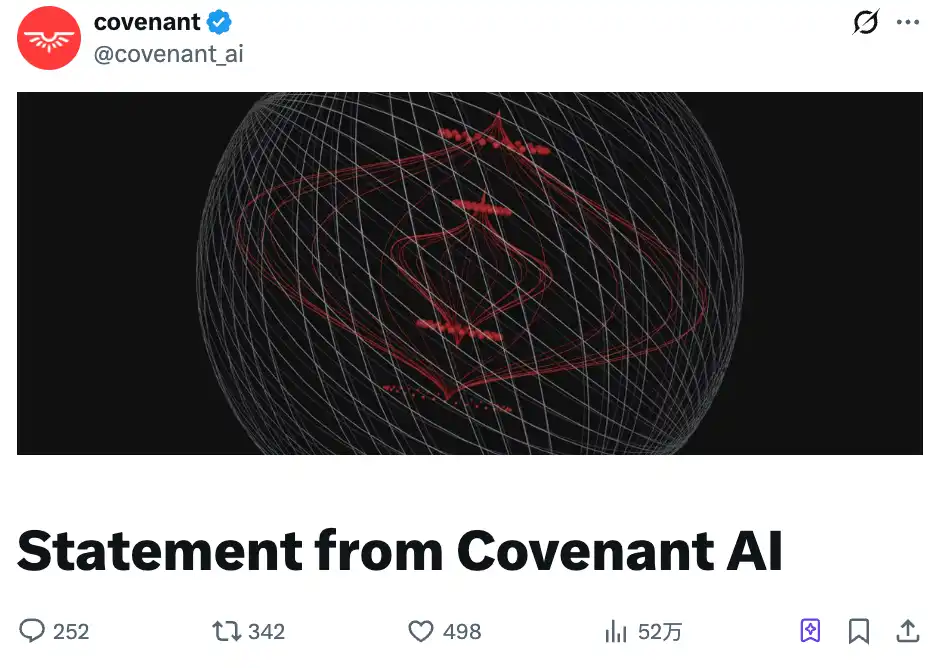
Sam Dare's open letter is lengthy, but the core allegation revolves around one thing:
Bittensor's founder Jacob Steeves (commonly known as Const within the circle) single-handedly controls the entire network, decentralization is just a facade.
In the letter, he listed a series of actions, with the harshest being the direct suspension of the Covenant subnet's emissions, essentially reducing the team's income to zero; and engaging in significant token sales during the conflict period to apply pressure, using market tactics to force compliance.
The newly launched whistleblower website Tao Papers today provided even stronger evidence. According to on-chain data disclosed by the website, from 2023 to 2026, Bittensor underwent a total of 41 network upgrades, with 38 of them going from proposal to signing to deployment, all from infrastructure controlled by Const, with the other two signers co-signing within minutes each time, without any public discussion records.
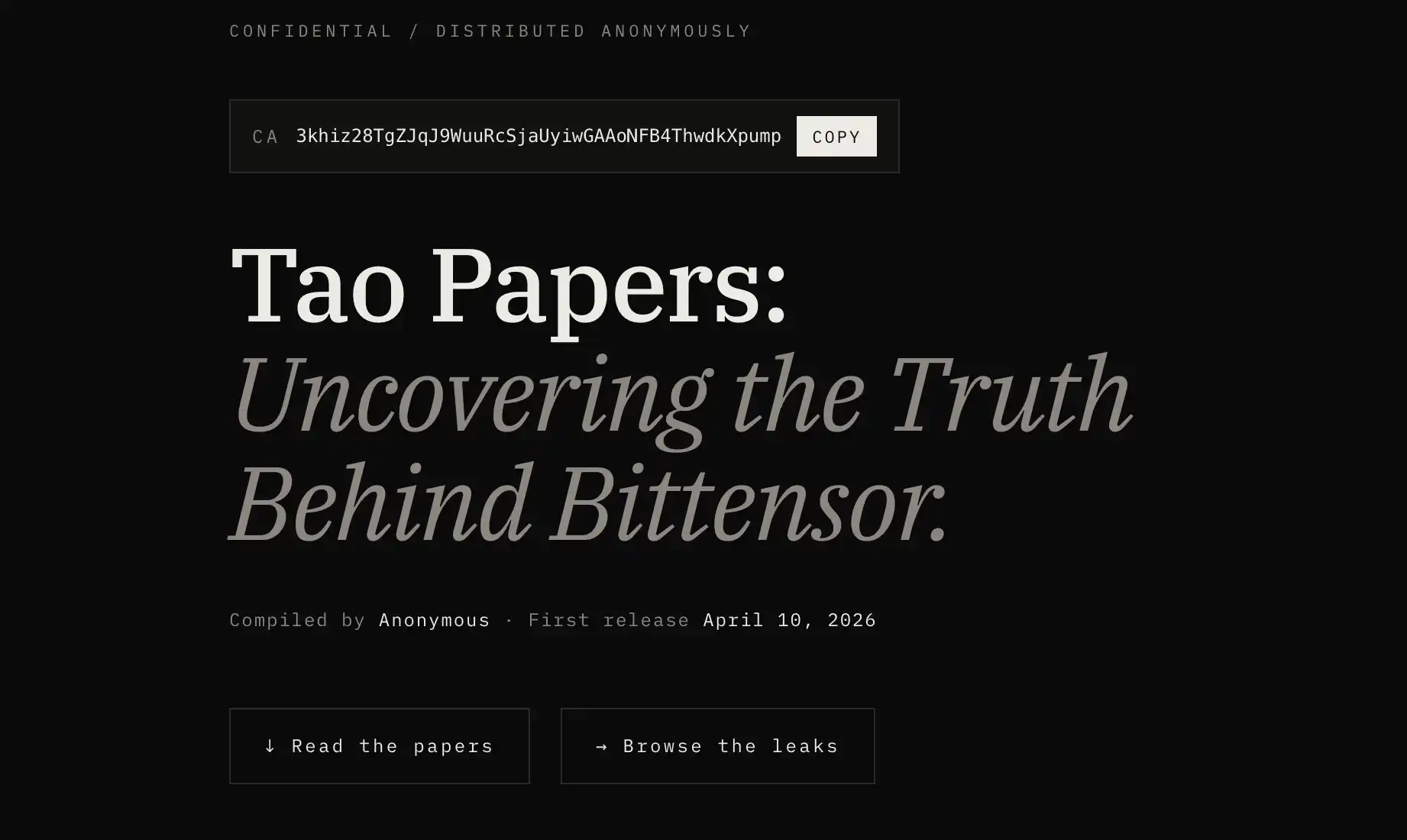
The so-called three-person "governance committee" is actually one person making decisions, with the other two providing endorsements.
The public letter and whistleblower website went live on the same day, clearly indicating that Sam's actions were not impulsive.
Correspondingly, just two months ago, Bittensor's founder, Const, announced his resignation as the CEO of the Opentensor Foundation (the development foundation behind Bittensor), citing a push for decentralization.
Simultaneously, after Sam announced his departure, on-chain data also revealed that he had sold all of his 37,000 TAO tokens, triggering further market FUD.
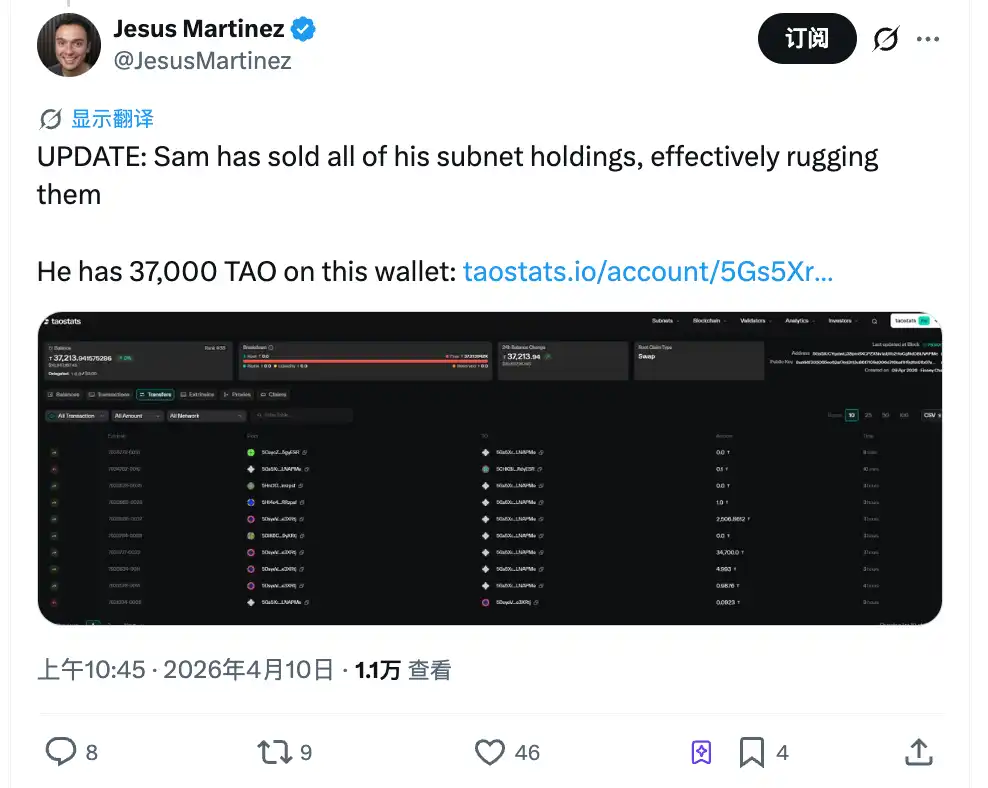
As of now, Const's only response to all this is a statement that essentially implies Covenant's departure is actually a good thing, as it can give rise to a team-independent, self-running subnet.
As for the accusations listed by Sam Dare, not a single word has been responded to. However, whether it's a public feud or contributions, it has already been priced in by the market.
In March, $TAO rose from around $170 to $337, nearly doubling. According to The Block, two weeks after Covenant-72B was released, TAO surged by over 50%, marking the largest single catalyst in the entire 90% rally.
CovenantAI is associated with Templar, Basilica, and Grail (sn3, sn39, and sn81), and the subnet tokens are linked to TAO through a staking mechanism. Upon the release of Covenant-72B, subnet tokens saw up to a 400% increase, pulling TAO along with them.
So, those buying TAO are ostensibly buying into a decentralized AI network with over a hundred subnets, but the price structure tells a different story, with almost half of the surge attributed to a single team.
Success is Covenant, failure is also Covenant. This sentence has been mentioned by many people today, but most only see the surface meaning.
What is more worth pondering is why a network claiming to have 125 subnets, when rising, relies on a few subnets to drive up the price, and when falling, also relies on the drama of a few subnets to push the price down. More subnets are almost invisible in these two market cycles.
Bittensor's decentralized narrative has been sold for three years, and the price structure always seems centralized. As for who is right or wrong in the conflict itself, the author doesn't think that's the point.
Any ecosystem will have star teams, and any star team may also leave.
The hard part is how you deal with this.
In a bear market, team infighting in crypto projects is not uncommon. When the market lacks hotspots, whether a project goes up or not depends entirely on whether there is a narrative to hype. Covenant-72B is one of the best narratives this year, endorsed by Huang Renxun, doubling in TAO, and everyone in the community thinks that decentralized AI has finally produced a competitive player.
But there is a natural issue with narrative-driven price increases—those who create the narrative can also destroy it. When it rises, it is the light of crypto; when it falls, it is the team fleeing. For those who bought TAO, the 90% you earned and the 15% you lost today come from the same source.
This may be the most genuine investment dilemma in crypto right now. The price always follows a narrative that emerged who knows when, and the narrative is tied to certain key individuals.
While people are around, the story is there; when people leave, you may not even find a counterpart to trade with.
-- Price
This content is provided for general informational purposes only and doesn't constitute financial, investment, legal, or tax advice. Any events, rewards, online promotions, or related information mentioned herein should not be considered a recommendation, solicitation, or invitation to purchase, sell, trade, or otherwise deal in any crypto assets. Crypto assets are highly volatile and may result in loss. The availability of WEEX services, products, and related events may vary by region. You are responsible for ensuring that your participation is in accordance with applicable local laws and regulations.
You may also like

The Hong Kong Securities and Futures Commission urges the SFC to optimize the CVAP exam, focusing on the operational costs of the new virtual asset policy

Bittensor new proposal: Validators may become active fund managers to reduce subnet token selling pressure

New Types of Information Laundering in Prediction Markets: How Secrets Integrate into Investment Signals

Top 12 Cryptocurrencies to Invest in April 2026
Key Takeaways: Bitcoin remains the dominant player with a $1.42 trillion market cap. Hyperliquid’s HYPE token gains traction,…

A Bittensor Developer Exits After Dumping 37,000 TAO Cryptos: Governance Crisis in Full Swing?
Key Takeaways: TAO price plummeted to $249, about 68% drop from its peak of $767.68, due to governance…

Top AI Tokens to Watch in 2026: Which AI Coins Are Worth Accumulating Early?
Looking for the best AI crypto tokens to invest in before the next market cycle? This guide explains what AI coins are, why 2026 could be a key accumulation window, and which infrastructure, AI agent, and data-layer projects may have strong long-term growth potential.
IOSG: TAO is like the Elon Musk who invested in OpenAI, Subnet is like Sam Altman

TAO is Elon Musk, who invested in OpenAI, and Subnet is Sam Altman

Morning News | Ether Machine terminates $1.6 billion SPAC deal; SpaceX holds approximately $603 million in Bitcoin; Michael Saylor releases Bitcoin Tracker information again

The latest disclosed candidate asset list from Gray includes HYPE, STX, VIRTUAL, and others

Top 5 Cryptos to Buy in 2026 Q1: A ChatGPT Deep Dive Analysis
Explore the top 5 cryptos to buy in Q1 2026 including BTC, ETH, SOL, TAO, and ONDO. See price outlooks, key narratives, and institutional catalysts shaping the next market move.
Bittensor co-founder responds to Covenant AI's accusations: no authority to suspend subnet emissions, and the amount sold is less than 1% of the investment

Why did Covenant AI flee from Bittensor?
Q1 Market Review: Traditional Assets Enter the Blockchain Era; Geopolitical Turbulence Puts Pressure on the Cryptocurrency Market

Grayscale Submits Initial GTAQ S-1 File to SEC

Venture Capital Post-Mortem 2025: Hashrate is King, Narrative is Dead
TAO Surges Above $520, Marking an 18.76% Increase in 24 Hours

10x Research: Bittensor subnet staking scale exceeds 600 million USD, possibly driven by strong momentum from AI narratives
Bittensor vs. Virtuals: Two Distinct AI Flywheel Mechanisms
Bittensor Ecosystem Token SN Surges 5x in March, What's Behind Richard Heart's One-Liner?
Data: Most of the cryptocurrency market is up, with the Meme sector rising by 5.09%, while only the GameFi and PayFi sectors are down

Bittensor (TAO) +18%: Essential Insights for Investors
Key Takeaways: The Bittensor (TAO) market has shifted from speculative potential to verified utility, marking an 18% rise…
Bittensor Surge: Understanding the TAO’s Bullish Performance and Institutional Inflows
Key Takeaways: Bittensor (TAO) is regarded as a key asset for institutional investors with a recent listing on…
Safello’s Bittensor Staked TAO ETP on Nasdaq Stockholm: A New Horizon
Key Takeaways: Bittensor Staked TAO ETP (STAO) by Safello is now listed on Nasdaq Stockholm. The ETP offers…

Bittensor (TAO) +18%: Critical Insights for Investors
Key Takeaways: Bittensor’s (TAO) recent 18% surge indicates a shift from potential to proven utility. The asset’s trading…
Data: The cryptocurrency market has generally risen, the AI sector has increased by over 10%, while only the RWA sector has seen a slight decline
Data: Today's price changes of the top 100 cryptocurrencies by market capitalization
Data: The cryptocurrency sector continues to rise, BTC breaks through the $72,000 mark, ETH rises over 4%
Who Will Control AI? Why Decentralized AI May Be the Only Alternative to Government and Big Tech
AI has become critical infrastructure, and governments and corporations are competing to control it. Centralized development and regulation are entrenching existing power structures. The Web3 community is building a decentralized alternative — distributed compute, token incentives, and community governance — before that window closes.
Data: The cryptocurrency sector is experiencing a broad increase, with the AI sector leading with over 7%, and BTC breaking through 70,000 USD
The Hong Kong Securities and Futures Commission urges the SFC to optimize the CVAP exam, focusing on the operational costs of the new virtual asset policy
Bittensor new proposal: Validators may become active fund managers to reduce subnet token selling pressure
New Types of Information Laundering in Prediction Markets: How Secrets Integrate into Investment Signals
Top 12 Cryptocurrencies to Invest in April 2026
Key Takeaways: Bitcoin remains the dominant player with a $1.42 trillion market cap. Hyperliquid’s HYPE token gains traction,…
A Bittensor Developer Exits After Dumping 37,000 TAO Cryptos: Governance Crisis in Full Swing?
Key Takeaways: TAO price plummeted to $249, about 68% drop from its peak of $767.68, due to governance…
Top AI Tokens to Watch in 2026: Which AI Coins Are Worth Accumulating Early?
Looking for the best AI crypto tokens to invest in before the next market cycle? This guide explains what AI coins are, why 2026 could be a key accumulation window, and which infrastructure, AI agent, and data-layer projects may have strong long-term growth potential.