
Paul Atkins Elected as New SEC Chairman, What Lies Ahead for the Future of Crypto?




On the early morning of December 5th, Trump announced on Truth Social that Paul Atkins has been confirmed as the Chairman of the U.S. Securities and Exchange Commission. In his statement, he wrote:
“I am pleased to announce the nomination of Paul Atkins as the next Chairman of the U.S. Securities and Exchange Commission.
Paul is an outstanding leader who advocates for common-sense regulation. He believes that strong and innovative capital markets can meet the needs of investors and provide capital support to drive our economy to be the strongest in the world. He also deeply understands that digital assets and other innovations are crucial to making America even greater.
Paul is the CEO and Founder of Patomak Global Partners, a consulting firm focused on risk management. Since 2017, he has served as Co-Chair of the Chamber of Digital Commerce's Token Alliance, dedicated to researching and advancing the digital asset industry. From 2002 to 2008, he served as a Commissioner of the U.S. Securities and Exchange Commission, during which he strongly advocated for transparency and investor protection. He holds a J.D. from Vanderbilt University Law School and an A.B. from Wofford College, graduating with highest honors and is a member of Phi Beta Kappa.”
Congratulations to Paul and his beautiful wife Sarah and their sons Stewart, Peter, and Henry.

Who is Paul Atkins?
Paul Atkins is a former SEC Commissioner during the George W. Bush administration, known for his opposition to imposing significant fines on companies violating securities laws. He previously opposed the Dodd-Frank Act, which aimed to strengthen federal regulatory powers after the 2008 financial crisis.
In 2016, Atkins played a key role in Trump's presidential transition team, influencing Trump's laissez-faire approach to financial regulation.
Currently, Atkins still serves at his consulting firm, Patomak Global Partners, founded in 2009. Since 2017, he has also been serving as Co-Chair of the Token Alliance, an industry association advocating for digital assets and the blockchain industry.
After Trump announced Paul's election as SEC Chairman, RSR experienced a short-term surge of 27%, with the price currently at $0.0231.
The reason for the association with RSR is that the community discovered Atkins had served as an advisor to the project.
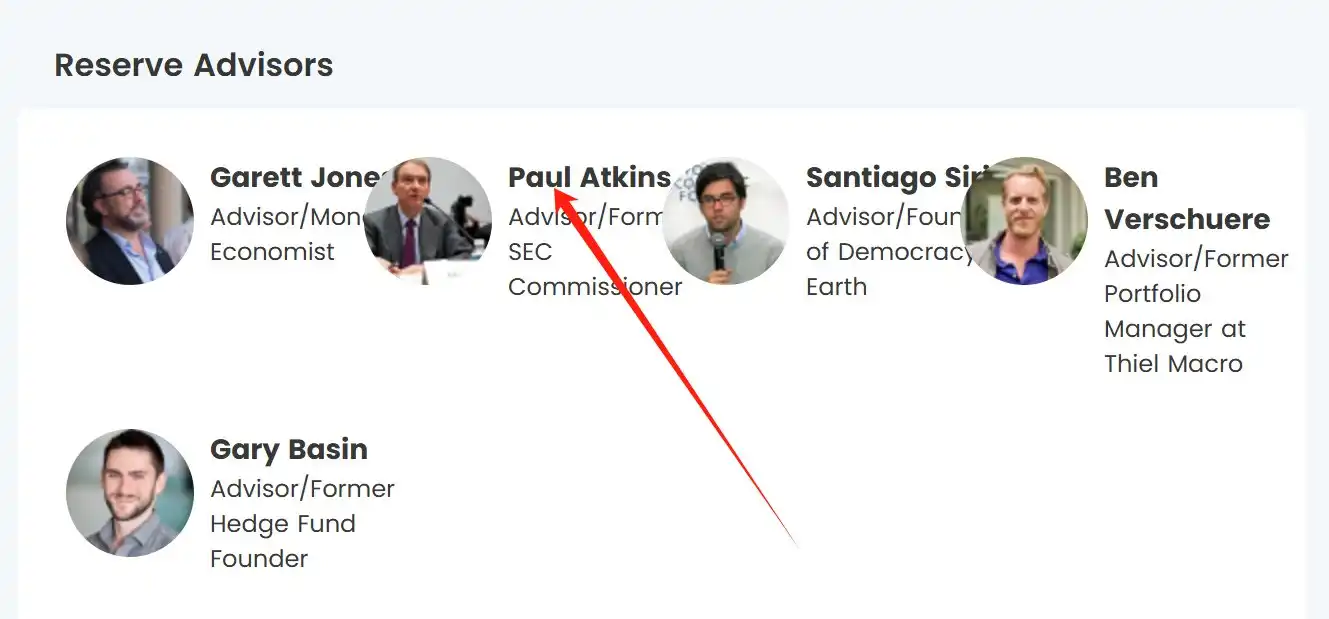
Meanwhile, Reserve founder Nevin Freeman previously explained, "Paul is not currently actively involved in advising Reserve. He was an early advisor to the project. However, in our interactions, his open-mindedness impressed me, and his willingness to publicly serve as a Reserve advisor indicates his commitment to and support of the cryptocurrency space."
What are some SEC Chairman Pump and Dump Concepts
RSR
Reserve Rights (RSR) is a dual-token stablecoin platform launched on the Huobi Prime platform in May 2019. Reserve aims to establish a stable, decentralized stablecoin and digital payment system, with stablecoins that have a self-adjusting supply pegged to demand and feature 100% or more on-chain collateralization.
The main issue that RSR attempts to address is volatility because cryptocurrency volatility limits the market's expansion as a medium of exchange. Due to concerns about potentially losing profits during market downturns, merchants have been reluctant to accept cryptocurrency. The Reserve protocol provides the market with a stable value store, medium of exchange, and deferred payment standard. Today, the focus of the Reserve Rights ecosystem is to help individuals, ministries of finance, and DAOs combat inflation.
RSR has a total supply of 100,000,000,000 tokens, with a current market capitalization of $1,390,407,126 and a TVL of $278,254,588.
DTF
DTF is a meme coin that is not directly related to the Decentralized Token Folios protocol introduced by Reserve. Its full name is "Believe In Something," corresponding to the DTF website's theme "Stop trading, believe in something."
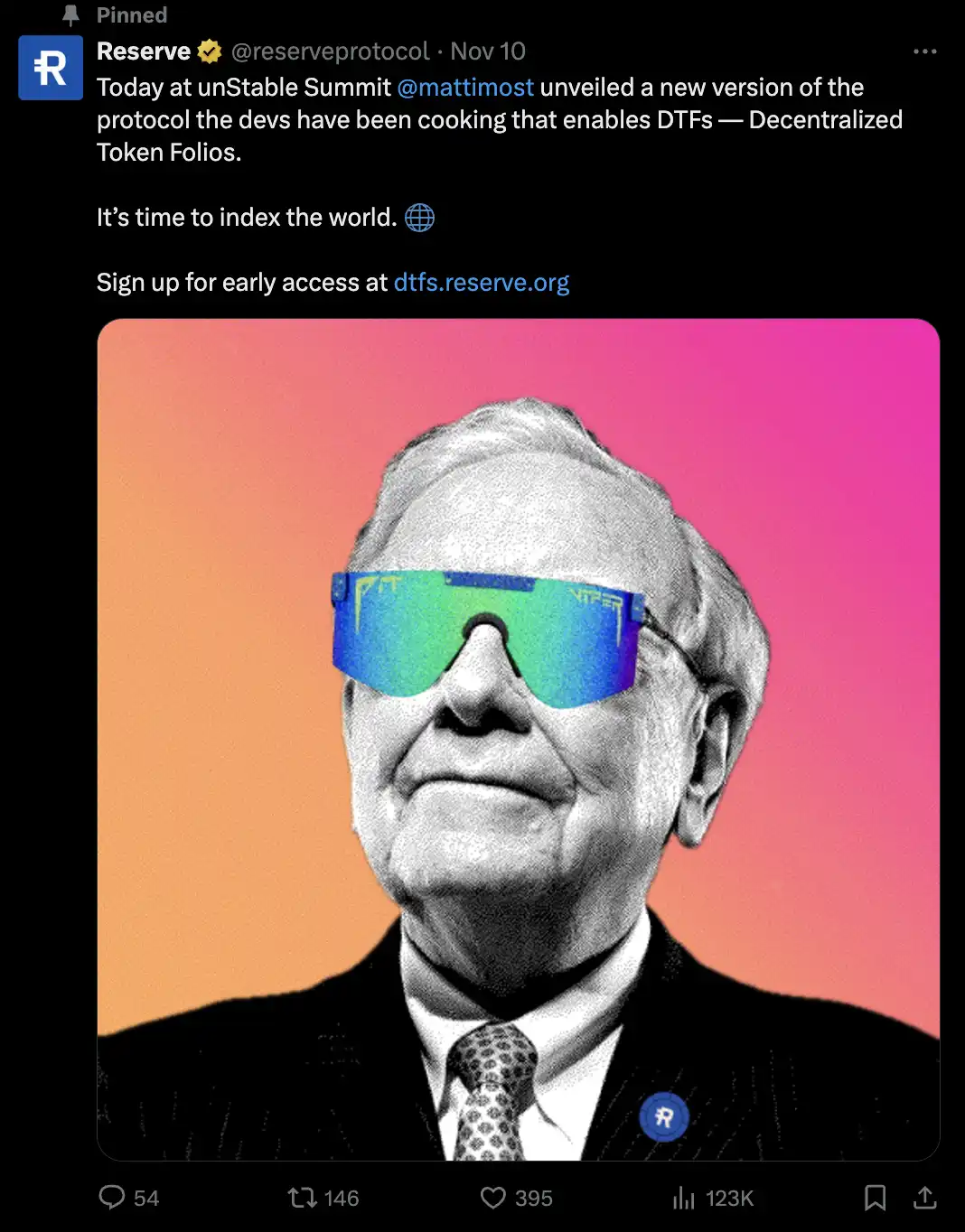
Currently, DTF has a total market value of $23.9 million with a 24-hour trading volume of $20 million.
XRP
XRP Surges Fivefold in a Month, Reclaims Third Place in Crypto Assets by Market Cap, returning to its pre-2020 SEC and Ripple lawsuit levels, making this veteran token one of the strongest performing altcoins recently.
Related Reading: "XRP Returns to Third Place in Crypto Market Cap, What Is Driving Its Surge?"
Ripple is a real-time gross settlement system, currency exchange, and remittance network created by the American technology company Ripple Labs Inc. Ripple was released in 2012, based on an open-source, distributed protocol that supports tokens representing fiat currency, cryptocurrency, commodities, or other value units. It claims to enable "secure, instant, and nearly free global financial transactions of any size, no chargebacks."
With a series of crypto-related policies introduced after Trump took office, XRP's path was significantly influenced by the current SEC chairman's announcement of resignation. In December 2020, the SEC sued Ripple and its two executives—CEO Brad Garlinghouse and co-founder Chris Larsen—alleging that they "conducted an unregistered $1.3 billion securities offering." However, this lawsuit has yet to reach a conclusion.
On December 1, former CFTC Chairman Chris Giancarlo stated in an interview that the SEC should rethink its approach, especially in light of recent legal outcomes and the changing regulatory landscape. When asked if the SEC would drop the lawsuit against Ripple, Giancarlo said, "I think they should... and my bet is that they will."
You may also like

Morning Report | BitMine increased its holdings by 126,971 ETH last week; trader Eugene announced his exit from the crypto market

Wang Chuan: How can one not feel anxious after the neighbor Old Wang made thirty times profit by investing in storage stocks? (Seven) - A quarter-century cycle

Cryptocurrency CEXs are flocking to sell US stocks, and traditional brokerages are facing an "uninvited guest."

$75 billion in foreign capital has fled, and South Korean retail investors have absorbed it all using leverage

Japan’s Three Megabanks Plan Joint Stablecoin Issuance in Fiscal 2026
MUFG, SMBC, and Mizuho reportedly plan to jointly issue fiat-pegged stablecoins in fiscal 2026, signaling Japan’s growing push into bank-led digital payment infrastructure.

Humanity Discloses H Token Dual-Chain Attack Details, With Losses on Ethereum and BSC Exceeding $36 Million
Humanity said the H token attack across Ethereum and BSC caused more than $36 million in losses after leaked ProxyAdmin keys enabled malicious contract upgrades and token minting.
White House Discusses CLARITY Act With Law Enforcement Ahead of Senate Vote
The White House discussed the CLARITY Act with law enforcement ahead of a Senate vote, focusing on illicit finance risks and developer protections.

Bitcoin Trading Guide 2026: Strategies for Experienced Traders

What Is XAUT and PAXG? Why Tokenized Gold Is Booming in 2026

Will the SpaceX IPO Hurt Bitcoin? Here's What Traders Are Watching

Foreign selling in the South Korean stock market accelerates, with cumulative net sales reportedly reaching $75 billion this year
On June 9, The Kobeissi Letter, citing Goldman Sachs data, reported that global investors are selling South Korean stocks at an unusually rapid pace. In the latest trading session, foreign investors sold about $801 million worth of Kospi constituent stocks again; total foreign outflows last week reached about $10 billion, and the market has been in net foreign selling on nearly every trading day over the past month. According to the data cited in the report, foreign investors have sold about $75 billion worth of South Korean stocks so far this year. Meanwhile, South Korean retail and institutional investors together recorded roughly $69 billion in net buying over the same period, suggesting that the market’s main buying support has come from domestic capital rather than returning overseas funds. The information currently disclosed still mainly comes from The Kobeissi Letter’s retelling and Goldman Sachs data summaries, while public details on the statistical period and the specific definition of “selling” remain relatively limited.

Fortune Warns of Strategy’s Financing Structure Risks as Bitcoin Premium Narrows
Fortune warned that Strategy’s Bitcoin treasury model faces growing financing risks as MSTR’s net asset premium narrows and preferred stock dividend pressure increases.

Ferrari Challenge Le Mans: Carl Moon to Dominate in WEEX Livery

Sahara AI Responds to SAHARA’s Sharp Drop: No Contract or Product Security Issues Found, Internal Investigation Underway
Sahara AI responded to SAHARA’s 60% price drop, saying no token contract or product security issues have been found and an internal investigation is underway.

WEEX Deposit/Withdrawal Dynamic Island: Your Asset Status, Always in Sight
Scaling Crypto Derivatives: The Digital Asset Infrastructure Behind High-Volume Trading
In the fast-moving digital asset ecosystem, derivatives platforms face an extreme architectural test. High-leverage futures markets demand more than just standard security—they require absolute operational precision, zero-latency matching engines, and ironclad structural scalability, all while navigating intense market volatility.
As global platforms scale to meet these demands, the industry is shifting away from rigid, monolithic setups toward a more agile, "decoupled" infrastructure philosophy.
The Blueprint for High-Volume Copy TradingFor elite global exchanges like WEEX (founded in 2018), this architectural choice becomes critical when scaling high-volume retail features like social copy trading. When thousands of users automatically mirror the real-time strategies of elite traders simultaneously, it triggers sudden, monumental spikes in concurrent transactional volume.
To prevent execution latency or settlement bottlenecks during these peak volatility events, a platform's primary engine must remain entirely dedicated to risk management, copy-trade synchronization, and order matching.
The Architectural Rule: New-generation platforms must separate front-end user execution engines from heavy backend infrastructural overhead to eliminate operational friction.
By separating these layers, platforms can maintain complete sovereignty over their trading environments and user experiences while strategically aligning with institutional-grade infrastructure ecosystems. This strategic framework allows modern exchanges to leverage advanced Digital Asset Custody infrastructure such as Cobo’s behind the scenes, ensuring that backend wallet management scales elastically alongside trading spikes.
Capitalizing on Market Momentum and 400× LeverageIn a derivatives arena where platforms offer up to 400× leverage on perpetual contracts, capital efficiency and market agility are core business metrics. To capture market momentum, an exchange needs the ability to rapidly expand its asset offerings, supporting everything from legacy crypto assets to sudden, trending altcoins across a massive library of trading pairs.
Adopting a flexible, scalable Wallet-as-a-Service (WaaS) solution such as Cobo’s could completely rewrite the development timeline for high-growth exchanges. Instead of spending months of engineering capital building out custom backend wallet architectures for every new blockchain network, platforms can deploy localized infrastructure in days.
This agility allows platforms to instantly scale their listings to over a thousand trading pairs without compromising security or delaying time-to-market. It mirrors the exact operational advantages seen during high-velocity market events, similar to how advanced wallet infrastructure empowers platforms during sudden asset surges; allowing exchanges to pass that speed and liquidity directly to their global user base.
A Mature Foundation for GrowthThe synergy between trusted infrastructure ecosystems and global trading platforms represents the natural evolution of a maturing crypto market. As WEEX continues to scale its global spot and derivatives offerings for over 6 million users, adopting robust backend paradigms proves that platforms no longer have to compromise between cutting-edge trading velocity and uncompromised structural security.

Get Paid to Onboard? Try WEEX’s New Homepage with Rewards for Registration, Deposit & Trade
WEEX Custom Layout: Build Your Perfect Trading Workspace in Seconds
Morning Report | BitMine increased its holdings by 126,971 ETH last week; trader Eugene announced his exit from the crypto market
Wang Chuan: How can one not feel anxious after the neighbor Old Wang made thirty times profit by investing in storage stocks? (Seven) - A quarter-century cycle
Cryptocurrency CEXs are flocking to sell US stocks, and traditional brokerages are facing an "uninvited guest."
$75 billion in foreign capital has fled, and South Korean retail investors have absorbed it all using leverage
Japan’s Three Megabanks Plan Joint Stablecoin Issuance in Fiscal 2026
MUFG, SMBC, and Mizuho reportedly plan to jointly issue fiat-pegged stablecoins in fiscal 2026, signaling Japan’s growing push into bank-led digital payment infrastructure.
Humanity Discloses H Token Dual-Chain Attack Details, With Losses on Ethereum and BSC Exceeding $36 Million
Humanity said the H token attack across Ethereum and BSC caused more than $36 million in losses after leaked ProxyAdmin keys enabled malicious contract upgrades and token minting.


