
- Buy Crypto
- Markets
 Futures
- Spot
- Copy Trade
- Earn
- More
Iranian Missile Heading Toward UAE, Claude Also Within Range

Original Article Title: "AI Within Cannon Range"
Original Article Author: David, DeepFlow Tech
On March 1st, Iran's missiles and drones struck the Gulf region, with one of them hitting a data center belonging to Amazon in the UAE.
The data center caught fire, lost power, and around 60 cloud services went down.
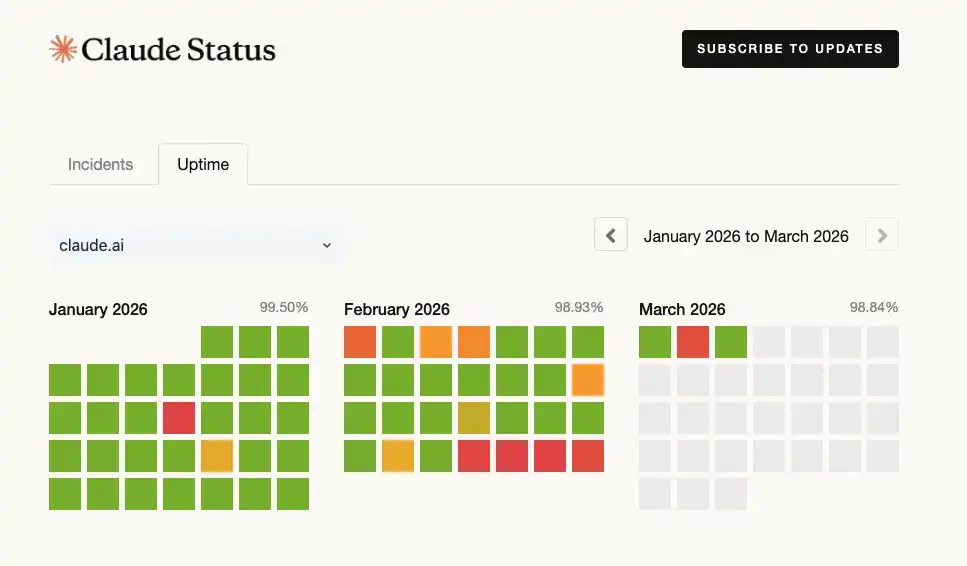
One of the world's largest AI systems, Claude, was running on Amazon's cloud. On the same day, Claude experienced a global outage.
Anthropic's official statement cited a surge in users overwhelming the servers.
As of the time of writing, there were still complaints on social media about Claude's service being unavailable; on the prominent prediction market Polymarket, there is already a prediction topic about "Claude experiencing several more outages in March."
If it is eventually confirmed to be Iran's doing, this will be the first time in human history:
A commercial data center physically destroyed in a war.
However, why would a civilian data center be targeted?
Let's rewind two days. On February 28th, the U.S. and Israel jointly bombed Iran, killing Supreme Leader Khamenei and a group of senior officials.
A significant portion of the intelligence analysis, target identification, and battlefield simulations for this airstrike were assisted by Claude. Through a collaboration with the military and the data analytics company Palantir, Claude had long been integrated into the U.S. military's intelligence system.
Ironically, just hours before the airstrike, Trump had ordered a full ban on Anthropic because Anthropic refused to hand over AI to the Pentagon without restrictions. But bans aside, the war had to be fought.
The public statement is that it would take at least six months to remove Claude from the military's systems.
So, while the ban was still fresh, the U.S. military took Claude along to bomb Iran. Then Iran retaliated, and a missile hit the data center running Claude's AI.

Image Source: Bloomberg
The data center was most likely not targeted for bombing, just collateral damage. But regardless of whether the missile was aimed at the data center, one thing is certain:
Truth is within the cannon's reach, and so is AI. On both sides of the cannon — the firing end and the receiving end.
AI Megaproject Built on Top of the Middle Eastern Powder Keg
Over the past three years, Silicon Valley has moved half of the AI industry to the Middle East Gulf.
The reason is simple. The UAE and Saudi Arabia have the world's richest sovereign wealth funds, cheap electricity, and one rule:
If you want to serve my customers, the data must reside in my territory.
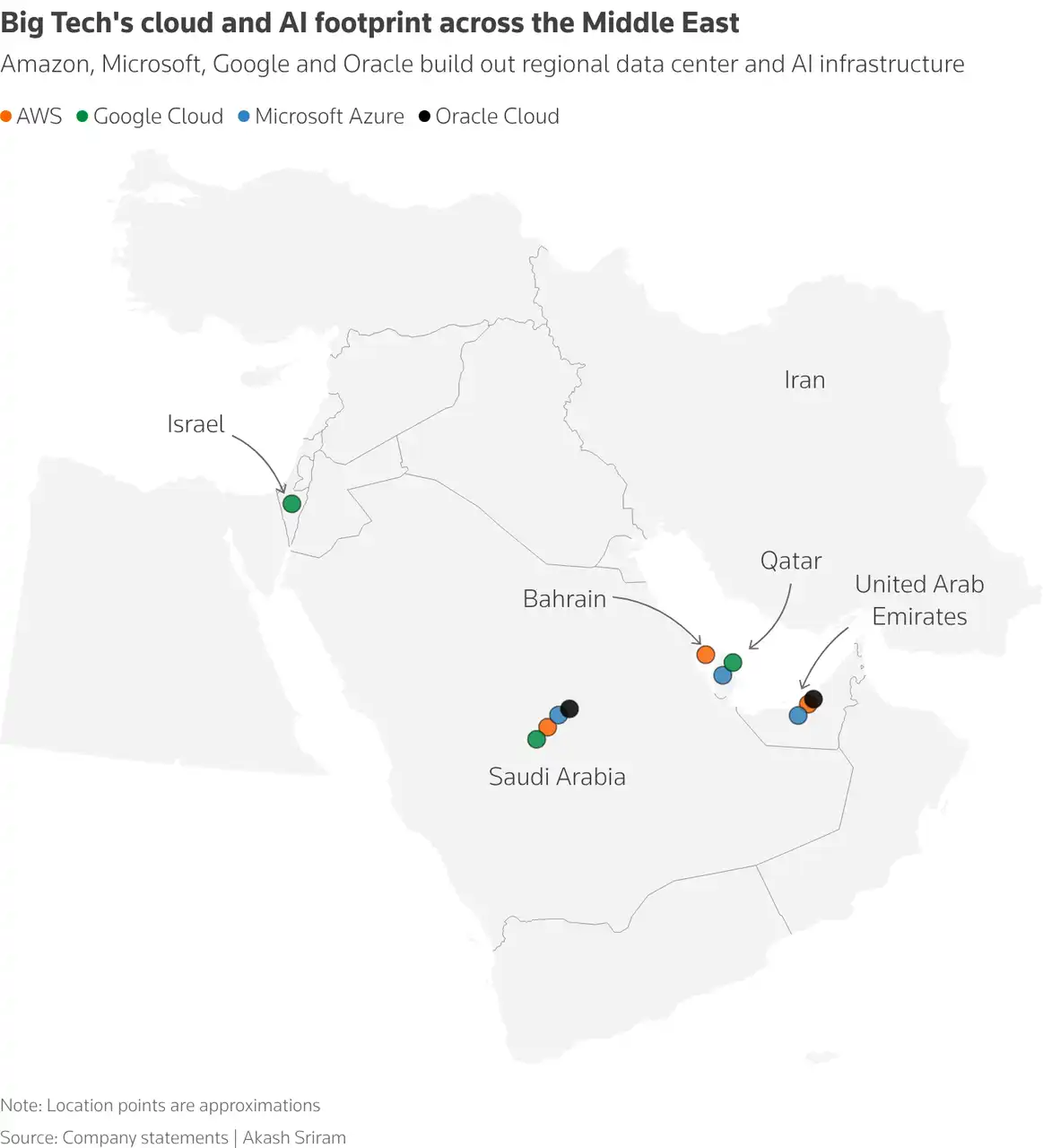
So Amazon has opened data centers in the UAE and Bahrain, and is poised to invest $5.3 billion in Saudi Arabia for another one; Microsoft has nodes in the UAE and Qatar, and has already built in Saudi Arabia.
OpenAI, in partnership with Nvidia and SoftBank, is building an AI hub in the UAE for over $30 billion, touted as the largest computing hub outside the U.S.
In January of this year, the U.S. just got the UAE and Qatar to sign an agreement called "Pax Silica." Translated, it means "Silicon Peace," which sounds lovely.
At the core of the agreement is controlling the flow of chips to ensure that advanced chips do not fall into Chinese hands.
In exchange, the UAE secured an annual import license for hundreds of thousands of Nvidia's most advanced processors. Abu Dhabi's G42 cut ties with Huawei, and Saudi AI companies pledged not to buy Huawei equipment...
The entire AI infrastructure in the Gulf, from chips to data centers to models, is now fully aligned with the U.S.
These agreements consider everything, from chip export controls, data sovereignty, investment reciprocity, to technology leakage risks.
But not a single one considered that someone might use a missile to bomb the data center.
An international security scholar at Qatar University made a pertinent remark upon seeing the Amazon data center on fire, which the author found quite fitting:
"These security frameworks are designed for supply chain control and political alignment, physical security was never on the agenda."
Cloud computing has told a decade-long story of elasticity, redundancy, and decentralization. But a data center is a physical building with an address, walls, a roof, and coordinates. No matter how advanced your chips are, if the data center is bombed, it's bombed.
“The Cloud” is a metaphor; the data center is not.
AI may appear ethereal, running on code, floating in the clouds. But the code runs on chips, the chips are housed in data centers, and data centers sit on the Earth.
Who Will Protect AI?
In this instance, Amazon's data center can be considered collateral damage, or perhaps, an unintended target.
But what about next time?
Amid escalating global geopolitical tensions, if there's an AI model in your data center helping an adversary with target recognition, the adversary has every reason to consider your data center a legitimate military target.
This issue is one that international law has yet to address.
Existing rules of war cover “dual-use facilities,” but those provisions reference factories and bridges; no one ever thought about data centers.
A data center that processes banking transactions during the day and conducts military intelligence analysis at night—does it qualify as civilian or military?
In times of peace, data center sites are chosen based on latency, electricity costs, policy incentives... When war breaks out, none of that matters. What matters is how close your data center is to the nearest military installation.
So, this recent bombing has begun to shift everyone’s attention.
Previously, everyone was discussing the same anxiety—whether AI would replace their jobs. But no one was talking about the other question:
Before AI replaces you, how vulnerable is AI itself?
A regional conflict caused the Middle East node of the world’s largest cloud provider to go down for an entire day, and that was just one data center.
There are nearly 1300 hyperscale data centers in the world today, with 770 more under construction. These data centers are consuming more and more electricity, water, and money while carrying an increasing load—your deposits, your medical records, your takeout orders, even military intelligence for a country...
Yet, the solutions to protect these data centers may still be limited to fire suppression systems and backup generators.
When AI becomes a country’s infrastructure, its security becomes everyone’s concern. Who will protect AI? The cloud providers? The Pentagon? Or the UAE's air defense system?
This question was purely theoretical just three days ago. Not anymore.
AI is within the cannon shot. And it's not just AI, actually. In this day and age, what isn't within the cannon shot?
You may also like

How to Earn Up to 40% Rebates on Crypto Futures Trading (WEEX Trade to Earn IV Guide)
WEEX Trade to Earn IV lets traders earn up to 40% fee rebates in real time through a tiered miner system tied to trading activity. With additional boosts from referrals, it offers a more reliable alternative to airdrops as the crypto market gains momentum.

NVIDIA Plays Trillion-Dollar Chess Game | Rewire News Morning Edition

Real-time Update | NVIDIA GTC 2026 Conference Highlights Galore

People Behind Pokémon Go: Started with CIA's Money, Now Mapping the World for the Military AI

Huang Renxun GTC Speech Full Text: By 2027, Market Demand Will Exceed $1 Trillion; Everyone Should Develop an OpenClaw Strategy

Stratechery Debunks the AI Bubble Myth: What Should We Do with AI?
Three Charts to Watch at NVIDIA's GTC: Cheaper Compute, Spend More
BTC Eight Green Candles Reach $76K, What Is the Logic Behind Outperforming Gold in the Midst of Battle?

Morning Report | Strategy invested $1.57 billion last week to increase its holdings by 22,337 bitcoins; Abra plans to go public through a SPAC merger; Metaplanet aims to raise approximately $765 million to increase its bitcoin holdings
CB Insights: Nine Predictions for the Fintech Sector in 2026, with Asset Tokenization Already Becoming a Trend

Huang Renxun's full GTC speech: The era of inference has arrived, with revenue expected to reach at least one trillion dollars by 2027, and lobster is the new operating system

Trade Gold, Silver & Oil on WEEX: $300K Rewards and 0% Fees
WEEX has launched a large-scale Gold, Silver, and Oil trading campaign featuring 0% fees, a $300K reward pool, and Trade-to-Earn opportunities, allowing traders to deposit, trade tokenized commodities like PAXG and XAUT, and compete on leaderboards — all at WEEX.

WEEX P2P now supports KZT, UZS, AMD, GEL & MDL—Merchant Recruitment Now Open
To make crypto deposits easier, WEEX has officially launched its P2P trading platform and continues to expand fiat support. We're excited to announce that the Kazakhstani Tenge (KZT), Uzbekistani Som (UZS), Armenian Dram (AMD), Georgian Lari (GEL) and Moldovan Leu (MDL) are now available on WEEX P2P!

21Shares Enhances Crypto ETP Pricing with FTSE Partnership
Key Takeaways: 21Shares AG updates the pricing methodology for its Bitcoin and Ethereum-linked ETPs on the London Stock…

Alibaba AI Projects Crypto Value Surge for XRP, Bitcoin, and Ethereum by 2026
Key Takeaways: Alibaba’s AI predicts significant price increases for XRP, Bitcoin, and Ethereum by 2026’s end, driven by…

Ethereum USD Reclaims $2,200 Amidst Crypto Market Surge
Key Takeaways: Ethereum USD rebounds from $1,840 lows, reclaiming the $2,200 mark with a +19% recovery as of…

TRUMP Memecoin Investors Granted Exclusive Mar-a-Lago Invite
Key Takeaways: $TRUMP memecoin holders gain exclusive access to a Mar-a-Lago event featuring Donald Trump and other key…

Why Is Crypto Up: BTC USD Decoupling From Gold Amid Heated Israel-Iran Conflict
Key Takeaways: Bitcoin’s price recently hit $74,000, marking its highest close since February 2026 before slightly retracting to…
How to Earn Up to 40% Rebates on Crypto Futures Trading (WEEX Trade to Earn IV Guide)
WEEX Trade to Earn IV lets traders earn up to 40% fee rebates in real time through a tiered miner system tied to trading activity. With additional boosts from referrals, it offers a more reliable alternative to airdrops as the crypto market gains momentum.


 App
App