
- Buy Crypto
- Markets
 Futures
- Spot
- Copy Trade
- Earn
- More
Different Rulings in Similar Cases: Why can Uniswap go free while Tornado Cash cannot?

Original Title: "The Same Judge, Different Outcomes for Uniswap and Tornado"
Original Author: Eric, Foresight News
In the early hours of March 3, Beijing time, a collective lawsuit against Uniswap and Uniswap founder Hayden Adams for fraudulent tokens on Uniswap was dismissed by the Southern District of New York federal court. Uniswap Foundation's General Counsel Brian Nistler referred to it as a "landmark ruling for DeFi."
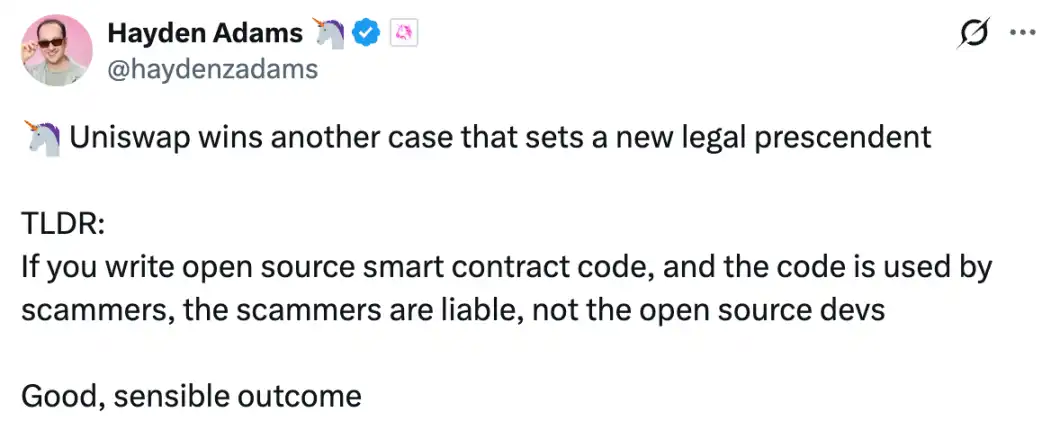
Hayden Adams also tweeted, "If you write open-source smart contract code and that code is used by scammers, then the responsibility lies with the scammer, not the open-source developer. This is a fair and just outcome."
For Web3 developers, this is undoubtedly good news. However, little-known is the fact that the judge who made this "just ruling" is the same person who, during their tenure as the former SEC chairman, found Tornado Cash developers guilty.
The Final Judgment
From the collective lawsuit against Uniswap to today's final judgment, nearly 4 years have passed.
In April 2022, Uniswap users represented by Nessa Risley filed a collective lawsuit in court, accusing defendants including Paradigm, a16z, Uniswap, and its founder Hayden Adams of violating federal securities laws by issuing and selling unregistered securities, including UNI, on Uniswap in token form. The defendants also failed to register Uniswap as an exchange or broker-dealer under applicable securities laws and failed to provide investors with a registration statement for the securities they issued and sold.
This lawsuit was initiated by the law firms Kim&Serritella and Barton, representing users who traded EthereumMax, Bezoge, MatrixSamurai, Alphawolf Finance, RocketBunny, and BoomBaby.io tokens on Uniswap between April 5, 2021, and April 4, 2022.
The five words "Unregistered Securities" had an unusually strong impact on the crypto industry at the time, but this lawsuit unexpectedly quickly turned overwhelmingly in favor of Uniswap.
Despite the presiding judge Katherine Polk Failla acknowledging that the plaintiff's so-called "scam token" did indeed qualify as a security, she believed that Uniswap was not liable for it. Failla argued that Uniswap's decentralized nature meant that the protocol could not control which tokens were listed on the platform or who could interact with it, stating that the "case is more like holding the developer of a self-driving car responsible for a third party using the car to commit a traffic violation or rob a bank."
Based on this, Failla dismissed the federal securities law charges in August 2023. The plaintiffs then appealed, with the Second Circuit Court of Appeals in 2025 affirming the dismissal at the federal level but remanding the state law claims for further review.
Subsequently, the plaintiffs amended their complaint and refiled. This time, the aggrieved investors accused Uniswap and other defendants of aiding and abetting fraud and making false statements, profiting from transactions involving the scam token, and violating multiple states' laws against fraudulent practices.
Following a reevaluation by the same Judge Failla, the amended lawsuit was once again dismissed, with no opportunity for further amendments, bringing the case to a definitive close.
The reasoning provided by the judge this time was essentially the same as before: Uniswap did not have knowledge of the scam token, and even if it did, it did not provide substantial assistance. Additionally, it did not meet the definition of fraudulent conduct in any state law. Regarding unjust enrichment, Uniswap did not receive any direct benefits, and the speculative nature of indirect benefits from such fraudulent projects expanding the user base was deemed too tenuous.
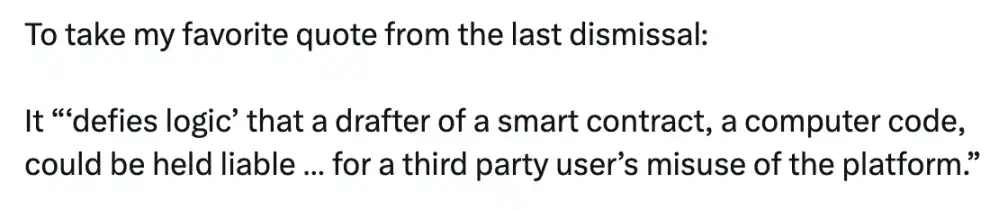
In a tweet, Brian Nistler expressed that, quoting a line from a previous court ruling, the drafter of a smart contract being held responsible for third-party misuse of the platform is simply "illogical."
Another Outcome for Tornado Cash
Facing the same judge, Roman Storm of Tornado Cash experienced a different outcome.
Tornado Cash was first added to the U.S. Treasury Department's Office of Foreign Assets Control (OFAC) sanctions list on August 8, 2022, accusing it of laundering over $7 billion for criminal entities, including North Korean hackers. Two days after being sanctioned, one of Tornado Cash's core developers, Alexey Pertsev, was arrested by Dutch authorities.
On May 14, 2024, a Dutch court sentenced Alexey Pertsev for money laundering to 64 months in prison. The court found that Pertsev was aware that his platform, which he developed and operated, was being used for criminal purposes, did not intervene, and subjectively tolerated Tornado Cash as a money laundering tool. Currently, Alexey Pertsev is still appealing, but there have been no recent developments.
7 months before Alexey Pertsev was convicted, the U.S. Department of Justice filed charges against two other developers, Roman Storm and Roman Semenov, in the Southern District of New York federal court. Roman Storm had previously been arrested in Washington State, while Roman Semenov was still at large.

Roman Storm in Court
Subsequently, despite an appeal, the court determined that OFAC sanctioning Tornado Cash was an overreach and the sanction was invalid. However, Roman Storm still took the defendant's seat in court in July of last year. After a trial presided over by Judge Katherine Polk Failla, the jury found that Roman Storm was "conspiring to operate an unlicensed money transmitting business," but formal sentencing has not yet taken place.
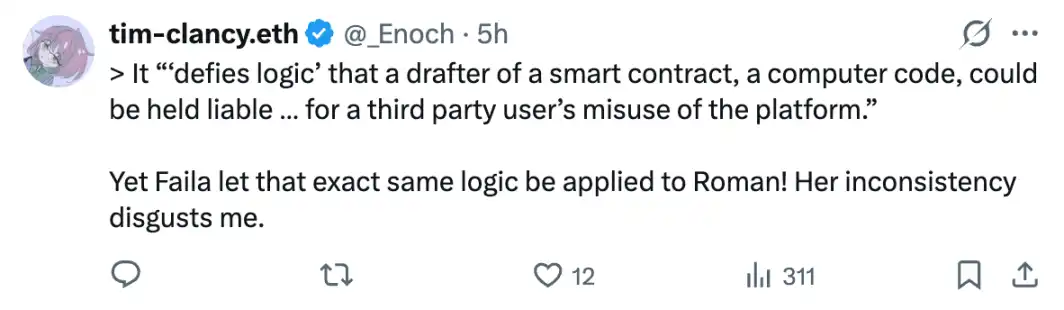
In response to Brian Nistler's tweet celebrating Uniswap's legal victory, Sigil developer tim-clancy.eth's tweet criticizing the inconsistencies before and after Failla's ruling (regarding Roman Storm's judgment actually made by the jury) received the highest number of likes in all comments.
Decentralization is Fine, but Privacy is Not
While I am not a professional lawyer, setting aside political factors, I can also roughly understand why Uniswap and Tornado Cash would have different outcomes from a simple emotional perspective.
The core reason is that the Tornado Cash developers should have been well aware that a mixer would inevitably be used for money laundering. This also clearly demonstrates the regulatory stance: decentralization is acceptable, but it must be traceable. Tether has also faced a similar dilemma in the past, which is why they later began to cooperate with money laundering investigations and added freezing functionality.
Perhaps Roman Storm would feel the today's verdict unjust behind bars, but what he should realize is that even in the United States under the pro-crypto Trump administration, aiding a nation-state hacker from North Korea in laundering money is not tolerable. With the power of Crypto today, it is still not enough to combat the power of a nation.
Web3 practitioners express their grievances for Tornado Cash developers and cheer for Uniswap's legal victory. Because in our eyes, the two protocols are not fundamentally different, and Tornado Cash even excels in privacy protection. Uniswap's decision to add front-end blocking of sanctioned addresses in 2022 has sparked some controversy, and now it seems that permissionlessness within the existing legal framework may be the only way for decentralized protocols to survive.
But then again, does Uniswap really have no responsibility in these fraud incidents?
Strictly speaking, as the metaphor given by the judge, you cannot hold Mercedes-Benz accountable for a bank robbery just because the robber used a Mercedes-Benz for the heist. But from a business perspective, we tend to believe that giants should provide protection within their capabilities. Current security tools can already proactively identify a large number of potential scam projects, and for these established projects that have enjoyed the benefits of Web3 development, simple screening is not a hassle.
It is not a necessary obligation to make every effort to protect investors, but it is a responsibility that ordinary investors hope Uniswap and others can proactively take on.
You may also like

How to Earn Up to 40% Rebates on Crypto Futures Trading (WEEX Trade to Earn IV Guide)
WEEX Trade to Earn IV lets traders earn up to 40% fee rebates in real time through a tiered miner system tied to trading activity. With additional boosts from referrals, it offers a more reliable alternative to airdrops as the crypto market gains momentum.

NVIDIA Plays Trillion-Dollar Chess Game | Rewire News Morning Edition

Real-time Update | NVIDIA GTC 2026 Conference Highlights Galore

People Behind Pokémon Go: Started with CIA's Money, Now Mapping the World for the Military AI

Huang Renxun GTC Speech Full Text: By 2027, Market Demand Will Exceed $1 Trillion; Everyone Should Develop an OpenClaw Strategy

Stratechery Debunks the AI Bubble Myth: What Should We Do with AI?
Three Charts to Watch at NVIDIA's GTC: Cheaper Compute, Spend More
BTC Eight Green Candles Reach $76K, What Is the Logic Behind Outperforming Gold in the Midst of Battle?

Morning Report | Strategy invested $1.57 billion last week to increase its holdings by 22,337 bitcoins; Abra plans to go public through a SPAC merger; Metaplanet aims to raise approximately $765 million to increase its bitcoin holdings
CB Insights: Nine Predictions for the Fintech Sector in 2026, with Asset Tokenization Already Becoming a Trend

Huang Renxun's full GTC speech: The era of inference has arrived, with revenue expected to reach at least one trillion dollars by 2027, and lobster is the new operating system

Trade Gold, Silver & Oil on WEEX: $300K Rewards and 0% Fees
WEEX has launched a large-scale Gold, Silver, and Oil trading campaign featuring 0% fees, a $300K reward pool, and Trade-to-Earn opportunities, allowing traders to deposit, trade tokenized commodities like PAXG and XAUT, and compete on leaderboards — all at WEEX.

WEEX P2P now supports KZT, UZS, AMD, GEL & MDL—Merchant Recruitment Now Open
To make crypto deposits easier, WEEX has officially launched its P2P trading platform and continues to expand fiat support. We're excited to announce that the Kazakhstani Tenge (KZT), Uzbekistani Som (UZS), Armenian Dram (AMD), Georgian Lari (GEL) and Moldovan Leu (MDL) are now available on WEEX P2P!

21Shares Enhances Crypto ETP Pricing with FTSE Partnership
Key Takeaways: 21Shares AG updates the pricing methodology for its Bitcoin and Ethereum-linked ETPs on the London Stock…

Alibaba AI Projects Crypto Value Surge for XRP, Bitcoin, and Ethereum by 2026
Key Takeaways: Alibaba’s AI predicts significant price increases for XRP, Bitcoin, and Ethereum by 2026’s end, driven by…

Ethereum USD Reclaims $2,200 Amidst Crypto Market Surge
Key Takeaways: Ethereum USD rebounds from $1,840 lows, reclaiming the $2,200 mark with a +19% recovery as of…

TRUMP Memecoin Investors Granted Exclusive Mar-a-Lago Invite
Key Takeaways: $TRUMP memecoin holders gain exclusive access to a Mar-a-Lago event featuring Donald Trump and other key…

Why Is Crypto Up: BTC USD Decoupling From Gold Amid Heated Israel-Iran Conflict
Key Takeaways: Bitcoin’s price recently hit $74,000, marking its highest close since February 2026 before slightly retracting to…
How to Earn Up to 40% Rebates on Crypto Futures Trading (WEEX Trade to Earn IV Guide)
WEEX Trade to Earn IV lets traders earn up to 40% fee rebates in real time through a tiered miner system tied to trading activity. With additional boosts from referrals, it offers a more reliable alternative to airdrops as the crypto market gains momentum.


 App
App