
Bitcoin ETF Inflows in 2026: Impact on BTC Price and Crypto Market Trends


TL;DR
- Bitcoin ETF inflows in 2026 are becoming a key signal for understanding BTC price stability
- Institutional investors are integrating BTC exposure into diversified portfolio strategies
- Traders combine spot positions, derivatives activity, and flexible yield allocation
- Yield strategies are increasingly used to improve capital efficiency during changing market cycles
Bitcoin ETF Inflows in 2026: Impact on BTC Price and Crypto Market Trends
Why Bitcoin ETF inflows matter in 2026
Bitcoin ETF inflows have become one of the most closely watched indicators for understanding institutional participation in crypto markets. Since spot Bitcoin ETFs were approved, they have provided a regulated access channel that makes it easier for traditional investors to gain exposure to Bitcoin without directly holding the underlying asset. This accessibility has helped integrate BTC exposure more naturally into broader portfolio allocation frameworks.
A spot Bitcoin ETF is designed to track the price of Bitcoin while allowing investors to gain exposure through regulated securities exchanges rather than holding the asset directly. By reducing operational complexity and improving accessibility within traditional financial infrastructure, ETFs make it easier for institutional investors to integrate BTC exposure into diversified portfolio allocation strategies.
Recent market data shows that ETF activity in early 2026 continued to reflect shifting institutional allocation behavior. While some periods saw weaker positioning, later inflow rebounds suggested that institutional exposure to BTC remains structurally relevant rather than purely speculative.
Despite broader signs of market softness earlier this year, spot Bitcoin ETF demand has recently improved, reversing a sustained outflow trend that began in November 2025. According to recent market flow tracking data reported by research platforms such as Foresight News, rolling 30-day net inflows exceeded 30,000 BTC, contributing to Bitcoin's price consolidation near the $70,000 range.
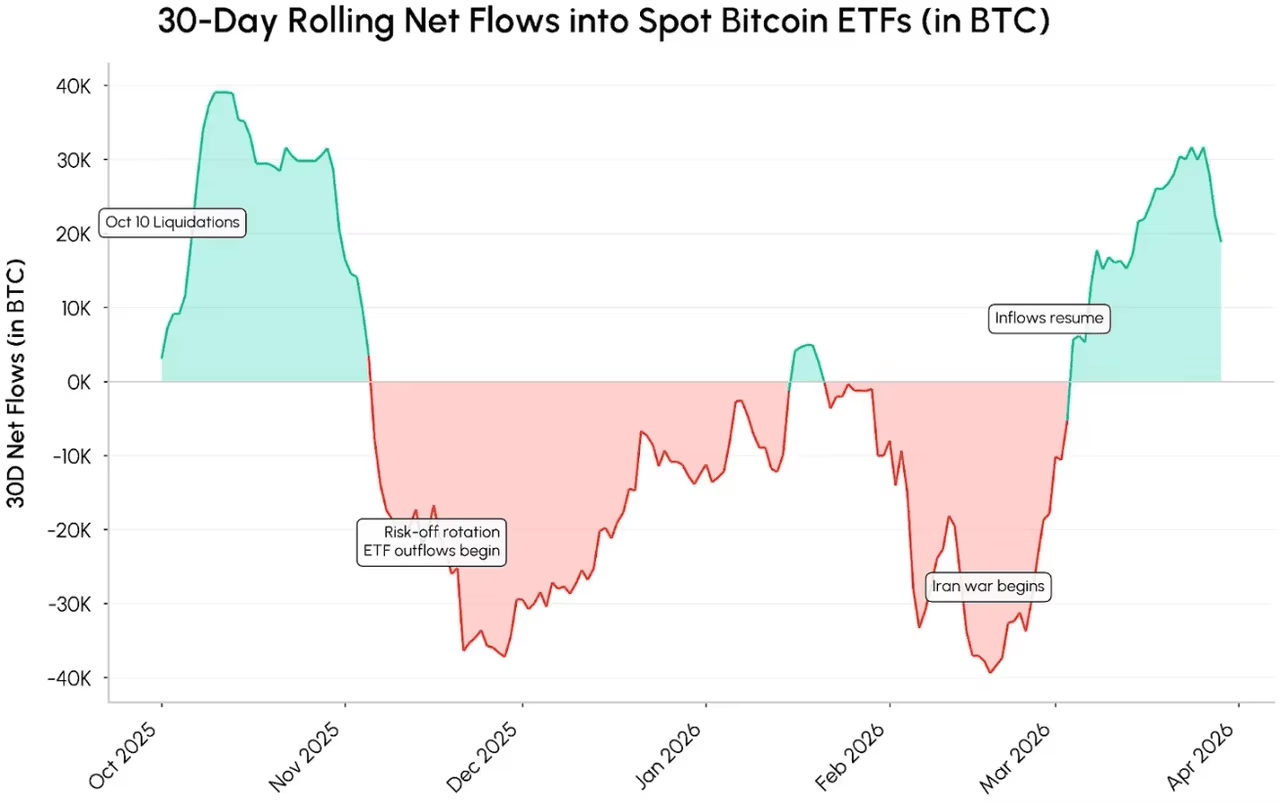
Data Source: Coin Metrics Network
Unlike retail-driven momentum cycles, ETF inflows typically represent slower but more persistent capital allocation decisions. This makes them an important signal when evaluating broader crypto market trends.
How ETF inflows influence BTC price structure
ETF inflows do not always trigger immediate price moves, but they often reshape the structure behind price stability.
Institutional capital entering through ETF channels can:
- strengthen spot-market demand consistency
- reduce extreme downside volatility during consolidation phases
- support longer accumulation ranges
- influence derivatives positioning across major exchanges
As a result, ETF-driven liquidity conditions increasingly affect how traders interpret BTC price behavior during both trending and ranging environments.
Rather than acting as short-term catalysts alone, inflows often function as structural support signals across multiple market cycles.
What ETF flows reveal about broader crypto market trends
Bitcoin ETF inflows also provide insight into how institutional investors approach crypto portfolio exposure.
Compared with earlier cycles dominated by speculative participation, recent inflow patterns suggest that allocation strategies are becoming more structured and diversified. Instead of relying only on directional positioning, many participants are combining spot exposure, derivatives activity, and yield-based capital allocation.
This shift reflects a broader transition in how crypto markets are being integrated into multi-asset investment frameworks.
As institutional participation grows, liquidity distribution across trading products is becoming more balanced than in previous market cycles.
How crypto traders adjust strategies during ETF inflow cycles
ETF inflow cycles often influence how traders manage capital efficiency rather than simply changing directional expectations.
As institutional participation increases, crypto portfolios are increasingly structured in layers rather than relying only on simple directional exposure. Many traders now combine spot holdings for long-term positioning, derivatives for short-term adjustments, and yield strategies to improve capital efficiency between volatility cycles.
Some participants increase exposure through futures positioning during inflow acceleration periods. Others rotate between BTC and major altcoins depending on liquidity concentration trends.
At the same time, a growing number of traders allocate part of their holdings into flexible yield strategies while maintaining active trading exposure.
This hybrid approach allows portfolios to remain responsive to volatility changes while keeping idle assets productive during slower market phases.
Why yield strategies are becoming part of crypto portfolio allocation
As crypto market structure becomes more institutionally influenced, capital allocation strategies are evolving beyond purely directional trading.
Instead of leaving assets inactive between trading cycles, many participants now integrate yield programs into their portfolio structure to improve capital efficiency.
Programs such as WEEX Auto Earn Boost Fest provide one example of how traders can keep assets productive while maintaining flexibility to respond to market opportunities. As ETF-driven liquidity cycles reshape volatility expectations, yield strategies are increasingly becoming part of broader crypto portfolio allocation rather than simply passive income tools.
During periods when ETF-driven liquidity shifts reshape volatility conditions, combining trading exposure with yield-focused allocation can help balance both participation and stability within a crypto portfolio.
Explore Spot Earn opportunities here: https://app.sensor.weex.tech:8106/t/njs
What ETF inflows could mean for crypto markets going forward
While ETF inflows alone do not determine market direction, they remain one of the most reliable indicators of how institutional capital is positioned within the crypto ecosystem.
As allocation frameworks continue to mature, ETF participation is likely to remain an important reference point for interpreting:
- BTC price structure
- liquidity stability
- volatility behavior
- portfolio allocation strategies
As institutional participation continues to expand through ETF channels, monitoring capital flow behavior is becoming increasingly important for understanding how liquidity conditions, volatility patterns, and portfolio allocation strategies evolve across crypto markets.
See also:
How Bitcoin ETF Inflows Are Changing BTC Volatility and Futures Trading in 2026
About WEEX
Founded in 2018, WEEX has developed into a global crypto exchange with over 6.2 million users across more than 150 countries. The platform emphasizes security, liquidity, and usability, providing over 1,200 spot trading pairs and offering up to 400x leverage in crypto futures trading. In addition to the traditional spot and derivatives markets, WEEX is expanding rapidly in the AI era — delivering real-time AI news, empowering users with AI trading tools, and exploring innovative trade-to-earn models that make intelligent trading more accessible to everyone. Its 1,000 BTC Protection Fund further strengthens asset safety and transparency, while features such as copy trading and advanced trading tools allow users to follow professional traders and experience a more efficient, intelligent trading journey.
Follow WEEX on social media
X: @WEEX_Official
Instagram: @WEEX Exchange
Tiktok: @weex_global
Youtube: @WEEX_Official
Discord: WEEX Community
Telegram: WeexGlobal Group
You may also like

SpaceX IPO, Nvidia, and Bitcoin: Why Traders Are Watching More Than Just Crypto in 2026

Why Is BlackRock Investing $5 Billion in the SpaceX IPO?

SpaceX vs Tesla vs xAI: Which Elon Musk Trade Has the Biggest Upside in 2026?

Bitcoin Trading Guide 2026: Strategies for Experienced Traders

What Is XAUT and PAXG? Why Tokenized Gold Is Booming in 2026

Will the SpaceX IPO Hurt Bitcoin? Here's What Traders Are Watching

Ferrari Challenge Le Mans: Carl Moon to Dominate in WEEX Livery
Bitcoin Crash to $50,000 or Bear Trap Before $100,000? Deep Dive for WEEX Traders

How Could the SpaceX IPO Affect Bitcoin, Altcoins season, and Crypto Liquidity?

What Is SpaceX IPO and Why Is Everyone Talking About It?

Bitcoin Price Prediction 2030: Ark Invest Forecasts $710K

WEEX Review 2026: Fees, Security and Trading Features
SOL Price Today: Live Solana Price, Charts & Market Data

What Is a Bitcoin ETF: Spot vs Futures Explained

Why Is Bitcoin Dropping 15% While Nasdaq Hits Record Highs?

What Is TradFi and Why Is Everyone Talking About It in 2026?

Paris Reigns Supreme: How PSG Crushed Arsenal’s Dream in a Historic UCL Final Thriller

Bitcoin Stuck Near $73K? How Traders Are Finding Rewards in a Sideways June Market
SpaceX IPO, Nvidia, and Bitcoin: Why Traders Are Watching More Than Just Crypto in 2026
Why Is BlackRock Investing $5 Billion in the SpaceX IPO?
SpaceX vs Tesla vs xAI: Which Elon Musk Trade Has the Biggest Upside in 2026?
Bitcoin Trading Guide 2026: Strategies for Experienced Traders
What Is XAUT and PAXG? Why Tokenized Gold Is Booming in 2026
Will the SpaceX IPO Hurt Bitcoin? Here's What Traders Are Watching


