
- Buy Crypto
- Markets
 Futures
- Spot
- Copy Trade
- Earn
- More
Bitcoin (BTC) Faces Internal Conflict Over Transaction Filtering
By: cryptosheadlines|2025/05/15 03:15:07
0
Share
Airdrop Is Live CaryptosHeadlines Media Has Launched Its Native Token CHT. Airdrop Is Live For Everyone, Claim Instant 5000 CHT Tokens Worth Of $50 USDT. Join the Airdrop at the official website, CryptosHeadlinesToken.com Alvin Lang May 12, 2025 09:39 The Bitcoin community is divided over transaction filtering, reminiscent of the 2015-2017 blocksize war, highlighting a potential internal conflict. The debate focuses on mempool policy and Bitcoin’s future direction. The Bitcoin (BTC) community is currently embroiled in a heated debate over transaction filtering on the blockchain, a situation that echoes the blocksize war from 2015 to 2017. According to blog.bitfinex.com, this issue has highlighted a significant division among developers, with two opposing factions emerging. One side advocates for stricter filtering to limit transactions such as Ordinals, Inscriptions, and CoinJoin, while the other defends an open, decentralized network.Filtering vs. CensorshipThe dispute centers around Bitcoin’s mempool policy, which has exposed deep divides within the developer community. The debate focuses on how to handle non-currency transactions, which are legitimate and pay market fees but are often targeted based on content or intent. A proposal by Peter Todd to remove the existing limit on arbitrary data storage via the OP_RETURN field has intensified the discussion. Proponents argue that current filters are ineffective and create a false sense of control, while opponents warn that relaxing these limits could turn Bitcoin into a general-purpose data ledger, undermining its core value.Comparison to the Blocksize WarThis ongoing debate mirrors the blocksize war, where disagreements over Bitcoin’s purpose—whether to remain minimalist and censorship-resistant or evolve for more flexible use cases—led to significant division. Similar to the blocksize debate, the current controversy involves fundamental questions about Bitcoin’s future direction and the balance of power within its governance model.The Feasibility of Spam FilteringBitcoin’s mempool serves as a distributed area where valid but unconfirmed transactions are held. The introduction of SegWit in 2017 inadvertently encouraged protocols like Ordinals and Inscriptions, which embed arbitrary content at low costs. These techniques, while operating within Bitcoin’s rules, have raised concerns about block space sustainability. Ocean, a Bitcoin mining group led by Luke Dash Jr., has implemented filters to reject transactions deemed spam, sparking further debate over censorship’s impact on Bitcoin’s neutrality.Ultimately, the outcome of this debate will shape Bitcoin’s identity as either a purely monetary system or an open platform for innovative applications. The risk of network splits and erosion of trust in Bitcoin’s decentralization looms large if consensus is not reached. This ongoing conflict serves as a critical test of Bitcoin’s adaptability and resilience in the digital age.Image source: Shutterstock Source link
You may also like

Particle Founder: The entrepreneurial insights I have gained the most from in the past year
Stop lean startup, stop lightning entrepreneurship, and think carefully about what your product aspirations are.

Huang Renxun's latest podcast transcript: The future of Nvidia, the development of embodied intelligence and agents, the explosion of inference demand, and the public relations crisis of artificial intelligence
The competition in the future is not just about whose model is larger or whose computing power is stronger, but also about who understands the industry better, who can embed AI more deeply into real processes, and who can organize these capabilities into a runnable and scalable system.

OKX Ventures Research Report: AI Agent Economic Infrastructure Research Report (Part 1)
The existing infrastructure is hostile to the Agent economy. Agents can think and act independently at the "capability level," but at the "economic level," they are still locked into infrastructure designed for humans.

The migration of settlement rights: B18 and the institutional starting point of on-chain banks
In the traditional system, banks decide the settlement; in the on-chain system, code begins to take over this responsibility.

From Tencent and Circle: Looking at the Simple and Difficult Questions of Investment
The AI narrative continues to ferment, but the recent performance of related stocks varies, with some in the midst of summer and others as if in winter.

The second half of stablecoins no longer belongs to the crypto circle
What Coinbase doesn't want, Mastercard is eager to buy.

Cursor "Shell" Kimi Controversy Reversed: From Copyright Infringement Allegations to Authorized Collaboration, China's Open Source Model Once Again Becomes a Global AI Foundation
Cursor was accused of being based on Kimi K2.5, which sparked controversy, and was later confirmed to be compliant through Fireworks AI due diligence.

The Real Reason Tokens Don't Sell: 90% of Crypto Projects Overlook Investor Relations
Provide an Investor Relations Best Practices Guide for Crypto Projects.

Is the income of pump.fun real, earning a million dollars a day despite the market downturn?
If it can really earn this much, what is the reason for the low price of $PUMP?

The real reason why tokens are not selling: 90% of crypto projects neglect investor relations
Investor Relations Practice Guide for Cryptocurrency Projects.

Who is the true winner of the "Tokenization" narrative?
Virtually everyone benefits, but the reason for the benefit, the timing, and the underlying logic are completely different.

Moss: The Era of AI-Traded by Anyone | Project Introduction
AI Trading Agent is rapidly growing its infrastructure.

Chip Smuggling Case Exposes Regulatory Loophole | Rewire News Evening Update
AI chips have become a strategic asset more sensitive than missiles

How a Structured AI Crypto Trading Bot Won at the WEEX Hackathon
Ritmex demonstrates how disciplined risk control and structured signals can make an AI crypto trading bot more stable and reliable on WEEX, highlighting the importance of combining execution discipline with scalable AI trading systems.

Old Indicator Fails, Three Major New Signals Emerge: BTC True Bottom May Still Be Below $60K
When the grocery shopping auntie on the subway, or Tony the hairdresser, start asking you about BTC, crypto, and cryptocurrency investments, selling immediately will be the only best option.

Meeting OpenClaw Founder at a Hackathon: What Else Can Lobsters Do?
Imperial College London MetaGame: AI Agent × Web3 Landing Three Major Directions.
Huang Renxun's Latest Podcast Transcript: NVIDIA's Future, Embodied Intelligence and Agent Development, Soaring Demand for Inferencing, and AI's PR Crisis
The future of competition is not only about whose model is bigger, whose computing power is stronger, but also about who understands the industry better, who can more deeply integrate AI into real processes, and who can organize these capabilities into a set of executable, scalable systems
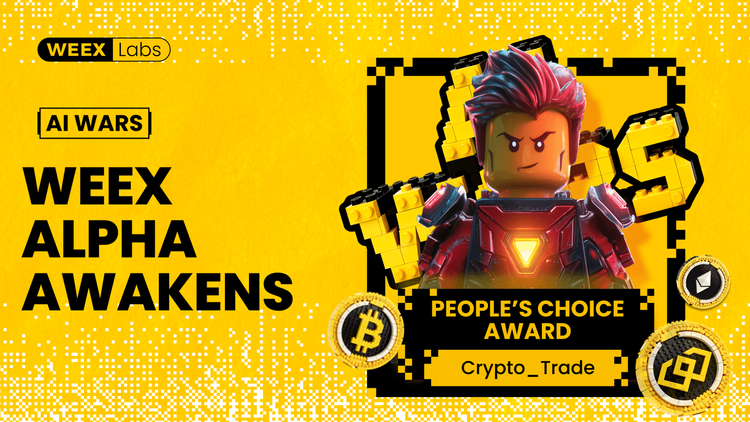
How a Structured AI Crypto Trading Bot Won at the WEEX Hackathon
Crypto_Trade shows how structured inputs and controlled adaptability can build a more stable and reliable AI crypto trading bot within the WEEX AI Trading Hackathon, highlighting a practical path toward scalable AI trading systems.
Particle Founder: The entrepreneurial insights I have gained the most from in the past year
Stop lean startup, stop lightning entrepreneurship, and think carefully about what your product aspirations are.
Huang Renxun's latest podcast transcript: The future of Nvidia, the development of embodied intelligence and agents, the explosion of inference demand, and the public relations crisis of artificial intelligence
The competition in the future is not just about whose model is larger or whose computing power is stronger, but also about who understands the industry better, who can embed AI more deeply into real processes, and who can organize these capabilities into a runnable and scalable system.
OKX Ventures Research Report: AI Agent Economic Infrastructure Research Report (Part 1)
The existing infrastructure is hostile to the Agent economy. Agents can think and act independently at the "capability level," but at the "economic level," they are still locked into infrastructure designed for humans.
The migration of settlement rights: B18 and the institutional starting point of on-chain banks
In the traditional system, banks decide the settlement; in the on-chain system, code begins to take over this responsibility.
From Tencent and Circle: Looking at the Simple and Difficult Questions of Investment
The AI narrative continues to ferment, but the recent performance of related stocks varies, with some in the midst of summer and others as if in winter.
The second half of stablecoins no longer belongs to the crypto circle
What Coinbase doesn't want, Mastercard is eager to buy.


 App
App