
Palantir Stock 24/7: How PLTR Perpetual Futures Really Price

 Prefer us on Google


You can take Palantir exposure around the clock, and it is not a share. Trading Palantir stock 24/7 means holding a perpetual futures contract priced against PLTR, which settles in stablecoin, never expires, charges a funding rate instead of a borrow fee, and keeps quoting a price on Saturday afternoon when Nasdaq has been shut for 40 hours. That last property is the entire point and the entire risk. This article covers how the contract discovers a price with the cash market closed, how profit and loss combine with funding over a multi-day hold, what happens to dividends and splits, and which order types survive the Monday open.
Palantir closed at $173.31 on September 14, 2026, up 3.64% on the day, on 29.19 million shares, with a $416.47 billion market capitalisation and a trailing P/E of 148.23 (StockAnalysis). Its 52-week range runs $106.37 to $207.52. Those are the numbers the perp is priced against — and the reason gaps matter: a stock with a 148x multiple reprices hard on news.
Can you trade Palantir stock 24/7? Yes, but not as shares
A PLTR perpetual gives you the price exposure without the share. You have no vote, no share register entry, and no dividend payment. What you have is a contract whose value tracks PLTR and whose position can be closed at any hour.
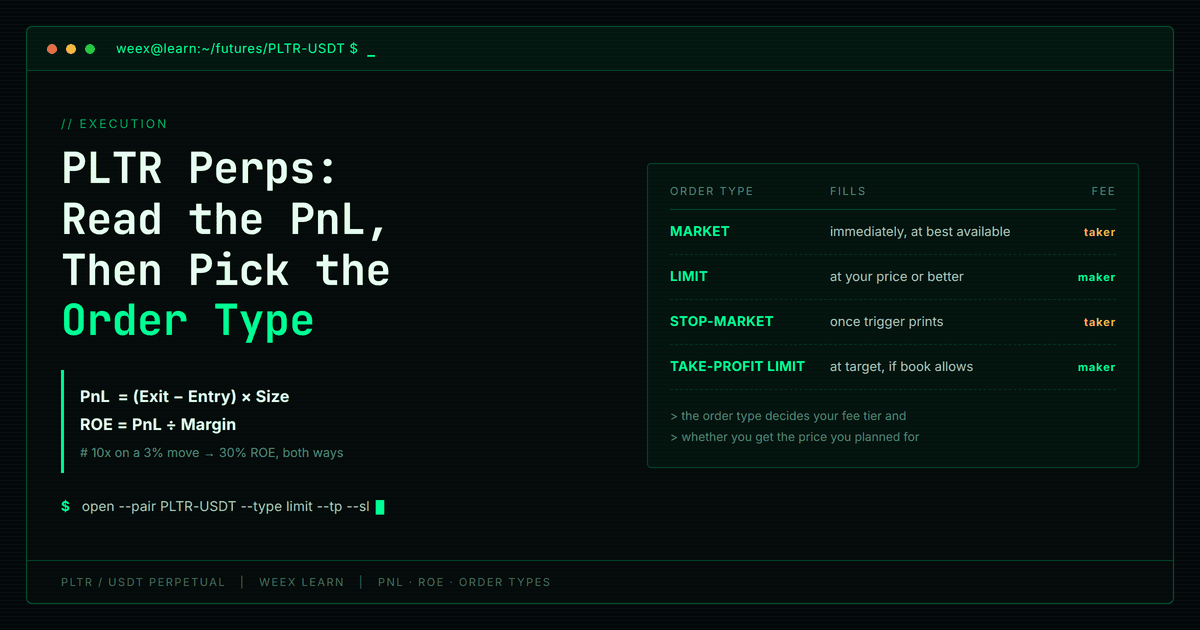
The difference from an equity CFD or a dated future is the funding mechanism. Instead of an expiry that forces convergence, a perpetual pays periodic funding between longs and shorts to pull the contract back toward its reference price. When the perp trades above reference, longs pay shorts; when it trades below, shorts pay longs. That is the tether, and when the underlying market is closed, it is the only tether.
Scale matters for expectations. Total open interest across stock perpetual futures was about $2.25 billion, against roughly $1.1 trillion a day in US equity turnover (Tiger Research, 2026). This is a young, thin market attached to a very deep one. The instrument works; the liquidity behind it is a rounding error next to the cash market, and it behaves accordingly.
If index-level equity derivatives are more familiar ground, WEEX's comparison of Nasdaq futures against stocks sets out how USDT-margined index perps sit alongside CME contracts.
How PLTR perpetual futures price while Nasdaq is closed
When the cash market shuts, the perp stops following and starts leading. There is no spot print to copy, so the order book itself sets the price, and it prices overnight news — a contract award, a downgrade, a macro print, a rate move — before any equity trader can act on it.
The measured behaviour of this is better than most people assume. In the Korean single-stock perp market, which has run long enough to study, perp direction during the closed session matched the next cash-market open 82% of the time for Samsung Electronics and 95% for SK Hynix, with regression coefficients of 0.93 and 1.00. Across weekends specifically, the match was 93% and 87%. The perp is a genuine price-discovery venue, not noise.
The imprecision shows up in level rather than direction. Intraday premiums to reference ran 0.15% for Samsung and 0.23% for SK Hynix, and the same name's perp on one venue averaged 0.93% above another venue's. When a gap between perp and reference opened, it closed halfway in about 40 minutes on average.
Two practical consequences for a PLTR position. First, the overnight move is usually informative — if the perp is down 3% at 4am, the Monday open is probably lower. Second, the exact level you see is venue-specific and carries a premium that decays over roughly the first hour of the cash session. Entering at the reopen means paying that premium; waiting for the convergence means missing part of the move. Neither is free.
Working out PnL and funding on a PLTR perp
Run the arithmetic once and the instrument stops being abstract. Take a $2,000 margin long on PLTR-USDT at $173.31 with 5x leverage — $10,000 notional, about 57.7 contract-units of PLTR exposure.
- PLTR moves to $180.00 (+3.86%). Gross PnL is 57.7 × $6.69, or about $386 — a 19.3% return on the $2,000 margin, which is the 3.86% move multiplied by 5.
- PLTR moves to $166.00 (−4.22%). Gross PnL is about −$422, a 21.1% drawdown on margin. At 5x, the liquidation point sits roughly 20% below entry before fees and maintenance margin, so $166 is uncomfortable but not fatal; $140 would be.
- Funding runs alongside both. At a 0.01% rate charged three times a day on the $10,000 notional, that is $1 per interval, $3 a day, $21 over a week — about 1% of your margin per week, invisible in the PnL line until you look for it.
That last line is where stock perps quietly differ from crypto perps. Crypto funding is driven by directional crowding. Stock perp funding also has to price the cost of carry and the dividend of the underlying, which means a persistent baseline drift rather than a symmetric oscillation around zero. Over a one-day trade it is noise. Over a month-long directional hold through earnings, it is a material line item, and traders coming from spot equities routinely forget to budget for it.
-- Price
Dividends, splits and earnings gaps on a stock perp
Corporate actions do not pass through to you as cash. They are handled inside the contract:
- Dividends are priced in through the funding rate and the mark price rather than paid out. Palantir does not currently pay one, so this is mostly theoretical for PLTR — but it explains why funding on dividend-paying names carries a directional bias that has nothing to do with sentiment.
- Stock splits trigger a position-size adjustment so that your notional exposure is unchanged afterwards. You end up with more units at a lower price, not a windfall.
- Mergers or acquisitions can halt the market, cancel open orders, and settle outstanding contracts at an adjusted takeover price. You do not get to ride the arb.
- Earnings are the gap event that matters most for PLTR. The next report is expected around November 2, 2026 (unconfirmed; Palantir has not published the date). Q2 2026, reported August 3, delivered $0.41 EPS on $1.94 billion of revenue, up 92.8% year on year — and the stock still fell 6% on September 2 on profit-taking at a 144 P/E despite a US Army TITAN production award and a senior executive hire the same day.
That September 2 session is the single most useful thing to remember about trading PLTR through a perp. Good news plus a demanding multiple produced a 6% down day. The contract will reprice that overnight, at 3am, with a thin book, while the cash market that would normally absorb it is closed.
Order types that survive a Monday open on PLTR-USDT
The reopen is where stock perp positions get damaged, and it is almost always an order-placement failure rather than a directional one.
- Never hold into a reopen without a resting exit. A market order placed into the first minutes of convergence pays the premium and the spread at once.
- Use trigger orders with the mark price, not the last price. Last price on a thin weekend book can be printed by a single trade; mark price is the smoothed reference the contract actually liquidates against. WEEX's guide to trigger orders covers choosing between the two and what makes a trigger fail to fill.
- Set the trigger outside the convergence band. Given observed premiums in the 0.15–0.93% range and half-life of roughly 40 minutes, a stop sitting within 1% of the mark is a stop placed inside normal reopen noise.
- Prefer limit exits to market exits on Sunday. Weekend books are thinner than weekday books on an instrument that is already small relative to the cash market. Slippage, not direction, is the dominant cost.
- Reduce size before a scheduled catalyst rather than tightening the stop. A tighter stop in a gap does not protect you; the gap jumps over it and fills at the next available price.
What traders usually miss
The instinct carried over from equities is that a stock does not move when the market is closed. On a perpetual it does, and the move is usually right about direction. Traders who lose money on PLTR perps are rarely wrong about Palantir. They are asleep when the contract reprices, they hold through funding they never budgeted, and they exit with a market order into the forty minutes when the premium is widest. All three are fixable before the position is opened, and none is fixable after.
FAQ
1. Is a PLTR perpetual the same as owning Palantir stock?
No. It is a contract that tracks the PLTR price and settles in stablecoin. There is no share ownership, no voting right, and no dividend payment — dividends on names that pay them are reflected through funding and mark price instead.
2. Can you really trade Palantir stock 24/7?
The perpetual contract trades 24/7 while the underlying equity trades 24/5. That gap is the source of weekend and overnight gap risk when the cash market reopens.
3. Does the overnight perp price predict the next open?
Usually. In the comparable Korean single-stock perp market, closed-session perp direction matched the next open 82–95% of the time depending on the name, and 87–93% across weekends. Direction is reliable; the exact level carries a venue-specific premium.
4. How much does funding cost on a PLTR perp?
It depends on the prevailing rate. As an illustration, a 0.01% rate charged three times daily on $10,000 of notional is $3 a day, or roughly 1% of a $2,000 margin balance per week. Check the live rate and countdown on the contract page before a multi-day hold.
5. What happens to my position if Palantir announces a stock split?
Position size is adjusted so your notional exposure stays the same — more units at a proportionally lower price. A merger or acquisition is handled differently and may result in halted markets, cancelled orders, and settlement at an adjusted price.
Risk Warning
Tokenized equity perpetuals are volatile leveraged products and can result in partial or total loss of margin. The risks specific to Palantir stock 24/7 exposure are distinct from ordinary crypto perp risk. The contract quotes continuously while Nasdaq is closed, so overnight, weekend, holiday and earnings gaps can move your position far past a stop before any exit fills, and PLTR's trailing P/E of 148 as of September 14, 2026 means the stock reprices sharply on news in either direction. Liquidity in single-name stock perpetuals is thin — total stock perp open interest was around $2.25 billion against roughly $1.1 trillion of daily US equity turnover — so slippage at the reopen is a real cost, and the same contract can trade at meaningfully different levels on different venues. Funding accrues continuously and compounds against long-duration positions. Corporate actions are settled inside the contract on the venue's terms, not in your favour. You do not own shares and have no shareholder rights or dividend entitlement. Trade only with capital you can afford to lose.
This content is provided for general informational purposes only and doesn't constitute financial, investment, legal, or tax advice. Any events, rewards, online promotions, or related information mentioned herein should not be considered a recommendation, solicitation, or invitation to purchase, sell, trade, or otherwise deal in any crypto assets. Crypto assets are highly volatile and may result in loss. The availability of WEEX services, products, and related events may vary by region. You are responsible for ensuring that your participation is in accordance with applicable local laws and regulations.
You may also like
Oracle Stock Futures After Earnings: How Leverage Got Liquidated

AVAV Stock Futures: How to Trade AeroVironment With Leverage

Hunter Biden's LAPTOP Memecoin: What TRUMP's Trajectory Suggests Could Happen Next

Cathie Wood Robinhood Stock: What Her 2026 Trades Really Show
Nike S&P 100 Exit: What the Removal Means for NKE Holders

Nike Stock Price Prediction 2026: What the $50 Target Actually Requires to Happen

AAPL Under Ternus: What Apple's CEO Change Means for Traders
NVIDIA Stock: What the $108B Q3 Guide Means for NVDA Next
PEP Stock Analysis: Why PEPon Trades Above PepsiCo Shares

CRMON After Salesforce's 23% Post-Earnings Surge: The Catch

PKR to USDT Rate: How to Spot a Bad P2P Spread in Pakistan

SOXSB Explained: Why the 3x Chip Bear ETF Resets Without You
Is WMT Stock a Buy After Falling 23% From Its 52-Week High? What the $137 Analyst Target Actually Implies

XRP ETFs Have Pulled Nearly 1 Billion Tokens off the Market: Why the Price Keeps Sliding Anyway
JPMorgan Says Buy the Chip Dip but Morgan Stanley Says Sell: What the SOXL Analyst Disagreement Actually Means
Bitcoin's $2.7 Billion Short Squeeze: What Triggered the Largest Liquidation Event of August 2026

Crypto Exchange API: Permissions, Signing and Rate Limits
QQQB and the Fed: What the FOMC Minutes Mean for Nasdaq-100
Oracle Stock Futures After Earnings: How Leverage Got Liquidated
AVAV Stock Futures: How to Trade AeroVironment With Leverage
Hunter Biden's LAPTOP Memecoin: What TRUMP's Trajectory Suggests Could Happen Next
Cathie Wood Robinhood Stock: What Her 2026 Trades Really Show
Nike S&P 100 Exit: What the Removal Means for NKE Holders
Nike Stock Price Prediction 2026: What the $50 Target Actually Requires to Happen


