
How to Set a Stop-Loss Order on WEEX: Full Guide 2026

 Prefer us on Google


What Is a Stop-Loss Order?
A stop-loss order is an automatic instruction. You pick a price. If the market hits that price, WEEX closes your position immediately. You don't have to watch the screen. You don't have to fight your emotions. The system does it for you.
On WEEX, stop-loss and take-profit appear together in the order panel. Check "stop-loss", enter your price, and you are done.
One important thing: execution is not guaranteed at your exact price. When triggered, WEEX uses a market order. Slippage, low liquidity, or violent moves can change the final fill price. On major pairs like BTC/USDT, the difference is usually small.
Why You Need a Stop-Loss on WEEX
Why bother with a stop-loss? Four real reasons.
Emotional trading kills accounts. You are down 20% and tell yourself "it will come back." It won't. A stop-loss removes the decision entirely.
Then there is capital protection. Crypto moves fast. Leverage moves it faster. One bad candle can wipe weeks of gains. A stop-loss is your seatbelt. You don't drive without one.
You also get to sleep like a normal person. Set your stop-loss, go to work, go to bed. If the market turns against you while you are asleep, WEEX closes the trade for you. No midnight panic checks.
Finally, it forces real risk management. Decide your maximum loss before you click buy. Not after. That is what professionals do. Amateurs guess and hope.
How to Set a Stop-Loss Order on WEEX: Step-by-Step Guide
Best for beginners. One setup, done.
Step 1: Log into WEEX
Open the WEEX website. Enable two-factor authentication (2FA) if you haven't already.
Step 2: Go to Futures Trading and Pick Your Trading Pair
Click "Futures" from the top navigation and select BTC/USDT, ETH/USDT, or any pair you want to trade.

Step 3: Choose Direction and Leverage
Click "Buy/Long" if you expect prices to rise, or "Sell/Short" if you expect them to fall. Set your leverage. New users should start with 3-5x until they understand how stop-loss works.
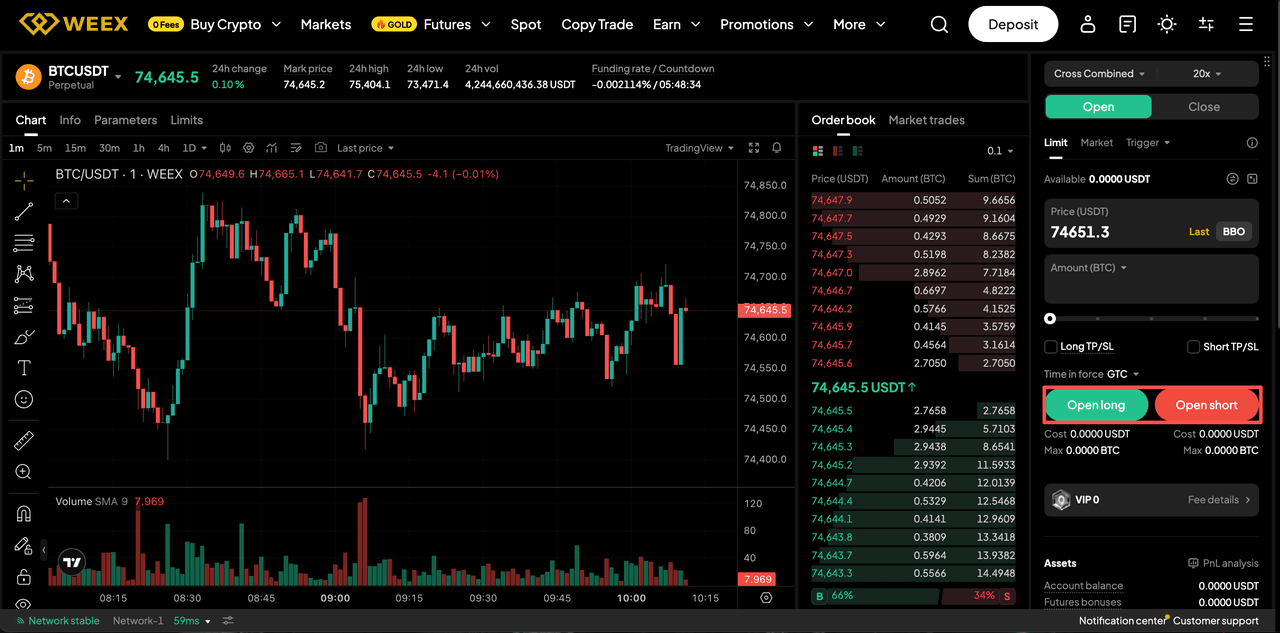
Step 4: Enter Your Stop-Loss Price
In the order panel, find "Stop-Loss (SL)". Toggle it on. Enter the price where you want to exit. Example: You buy BTC at $60,000. Set stop-loss at $57,000. If BTC drops to $57,000, WEEX closes your position. Your maximum loss is 5%.
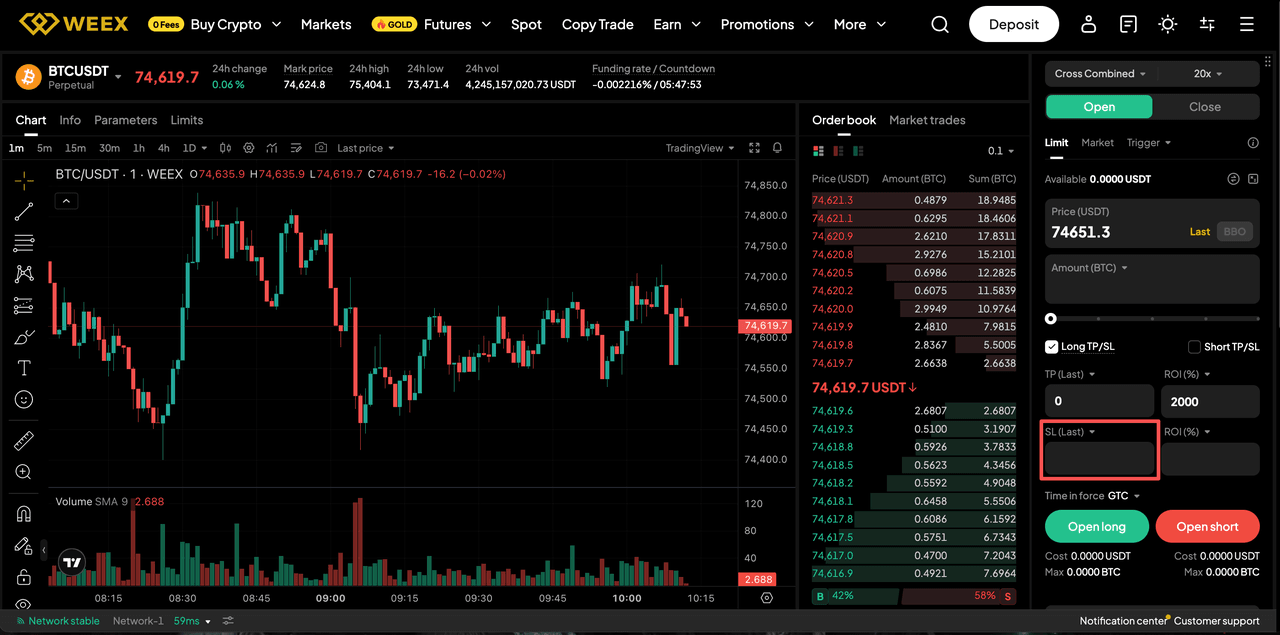
Step 5: Confirm the Order
Review everything. Click "Buy/Long" or "Sell/Short". Your stop-loss is now active.
-- Price
Pro Tips for Setting Stop-Loss on WEEX
Knowing how to click the buttons is one thing. Knowing where to place your stop-loss is what separates profitable traders from everyone else. The methods above show you how to set a stop. These five tips tell you where to put it — and why most traders get it wrong.
- Tip 1: Don't place stop-loss too tight. If your stop is 1% away from entry, normal market noise will knock you out. For BTC or ETH, use 3-5%. For altcoins, use 8-15%. Give the trade room to breathe.
- Tip 2: Use support and resistance levels. Do not pick round numbers like $50,000 just because it looks nice. Look at the chart. For a long position, place your stop just below a key support level. For a short position, place it just above a key resistance level. This avoids being stopped out by random wicks.
- Tip 3: No stop-loss = gambling. Before you click "buy", decide your max loss. Write it down if you have to. That is the difference between a trader and a gambler.
- Tip 4: Higher leverage needs tighter stops. If you use 50x leverage, a 2% move against you can wipe your position. Your stop-loss must be very close. Better yet, use lower leverage.
- Tip 5: Check your stop-loss after partial closing. If you manually close part of your position, the remaining position keeps the original stop-loss unless you adjust it.
FAQ
Q1: Do I have to set both stop-loss and take-profit on WEEX?
No. You can set only a stop-loss, only a take-profit, or both. If you only want to limit losses, just set the stop-loss.
Q2: Will my stop-loss fill exactly at the price I set?
Not always. When triggered, WEEX sends a market order. Slippage can happen during high volatility or low liquidity. On BTC/USDT, the difference is usually small. On low-volume altcoins, it can be larger.
Q3: Can I set multiple stop-losses on one position?
WEEX allows up to 20 conditional orders per position. But one stop-loss is standard. Multiple stop-losses on the same position usually don't make sense.
Q4: What happens to my stop-loss if I get liquidated?
Liquidation happens when your margin runs out. A stop-loss is designed to prevent liquidation. If you get liquidated, your stop-loss order is canceled. That is why you set the stop-loss early — before margin gets too low.
This content is provided for general informational purposes only and doesn't constitute financial, investment, legal, or tax advice. Any events, rewards, online promotions, or related information mentioned herein should not be considered a recommendation, solicitation, or invitation to purchase, sell, trade, or otherwise deal in any crypto assets. Crypto assets are highly volatile and may result in loss. The availability of WEEX services, products, and related events may vary by region. You are responsible for ensuring that your participation is in accordance with applicable local laws and regulations.
You may also like

What Are Spot Stock Tokens? How Synthetic Stock Trading Works

Cathie Wood Nvidia Stock Purchase: What ARK's August Buys Show

PEP Stock Analysis: Why PEPon Trades Above PepsiCo Shares
SpaceX Stock Price Holds Near $141: Why Isn't a $100 Billion Spaceport Plan Moving It?

"我的女友景甜" Days Later: What Happened to the Viral Meme Coin

XST Coin Price Bounced 19% Off a New Low in Hours: Is This the Bottom or Just Noise?
Is NVDA Stock Overvalued After Record Q2 Earnings?
NVDA Stock Pulls Back After Earnings: Is $250 Still Next?

Salesforce Stock Price Targets Are Rising Fast: What Wall Street Actually Sees
MRVL Stock Price Target: Why Options Traders Bet on $300 Before Earnings

Marvell Stock (MRVL) Beat Earnings and Raised Guidance: Why Did It Fall Anyway?

What Is the WEEX Mini App? A Lightweight Way to Trade Inside Telegram
What Is CLAN? Is a Dump Coming After Its 100% Surge?
How to Evaluate a Crypto Exchange in Pakistan: A Practical Checklist for Traders
Which Crypto Exchange Offers the Widest Range of Assets for Pakistani Traders?

XST Coin Price Crosses Into Deep Capitulation Territory: What a 90%+ Decline Actually Signals
A Breakup Became "我的女友景甜" Token in Hours: What That Says About Crypto's Attention Economy
NVDA Stock Jumps 7% After Earnings: Is $250 Next?

PONS After 200% Rally: Overvalued or Still a Growth Story?
What Happened to Raini Studios Token? RST After the Game Shutdown
RST vs RAINI: Which Raini Studios Token Is Still Supported?
CYBERLINK or CYBERLEEK? Check the Ticker and Chain Before Trading

SEC Sends Crypto Custody Rule to White House: What the Review Means for Investment Advisers
SEC Crypto Custody Rules for Investment Advisers: A 2026 Guide
NVDA Earnings Call Recap: Revenue Guidance, AI Demand and Key Takeaways
Hamster Kombat Is Down 97% From Its Peak: What Happened to Crypto's Biggest Web3 Onboarding Experiment?
Nvidia Earnings Report Today: Did NVDA Beat Revenue and EPS Estimates?
Nvidia After-Hours Stock Price: What Moved NVDA After the Earnings Report?
Why Did Nvidia Stock Rise After Earnings? NVDA Results and Outlook
Did Nvidia Beat Earnings? NVDA Q2 Results and Stock Reaction Explained
What Are Spot Stock Tokens? How Synthetic Stock Trading Works
Cathie Wood Nvidia Stock Purchase: What ARK's August Buys Show
PEP Stock Analysis: Why PEPon Trades Above PepsiCo Shares
SpaceX Stock Price Holds Near $141: Why Isn't a $100 Billion Spaceport Plan Moving It?
"我的女友景甜" Days Later: What Happened to the Viral Meme Coin
XST Coin Price Bounced 19% Off a New Low in Hours: Is This the Bottom or Just Noise?
Contents
Popular coins
Latest articles


